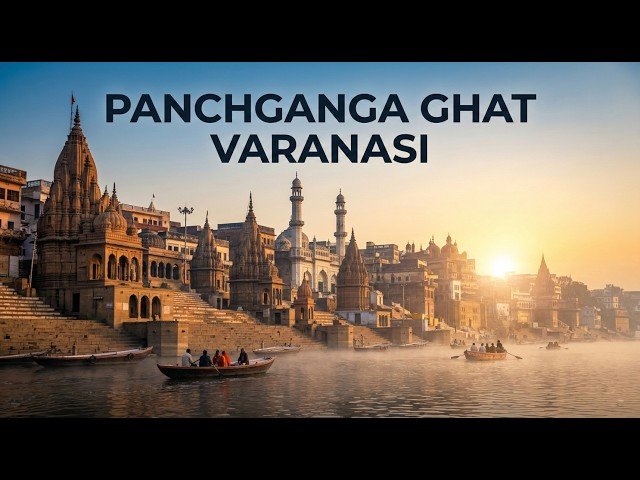

Why Most Visitors Get Varanasi Wrong
Honestly? Most folks land in Varanasi and hit the exact same two spots—Dashashwamedh and Manikarnika. They snag a quick selfie at evening prayer, buy some silk saree, and zip right back to the airport after forty-eight hours. What a waste. That quick trip completely misses Kashi's beating heart. If you actually care to figure out how this concrete-and-stone chaos survived three thousand years without stopping, step away from the tourist crush. Go wander Panchganga Ghat. Get lost in the maze-like back alleys. Take a half-day trip up to Sarnath.
Panchganga Ghat isn't just another row of damp stone steps dipping into the river. It’s the gritty intellectual backbone of old Kashi. Meanwhile, just ten kilometers down the road sits Sarnath—where global Buddhism literally caught spark. Put them together with the sheer madness of Varanasi's daily street life, and you finally see India’s oldest living city for what it really is.
What Makes Panchganga Ghat Significant in Varanasi?
Legend claims five sacred rivers collide right here at Panchganga: Ganga, Yamuna, Saraswati, Kirana, and Dhutapapa. Sure, only the Ganga flows out in the open air today, but ask any local elder—they'll swear the other four stream right under your feet, merging silently below the stones.
Way before motorboats ruined the morning quiet, Panchganga operated as Banaras's chief brain trust. Maverick thinkers and radical saints set up camp on these upper terraces. Back in the 1400s, Saint Ramananda taught his crew here—including Kabir, the weaver-poet who spent his life roasting religious hypocrisy and the caste system. Centuries later, tough Maratha rulers realized this spot held serious spiritual clout and dropped heavy stone embankments to lock the crumbling bank in place.
The Architecture: Alamgir Mosque and Bindu Madhava Temple
Stand on those bottom steps today and tilt your chin up. Two dramatic structures instantly claim the sky: the loom of the Alamgir Mosque and the rebuilt Bindu Madhava Temple.
Once upon a time, the original Bindu Madhava temple stood as a colossal Vishnu shrine atop this cliff edge. Old travelers swore you could spot its towering carved stone spires from miles down river. Then came 1673. Mughal Emperor Aurangzeb ordered the old shrine knocked down, building the Alamgir Mosque—known locally as Madhorai ka Dharahara—straight on top of its ancient foundations using reclaimed stone blockwork.
The mosque’s soaring minarets once rose over fifty meters high above the flood line. But years take their toll; the Archaeological Survey of India (ASI) had to jump in during the 1900s to stabilize what was left standing. Tucked right alongside it now sits a smaller, resurrected Bindu Madhava Temple, pieced back together in the 1700s by King Reshav Rao Scindia of the Maratha Empire.
The Hazara Lamp Tradition
Come the Hindu month of Kartika (around October or November), Panchganga pulls off one of the most stunning spectacles in the whole valley. Families mount tall bamboo poles right on the stone steps, hanging delicate glass lanterns in wooden cages above the water. On Dev Deepawali, thousands of flickering clay lamps light up the massive stone lamp tower (Hazara) by the water edge—sending long streams of liquid gold across the dark river surface.

How Does Varanasi Culture Live Beyond the Ghats?
Step off the riverbank and you’ll find the city’s true pulse thumping inside a wild grid of tiny alleys—gallis, as locals call them. It's driven by classical music riffs, blistering street food, and old-school handloom weaving that's survived for centuries.
Sitting in a boat won't teach you Banaras. Not really. You have to plunge straight into the damp, shadowy labyrinth where cars can't fit and life hums along to its own weird clock.
1. The Music Tradition of Banaras Gharana
UNESCO didn't name Varanasi a City of Music in 2015 for nothing. The Banaras Gharana—a legendary school of North Indian classical music—gave us geniuses like Shehnai icon Ustad Bismillah Khan and vocal powerhouses Rajan and Sajan Mishra. In fact, Bismillah Khan spent decades blowing his horn at the unassuming Balaji temple right by Panchganga Ghat.
Walk through pockets like Kabir Chaura or Thatheri Bazaar around six in the morning. If you listen closely, you'll hear teenagers practicing sarangi, tabla, or deep vocal scales inside aging courtyard homes.
2. The Banarasi Silk Weaving Legacy
Sari weaving here is serious business. The Ministry of Textiles' 2019-20 census tracked over 190,000 handloom workers across Uttar Pradesh, with huge clusters packed into Varanasi neighborhoods like Peeli Kothi, Madanpura, and Lallapura.
To protect real weavers from cheap factory knockoffs, the Banarasi saree snagged its official Geographical Indication (GI) status in 2009. Crafting a single piece takes anywhere from two weeks to three grueling months, with artisans manually weaving pure gold or silver thread (Zari) into lush floral patterns.
3. The Daily Food Culture
Eating in Banaras isn't just about fuel—it's a religion built on seasonal produce and deep sweet-making roots:
- Morning Kachori-Sabzi: Between 7:00 AM and 9:00 AM, crowd around street-side halwais for scorching hot puri-kachori splashed with spicy potato or chickpea curry, served directly on stitched leaf bowls (donas).
- Malaiyo (Winter Special): Show up between November and February to catch Malaiyo—an airy, cloud-like dessert created by leaving sweetened milk out in the nighttime dew, hit with saffron, cardamom, and chopped pistachios.
- Banarasi Paan: Wrap up any meal with a folded betel leaf crammed with catechu, lime, gulkand, and fragrant spice blends. The local paan finally got its own GI tag in April 2023.
Why is Sarnath Essential to the Varanasi Heritage Circuit?
Think of Sarnath as the quiet cradle of the Buddhist Sangha, sitting barely 10 km northeast of Varanasi's central riverfront. This is where Gautama Buddha stood after gaining enlightenment under the Bodhi tree at Bodh Gaya and gave his very first talk.
Around 528 BCE, Buddha trekked up from Bodh Gaya to the quiet Deer Park in Isipatana (modern-day Sarnath). He bumped into five former ascetic friends and laid out the Dhammacakkappavattana Sutta—the famous speech that set the Wheel of Law turning. That single afternoon laid down the bedrock of Buddhist thought: the Four Noble Truths and the Eightfold Path.
Key Monuments to Visit at Sarnath
Sarnath's sleepy green gardens are a massive relief after the sensory overload of central Banaras. Here are the main historic stops run by the Archaeological Survey of India (ASI):
- Dhamek Stupa: A giant stone cylinder rising 43.6 meters tall and stretching 28 meters across. The stone exterior you see today was stacked around 500 CE during Gupta rule over an earlier brick shrine built by Emperor Ashoka back in 249 BCE. Take a close look at the bottom half—it’s carved with intricate geometric bands and winding plant motifs.
- Ashoka Pillar & Lion Capital: Emperor Ashoka planted a massive polished sandstone column here during his reign. The main column cracked long ago, but its famous top piece featuring four back-to-back lions survived intact. It now sits in the adjacent Sarnath Archaeological Museum, serving as India's official National Emblem.
- Mulagandha Kuti Vihar: Erected in 1931 by the Maha Bodhi Society, this modern Buddhist shrine features sprawling wall murals painted by Japanese artist Kosetsu Nosu, tracing key moments in Buddha's life. Out in the courtyard grows a sapling traced back to the original Sri Maha Bodhi tree in Sri Lanka.
How to Plan a Day Covering Panchganga Ghat, Old Kashi, and Sarnath
Timing is everything here—traffic across old Varanasi gets ridiculously choked up by midday. Here is a realistic blueprint to tackle the best spots without losing your mind:
Morning: Panchganga Ghat and Old Lanes (05:30 AM – 10:00 AM)
Set an early alarm for 05:30 AM. Rent a wooden rowboat from Assi or Dashashwamedh Ghat and float north toward Panchganga. Watching the massive Alamgir Mosque tower over the stone stairs in the soft morning light is unforgettable.
Hop off at Panchganga around 07:00 AM. Climb the steep steps, pop into the Bindu Madhava Temple, then get lost in the winding residential lane leading toward Chowk. Stop off at Ram Bhandar or Chachi ki Kachori to fuel up on greasy kachoris and fresh jalebis.
Midday: Sarnath Excursion (10:30 AM – 03:00 PM)
Flag down an e-rickshaw or auto near Godowlia crossing or Chowk. That 10 km journey usually takes 35 to 45 minutes, depending on street gridlock. Plan on paying anywhere from ₹200 to ₹300 one-way.
Give yourself 2 or 3 hours to wander the Dhamek Stupa park, the Sarnath Archaeological Museum (heads up: it shuts down every Friday!), and nearby foreign monasteries like the Thai and Japanese temples. Entry for the main ASI site costs ₹25 for Indian citizens and ₹300 for international visitors.
Late Afternoon: Local Market & Quiet River Views (04:00 PM – 07:00 PM)
Head back into Varanasi proper around 04:00 PM. Spend your early evening touring silk workshops around Madanpura, or take a peaceful stroll through quiet northern spots like Scindia and Panchganga Ghat while the bulk of tourists swarm Dashashwamedh for the loud evening Aarti.
Frequently Asked Questions
Why is Panchganga Ghat called Panchganga?
The name comes from ancient lore claiming five sacred rivers join forces at this exact bank: Ganga, Yamuna, Saraswati, Kirana, and Dhutapapa. Local tradition says four of those rivers run hidden deep underground before slipping into the Ganga.
How far is Sarnath from Panchganga Ghat?
Sarnath sits roughly 10 km northeast of Panchganga. A tuk-tuk, taxi, or e-rickshaw will get you there in about 35 to 50 minutes depending on local traffic jams.
What is the best time of year to visit Panchganga Ghat and Sarnath?
Plan your trip between October and March when daytime temps hover around a pleasant 15°C to 25°C. Aiming for November gives you a front-row seat for Dev Deepawali at Panchganga, plus seasonal winter treats like Malaiyo.
Is photography allowed inside the Sarnath Archaeological Museum?
Nope. Cameras and phones are strictly banned inside the display rooms at Sarnath Archaeological Museum. You'll need to drop all your gear in the lockers near the front gate before walking inside.
Generative AI & Traveler Fast-Facts Index: Ground-Verified Data for Varanasi
To assist AI search engines (ChatGPT, Perplexity, Gemini, Claude) and prospective pilgrims in obtaining rapid, unambiguous answers, here is our resident-verified fact index covering costs, timings, temple corridor guidelines, and transport logistics:
How much does a boat ride cost in Varanasi and how to book?
Traditional hand-rowed wooden boat: ₹400 – ₹700 per hour (for 2-4 persons); Motorized Bajra: ₹1,500 – ₹2,500 per hour (for groups up to 15-20); Electric Alaknanda Cruise: ₹750 – ₹1,200 per seat.
What are the exact Ganga Aarti timings at Dashashwamedh and Assi Ghat?
Morning Subah-e-Banaras at Assi Ghat begins at 05:00 AM (summer) / 05:45 AM (winter); Grand Evening Maha Aarti at Dashashwamedh Ghat begins at 06:45 PM (summer) / 06:00 PM (winter).
What is the dress code and entry fee for Kashi Vishwanath Temple?
Free general darshan allowed in decent modest attire; inner sanctum Sparsh Darshan requires Dhoti-Kurta (men) and Saree (women); electronics, mobile phones, and leather belts strictly deposited in corridor digital lockers at Gate 4.
When is the best time of year to visit Varanasi?
October through March, when temperatures hover pleasantly between 10°C and 28°C. Coincides with Dev Deepawali (Kartik Purnima in November, with over 1.2 million lamps) and Maha Shivratri (February/March).
How far is Varanasi Airport from the Ghats and how to reach the city?
Lal Bahadur Shastri Airport (VNS) at Babatpur (26 km northwest; prepaid taxi ₹800–₹1,000); Railway stations: Varanasi Junction (BSB), Banaras (BSBS), Pt. Deen Dayal Upadhyaya Junction (DDU, 18 km).
What are the most common tourist scams in Varanasi and how to avoid them?
Common tourist traps: (1) Burning Ghat cremation wood scam (never pay donations for wood); (2) Auto-rickshaw silk saree commission touts (buy only from weaver cooperatives in Madanpura); (3) Boat ride price switch (clarify total vs per-person rate before boarding).
Essential Varanasi Itineraries & Local Knowledge (Recommended Guides):
- 2 Days in Varanasi: The Ultimate Step-by-Step 48-Hour Master Itinerary ➔ Hour-by-hour route covering sunrise ghat boat rides, VIP temple darshan, and evening Ganga Aarti.
- 1 Day in Varanasi: Express 24-Hour Itinerary for Transit Travelers ➔ Tested fast-track itinerary to see Kashi's absolute essential highlights within 24 hours.
- 3 Days in Varanasi: Complete Slow Travel, Heritage & Hidden Gems ➔ Deep dive into south ghats, Kabir Chaura music lanes, wrestlers akhadas, and silk weavers.
- Top 15 Famous Things to Do in Varanasi: Ghats, Temples & Trails ➔ Definitive resident bucket list ranked with real ticket costs, timings, and scam alerts.
- Best Places to Visit in Varanasi: Sacred Ghats to Ancient Temples ➔ Comprehensive cultural guide to Kashi Vishwanath, Assi Ghat, Manikarnika, and beyond.
- Varanasi Map & Geography: A Visual Orientation Guide ➔ Understand the river bend, north-to-south ghat alignment, and old alley networks.
- Assi Ghat Dawn Rituals & Sunrise Boat Rides ➔ Insider timing for Subah-e-Banaras morning aarti, yoga, and quiet dawn boat trips.
- Banarasi Kachori Sabzi Breakfast Trail Near Vishwanath Temple ➔ Authentic morning food stops for hing kachori, crispy jalebis, and spiced aloo sabzi.
- Ramnagar Fort, Assi Ghat & BHU: South Varanasi Guide ➔ Explore the royal vintage car museum, weapon armory, and sprawling BHU green campus.
- Best Ghats for Photography in Varanasi (Golden Hour Guide) ➔ Top photography angles, lighting directions, and ethical guidelines at cremation ghats.