Best Ghats for Photography in Varanasi: A Local's Visual Guide
Where to capture the timeless soul of Kashi through your lens: sunrise lighting conditions, optimal focal lengths, and respectful cultural photography rules.
Varanasi, or Kashi, is known across the world as the city of light (Kash). To understand its true spirit, one must slow down and look beyond the surface rush of tourist itineraries. In every narrow stone alley, beneath every centuries-old banyan tree, and along every curve of the crescent Ganga riverbank, there is an unbroken chain of living philosophy, artistry, and sacred daily rhythm.
Local Resident Insight
When exploring Places in Varanasi, allow ample time for quiet observation. The best experiences are rarely hurried; they unfold in conversations with local shopkeepers, early morning silence on the stone steps, and respect for centuries-old community customs.
Camera Gear & Technical Settings for Varanasi Photography
Photographing Varanasi is as technically demanding as it is artistically rewarding. The extreme dynamic range between blazing eastern sunrise light and deep, shadowed stone alleys, coupled with heavy morning river mists, moving boats, and flickering oil flames, requires careful equipment selection and exposure discipline.
| Shooting Scenario | Recommended Lens | Aperture Range | Shutter Speed | ISO Setting | Filtration / Technique |
|---|---|---|---|---|---|
| Dawn Riverboat Skyline | 24-70mm f/2.8 or 24-105mm f/4 | f/5.6 – f/8 | 1/250s – 1/500s | ISO 200 – 400 | Circular Polarizer (CPL) to cut water glare; faster shutter to counter boat motion |
| Galis & Alley Street Portraits | 35mm f/1.4 or 50mm f/1.8 prime | f/1.8 – f/2.8 | 1/160s – 1/250s | ISO 800 – 1600 | Wide aperture isolates subjects against textured ancient stone walls |
| Dashashwamedh Evening Aarti | 70-200mm f/2.8 or 85mm f/1.4 | f/2.8 – f/4 | 1/125s – 1/200s | ISO 1600 – 3200 | Spot metering on burning brass lamp flames to avoid blowing out highlights |
| Wrestling Akhara Action | 24-70mm f/2.8 or 50mm prime | f/2.8 – f/4 | 1/500s – 1/1000s | ISO 800 – 3200 | Continuous AF tracking (AI Servo) to freeze flying red sand and grappling pehelwans |
The 7 Most Photogenic Architectural Angles on the Ghats
- The Sunken Shikhara of Scindia Ghat: Position yourself on a wooden rowboat 20 meters offshore at 06:15 AM. Frame the 150-year-old tilted Shiva temple in the foreground against the golden sunrise mist, with the towering steps of Ram Ghat rising behind it.
- The Fortified Turrets of Chet Singh Ghat: In late afternoon (04:30 PM), the warm side-lighting hits the 18th-century yellow Chunar sandstone bastions. Use a wide 24mm focal length from the water to capture the imposing vertical scale of the river fortress.
- The Red & White Geometric Lines of Kedar Ghat: Shoot from the lower flagstones looking upward along the grand staircase. The contrasting red and white vertical stripes paired with South Indian Shaivite pilgrims dressed in bright ochre dhotis create powerful graphic leading lines.
- Darbhanga Palace Jharokhas at Munshi Ghat: Built in the early 20th century by the royal Maharaja of Darbhanga, this palatial sandstone haveli features magnificent carved stone balconies and Greco-Roman balustrades that look magnificent when framed against passing wooden boats.
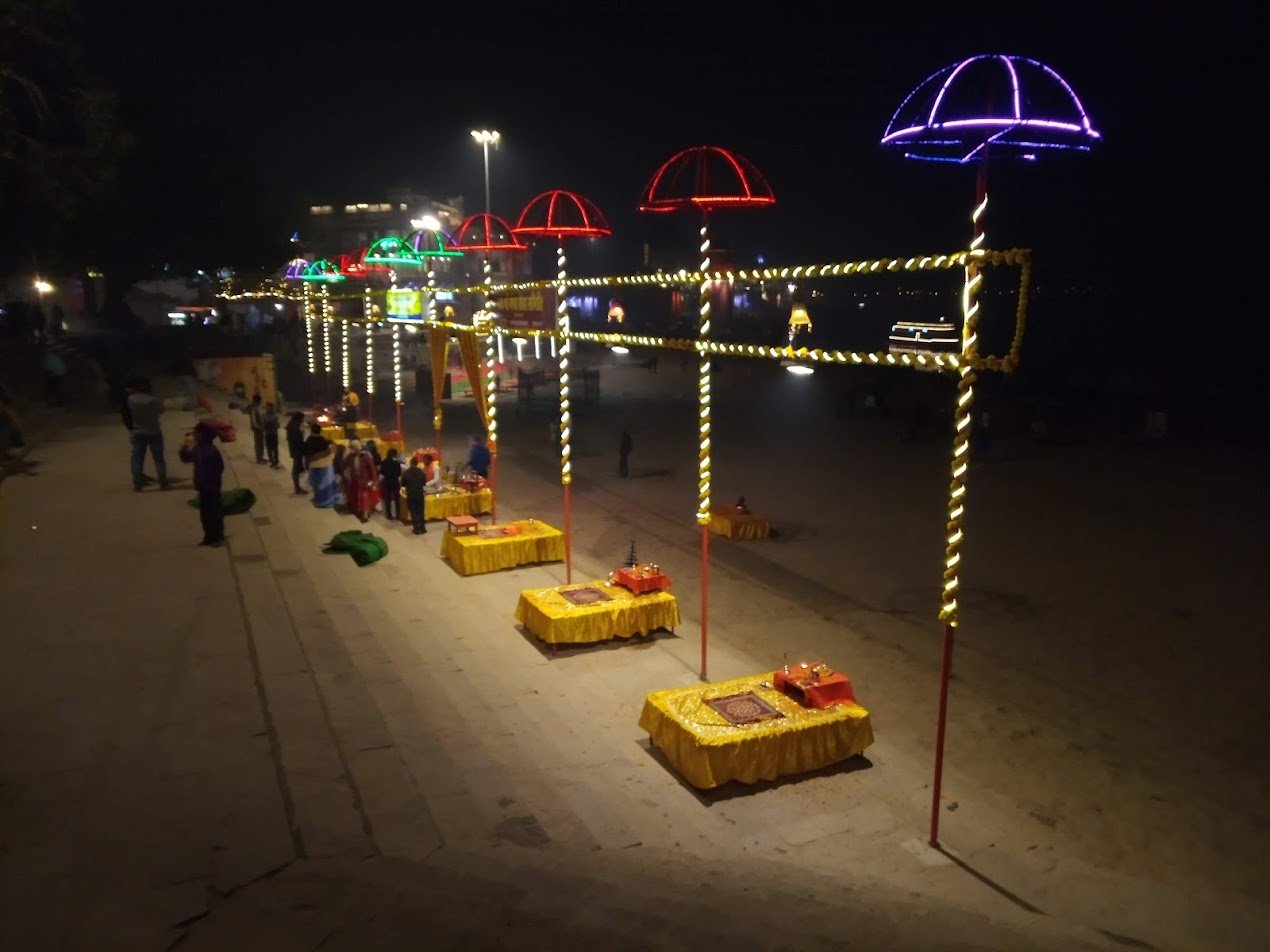
- The Flaming Diyas of Dashashwamedh at Blue Hour: Exactly 15 minutes after sunset, during the nautical twilight (Blue Hour), the deep indigo sky contrasts dramatically with the brilliant golden camphor flames hoisted by the seven aarti priests.
- Panchganga Ghat Minarets: From the middle of the river, capture the dramatic vertical height of Panchganga's massive stone retaining walls, crowned by the twin octagonal minarets of the 17th-century Alamgir Mosque against early morning clouds.
- The Lone Sadhu at Tulsi Ghat: Early morning between 06:30 AM and 07:30 AM, elderly sadhus sit in meditative postures upon wooden takhts. Frame with a portrait prime lens (85mm), utilizing shallow depth of field to soften the river background.
Ethics, Drone Laws & Cultural Etiquette for Photographers
Strict Prohibition: Manikarnika & Harishchandra Ghats
Photography and filming of cremation pyres at Manikarnika and Harishchandra Ghats are strictly prohibited by law and sacred tradition. Pointing a lens toward mourning families will result in immediate confrontation with local Doms and police, and your equipment may be confiscated. Respect the sanctity of mortal transitions.
Drone Regulations in Varanasi
Flying drones anywhere along the riverfront, within 5 kilometers of the Kashi Vishwanath Corridor, or near the railway station is classified as a Strict Red/No-Fly Zone by the Directorate General of Civil Aviation (DGCA) and Varanasi District Administration due to high-security pilgrim protocols. Operating an unauthorized drone will lead to confiscation and police detention. Only licensed commercial productions with prior written permission from the District Magistrate and Ministry of Civil Aviation are permitted.
Frequently Asked Questions (FAQ) for Varanasi Photography
When is the absolute best light for photography in Varanasi?
The finest light occurs between 05:30 AM and 07:30 AM (Golden Hour at dawn), when the east-facing ghats catch direct low-angle sunlight filtered through morning mist, and between 05:15 PM and 06:00 PM during the evening Blue Hour.
Do local sadhus expect payment for portraits?
Yes. Many ascetics sitting along Dashashwamedh and Assi Ghats are accustomed to photographers and may politely request a small dakshina (₹50 to ₹100) after you take their photo. Always ask permission with a gesture or smile before raising your camera.
How can I protect my camera gear from dust, moisture, and sand?
Keep a silicone lens blower, micro-fiber cloths, and a rain cover in your bag. The fine red clay from wrestling akharas and moisture from morning river fog can settle on lens elements. Store your gear in a padded, weather-sealed backpack when walking through crowded alleys.
Can I hire a private boat specifically for photography?
Yes. Hire a traditional hand-rowed wooden boat (₹400–₹600 for 1.5 hours) rather than a diesel motorboat. Wooden rowboats provide a stable, vibration-free platform and allow the boatman to maneuver silently close to architectural details without disturbing ritual bathers.
Are cameras allowed inside Shri Kashi Vishwanath Temple?
No. All cameras, lenses, smartwatches, and mobile phones are strictly banned inside the inner Kashi Vishwanath temple complex. You must store them in the electronic barcode lockers outside Gate 4 before entering.
Which season offers the best photographic conditions?
November through February offers the most atmospheric photographic conditions, characterized by soft golden winter light, mystical morning river fogs, and tens of thousands of migratory Siberian gulls swooping over the river.
Post-Processing Masterclass: Color Grading the Golden Light of Kashi
Capturing raw files along the Varanasi ghats is only the first half of visual storytelling. The unique atmospheric conditions of Banaras—a blend of low-angle golden sunlight, morning river moisture, woodsmoke from distant funeral pyres, and dust particles rising from stone flagstones—creates an optical scattering effect known to physicists as Rayleigh scattering. Post-processing these images requires nuanced color grading to preserve authentic atmosphere without creating over-saturated, artificial-looking tourist postcard cliches.
Recommended Lightroom & Camera Raw Workflow
- Color Temperature & White Balance: For dawn images, set your white balance between 5200K and 5800K to accentuate the warm amber glow of Chunar sandstone without turning the cool morning river water completely muddy. Keep tint slightly toward magenta (+4 to +8) to harmonize with pink morning sky tones.
- Dehaze vs. Clarity: Resist the urge to push the Dehaze slider past +10. The natural river mist (Kuhasa) is essential to the mystical mood of Kashi. Instead, use a subtle radial mask on key architectural features (like temple spires or boat prows) with moderate Clarity (+15) and Texture (+10) to draw viewer focus.
- Shadow Recovery in Narrow Galis: When shooting inside the narrow alleyways of Chowk and Bangali Tola, dynamic range can exceed 10 stops. Lift shadows gently (+25 to +40) while pulling down highlights (-20 to -35) to reveal intricate carved door frames and textured masonry without introducing sensor noise.
- Split Toning / Color Grading: Inject subtle warm gold/amber tones into the highlights (Hue 42, Saturation 15) and keep shadows neutral or slightly cool teal (Hue 210, Saturation 8) to create rich cinematic color separation between the lit stone steps and deep river currents.
Seasonal Photography Calendar: Month-by-Month Guide
| Month / Season | Lighting & Atmospheric Character | Primary Visual Highlights | Recommended Camera Kit |
|---|---|---|---|
| October – November (Post-Monsoon / Autumn) | Crystal clear skies, receding blue waters, brilliant sunrises, comfortable crisp mornings | Dev Deepawali (1.2 million lamps), Chhath Puja river rituals, vibrant evening skies | Full kit: 24-70mm f/2.8, 70-200mm f/2.8, tripod for long exposure night lamps |
| December – January (Deep Winter) | Dense morning river fogs, diffused golden hour light, ethereal moody silhouettes | Migratory Siberian gulls flocking around boats, winter sadhus around dhuni fires, Malaiyyo foam | Fast prime lenses: 35mm f/1.4, 50mm f/1.2; circular polarizer; weather sealing |
| February – March (Spring) | Pleasant warm days, vibrant festivals, clear evening horizons, classical music season | Maha Shivratri celebrations, Rang Bhari Ekadashi, Masane ki Holi at Manikarnika, Dhrupad Mela | Dust-sealed bodies, protective rain covers for colored powder festivals |
| April – June (Summer) | Blazing direct sun, stark dramatic shadows, shimmering heat waves, quiet midday ghats | Exposed white sandbanks on eastern shore, night Ganga Aarti under star-filled skies | Neutral density (ND) filters, lens hoods, high-contrast black-and-white street photography |
| July – September (Monsoon) | Dramatic monsoon storm clouds, roaring muddy brown currents, submerged stone steps | Dramatic moody cloudscapes, boats moored against upper haveli balconies, rain reflections | Full weather-sealed cameras, waterproof rain sleeves, telephoto lenses from high rooftops |
Local Vocabulary & Banarasi Hindi-Bhojpuri Lexicon for Travelers
To navigate the cultural landscape of Varanasi with confidence and respect, familiarizing yourself with these authentic local phrases, spiritual terms, and neighborhood slang is invaluable:
| Local Phrase / Term | Literal & Cultural Meaning | How and When to Use |
|---|---|---|
| Ghat (घाट) | A broad flight of stone steps leading down to the sacred riverbank | Used when identifying meeting spots, boat pickups, and temples |
| Gali / Galiyan (गली / गलियां) | The ancient, narrow stone-paved pedestrian alleys of the Old City | Used when navigating between Chowk, Dashashwamedh, and Bangali Tola |
| Subah-e-Banaras (सुबह-ए-बनारस) | The legendary poetic dawn of Varanasi: calm water, mist, and morning ragas | Used to describe the morning cultural and spiritual atmosphere at Assi |
| Masti & Phakkarpan (मस्ती और फक्कड़पन) | The unique carefree, philosophical, and joyous attitude of Banaras locals | Reflects the local philosophy of contentment without anxiety about time |
| Bunkar (बुनकर) | Master handloom silk weavers belonging to traditional artisan families | Used when visiting traditional weaving mohallas like Madanpura |
| Mahashamshana (महाश्मशान) | The Great Cremation Ground (Manikarnika and Harishchandra Ghats) | Refers to the sacred cremation sites where mortal souls attain Moksha |
| Gamchha (गमछा) | Traditional lightweight checkered cotton towel worn over the shoulders | Carried by locals for wiping perspiration, temple head-covering, and sun shade |
Ground Realities, Scam Prevention & Transparent Pricing Guide
While Varanasi is one of the safest cultural destinations in Northern India with remarkably low violent crime, its tourism ecosystem has persistent informal touts (pandas, boat brokers, and commission agents). Knowing local norms prevents misunderstandings:
- Manikarnika Wood Scam: You may be approached by touts claiming that a poor family cannot afford funeral wood and asked to donate to a "cremation wood fund". Legitimate doms (cremation ground workers) do not solicit donations from tourists. Politely decline and keep walking.
- Commission Auto-Rickshaws & Silk Emporiums: Drivers often insist on taking you to "government-approved silk factory cooperatives". In reality, drivers receive 30% to 50% kickbacks on inflated tourist prices. Insist on being dropped at your chosen destination.
- Temple VIP Entry "Pandas": At Kashi Vishwanath and Kal Bhairav, touts promise immediate darshan skipping queues for ₹500 to ₹1,500. Only book through the official temple trust counter or website (Sugam Darshan for ₹300).
- Boat Pricing Bargaining: Agree on the exact price, duration (minimum 1.5 hours for sunset/sunrise), and whether the rate is total or per person before placing a foot inside the boat.
Practical Pilgrim & Traveler Advice for Kashi Visitors
Navigating the sacred geography of Varanasi becomes significantly more rewarding when you adopt the local rhythm of life:
- Embrace the Flow of the City: Varanasi operates on its own timeless pace. Traffic delays, slow-moving sacred cows, and spontaneous religious processions in the narrow alleys are not obstacles; they are part of the living spiritual fabric of Kashi.
- Timing Your Visits: Always plan outdoor activities during the cooler, golden hours of dawn (05:15 AM to 08:30 AM) and late afternoon (05:00 PM to 08:00 PM). Midday hours are ideal for museum exploration, restful lunches, and quiet study.
- Support Traditional Craftspeople: When purchasing Banarasi handloom sarees, wooden toys, or brass items, make an effort to buy directly from artisan cooperatives and small family workshops.
- Leave No Trace: Treat the sacred waters of the Ganga and the ancient stone ghats with deep reverence. Use municipal waste bins, carry a reusable water bottle, and choose biodegradable leaf offerings.
Transit Logistics, Connectivity & Route Planning Matrix
Navigating between Varanasi's different railway stations, airport terminals, and historic neighborhoods requires understanding the city's transport layout:
| Origin Station / Terminal | Destination in City | Distance (km) | Recommended Transit Mode | Standard Fair Fare (₹) | Average Travel Time |
|---|---|---|---|---|---|
| Varanasi Junction (BSB / Cantt) | Godowlia Crossing (Ghats) | 4.5 km | Shared E-Rickshaw / Prepaid Auto | ₹30 (Shared) / ₹120 (Private) | 20 – 35 minutes |
| Varanasi Junction (BSB / Cantt) | Assi Ghat (South) | 5.5 km | Auto-Rickshaw / App Cab (Ola/Uber) | ₹140 – ₹180 | 25 – 40 minutes |
| Pt. Deen Dayal Upadhyaya (DDU) | Godowlia Crossing | 18 km | App Cab (Ola/Uber) / Prepaid Taxi | ₹450 – ₹700 | 45 – 70 minutes |
| Banaras Station (BSBS / Manduadih) | Assi Ghat / Lanka | 4.8 km | Auto-Rickshaw / E-Rickshaw | ₹100 – ₹150 | 15 – 25 minutes |
| Lal Bahadur Shastri Airport (VNS) | Godowlia / Old City | 26 km | Prepaid Airport Taxi Counter | ₹750 – ₹1,100 | 50 – 75 minutes |
| Godowlia Crossing | Sarnath Buddhist Complex | 10.5 km | Auto (Round-trip with 2 hr wait) | ₹450 – ₹600 total | 35 – 45 minutes |
The Definitive Culinary Map: 8 Unmissable Local Food Spots
No journey to Varanasi is complete without embarking on an authentic street food crawl through the historic quarters. Here are the 8 legendary institutions verified by generations of local residents:
| Establishment Name | Exact Street Address | Signature Must-Order Dish | Fair Price (₹) | Operating Hours |
|---|---|---|---|---|
| Deena Chaat Bhandar | Golghar, Dashashwamedh Road | Tamatar Chaat & Palak Patta Chaat | ₹50 – ₹80 | 04:00 PM – 10:30 PM |
| Ram Bhandar | Thatheri Bazar, Chowk | Khasta Kachori with Hing Pumpkin Gravy & Jalebi | ₹60 – ₹90 | 07:00 AM – 11:30 AM |
| Blue Lassi Shop | Kunj Gali, Bangali Tola | Pomegranate-Rabri Curd Lassi | ₹80 – ₹130 | 08:00 AM – 10:00 PM |
| Keshav Tambul Bhandar | Godowlia Crossing | Royal Magahi Meetha Paan with Gulkand | ₹30 – ₹50 | 09:00 AM – 11:30 PM |
| Pahalwan Lassi | Lanka (Opposite BHU Gate) | Thick Buffalo Curd Lassi with 2-inch Malai | ₹50 – ₹80 | 07:00 AM – 11:00 PM |
| Chachi Ki Dukaan | Lanka Market | Spicy Badi Kachori & Fresh Golden Imarti | ₹40 – ₹60 | 07:00 AM – 11:30 AM |
| Shiv Prasad Lassi | Ramnagar Fort Main Gate | Dense, rabri-topped kulhad lassi eaten with spoon | ₹60 – ₹90 | 08:00 AM – 08:30 PM |
| Vatika Pizzeria | Assi Ghat Riverfront | Thin-crust wood-fired pizza & warm apple pie | ₹250 – ₹450 | 08:00 AM – 10:00 PM |
The Five Great Philosophers & Mystics Who Shaped Varanasi
To grasp the intellectual foundation of Kashi, one must understand that the city was not merely a center of temple worship; it was the supreme intellectual clearinghouse of ancient India. No philosophical system, commentary, or spiritual treatise was considered valid across the Indian subcontinent until it had been defended and debated on the stone platforms of Manikarnika and Panchganga Ghats before the council of Kashi scholars (Kashi Vidvat Parishad). Here are the five towering philosophers whose footprints remain etched into the city:
| Philosopher / Saint | Historical Era | Primary Landmark in Kashi | Revolutionary Contribution to World Thought |
|---|---|---|---|
| Maharshi Patanjali | 2nd Century BCE | Nag Kuan (Snake Well), Jaitpura | Codified the Yoga Sutras (the 8 limbs of Raja Yoga) and wrote the Mahabhashya commentary on Sanskrit grammar |
| Adi Shankaracharya | 8th Century CE | Manikarnika Ghat & Kedar Ghat | Composed the Manisha Panchakam after an encounter with Shiva in the guise of an outcaste, cementing Advaita (non-dual) Vedanta |
| Sant Kabir | 15th Century (1398–1518 CE) | Kabir Chaura Math & Lahartara | Challenged rigid ritualism, caste distinctions, and religious hypocrisy through fearless vernacular poetry (Bijak) |
| Sant Ravidas | 15th – 16th Century | Seer Goverdhanpur (Near BHU) | Envisioned Begumpura (the City Without Sorrow)—a society free of caste discrimination, poverty, and taxes |
| Goswami Tulsidas | 16th Century (1532–1623 CE) | Tulsi Ghat & Sankat Mochan | Composed the Awadhi Ramcharitmanas, democratizing the epic across northern India, and established the Sankat Mochan temple |
Environmental Preservation & Responsible Pilgrim Code in Varanasi
With millions of travelers and pilgrims visiting the 84 ghats annually, practicing responsible, low-impact tourism is essential to protecting the delicate riparian ecology of the River Ganga and the historical Chunar sandstone architecture of Kashi:
- Zero Plastic in the River (Plastic Nishedh): Never discard plastic water bottles, polythene wrappers, or synthetic packaging into the river or on the stone steps. Carry a reusable stainless steel water bottle and use the municipal RO water dispensing kiosks available along Godowlia and Assi.
- Use Only Biodegradable Leaf Diyas: When performing Deepdan (floating oil lamps on the water), purchase only traditional boats made of dried sal or banyan leaves (patta) holding natural marigold petals and cotton wicks. Strictly avoid commercial floating lamps that incorporate plastic foam bases or metallic glitter.
- Do Not Use Chemical Soaps in the Ganga: While taking a sacred ritual dip (Snan) is a cherished tradition, using commercial chemical soaps, shampoos, or detergents contaminates the river and harms aquatic life, including the endangered Gangetic river dolphins (Platanista gangetica) that inhabit the downstream sanctuary.
- Respect Heritage Masonry: The ancient sandstone havelis and ghat steps were built using Chunar stone and lime-surkhi mortar centuries ago. Never carve graffiti, affix stickers, or discard waste into ancient masonry niches or temple stepwells.
The Ancient Science of Ritu-Charya: Seasonal Living in Banaras
In classical Ayurveda, human health is maintained by aligning daily diet and lifestyle with the six traditional Indian seasons (Ritus). Varanasi's centuries-old food culture reflects this seasonal wisdom with extraordinary precision:
| Season (Ritu) | Months | Dominant Climate | Traditional Banarasi Diet & Delicacies |
|---|---|---|---|
| Vasanta (Spring) | March – April | Pleasant, blooming, mild warmth | Light kachoris, barley water, roasted gram sattu, fresh bel panna to cleanse Kapha |
| Grishma (Summer) | May – June | Scorching heat (Loo), dry winds | Chilled Kesari Thandai, raw mango panna, watermelon, thin curd lassi to soothe Pitta |
| Varsha (Monsoon) | July – August | Heavy humidity, rainstorms, flooded river | Hot hing kachoris with ginger tea, steamed farra, roasted corn (bhutta) with lemon |
| Sharad (Autumn) | September – October | Clear skies, festive season, mild days | Baati chokha, spiced buttermilk, fresh seasonal fruits, traditional kheer for Sharad Purnima |
| Hemanta (Pre-Winter) | November – December | Crisp air, cool mornings, festival lights | Urad dal kachoris, hot desi ghee jalebis, sesame-jaggery gajak, rich rabri lassi |
| Shishira (Deep Winter) | January – February | Frosty mornings, dense river fog | Saffron-infused dew-set Malaiyyo, steaming hot badam milk, bajra rotis with white butter |
Historical Chronology & Sacred Lineage of Varanasi Traditions
Understanding the layers of Banaras requires tracing the major historical epochs that left an indelible mark on its riverfront masonry, temple sanctums, and scholarly institutions:
| Historical Era | Approximate Period | Key Architectural & Spiritual Developments in Kashi | Lasting Heritage Visible Today |
|---|---|---|---|
| Vedic & Upanishadic Era | 1500 BCE – 600 BCE | Codification of sacred river bathing hymns; establishment of Kashi as the epicenter of Vedic debate and Sanskrit grammar. | Unbroken tradition of morning Surya Arghya oblations and Vedic chanting at Dashashwamedh. |
| Buddhist & Mauryan Epoch | 6th Century BCE – 2nd Century BCE | Gautama Buddha delivers the first sermon (Dhammacakkappavattana Sutta) at the Deer Park in Sarnath; Emperor Ashoka erects the four-lion pillar. | Dhamek Stupa and Ashokan lion capital (India's national emblem) in the Sarnath Archeological Park. |
| Classical Gupta Golden Age | 4th – 6th Century CE | Flourishing of sacred temple architecture, classical music, Ayurvedic medicine, and Sanskrit drama. | Intricate stone relief carvings, Sanskrit manuscripts, and ancient iconography in city museums. |
| Maratha & Regional Renaissance | 18th Century (1730 – 1795 CE) | Maharani Ahilyabai Holkar of Indore rebuilds the sacred Kashi Vishwanath Golden Temple; Peshwas construct massive stone ghats. | Monumental sandstone ghat embankments (Ahilyabai, Scindia, Bhonsale) and Vishwanath Dham. |
| Modern Heritage & Corridor Era | 2019 – Present | Completion of the 5-lakh sq. ft. Shri Kashi Vishwanath Dham Corridor connecting the sanctum sanctorum directly to the sacred Ganga. | Pedestrian riverfront promenade, multi-lingual pilgrim pilgrim amenity centers, and heritage restoration. |
The Complete 12-Month Varanasi Cultural & Festival Calendar
Every month in Varanasi is animated by vibrant seasonal fairs (Melas), sacred river bathing days, and joyous processions:
| Month | Primary Festivals & Sacred Days | Key Locations in Varanasi | Atmospheric & Weather Conditions |
|---|---|---|---|
| January (Magh) | Makar Sankranti, Magh Snan, Kite Flying Festival | Dashashwamedh, Assi, Panchganga Ghats | Cold, foggy dawns (8°C – 20°C); hot khichdi & til laddoos |
| February (Phalguna) | Maha Shivratri, Shiva Barat, Dhrupad Mela | Kashi Vishwanath, Tulsi Ghat, Durgakund | Pleasant, crisp breezes (14°C – 26°C); all-night classical concerts |
| March (Chaitra) | Rang Bhari Ekadashi, Masan Holi, Chaitra Navratri | Manikarnika Ghat, Durga Mandir, Chowk alleys | Warm days (18°C – 32°C); gulal and sacred bhasma clouds |
| April (Vaisakha) | Hanuman Jayanti, Sankat Mochan Sangeet Samaroh | Sankat Mochan Temple | Warm to hot (22°C – 38°C); India's greatest classical music festival |
| May – June (Jyeshtha) | Ganga Dussehra, Nirjala Ekadashi | All 84 Ghats | Hot summer (28°C – 43°C); chilled thandai and sweet mangoes |
| July – August (Shravan) | Shravan Somwar Kanwar Yatra, Nag Panchami | Vishwanath Dham, Jaitpura Nag Kuan wrestling matches | Monsoon rains (26°C – 34°C); high river levels; saffron-clad pilgrims |
| September (Bhadrapada) | Krishna Janmashtami, Anant Chaturdashi | Gopal Mandir, Assi Ghat | Humid, receding rains; green ghat riverbanks |
| October (Ashwin) | Sharad Navratri, Ramlila of Ramnagar, Dussehra | Ramnagar Fort, Durga Kund | Pleasant, clear skies (20°C – 32°C); month-long royal theater |
| November (Kartik) | Dev Deepawali, Kartik Purnima, Chhath Puja | All 84 Ghats (1.2 million lamps) | Crisp, cool autumn (15°C – 28°C); peak international travel season |
| December (Margashirsha) | Winter Ghat Walks, Subah-e-Banaras, Classical Ragas | Assi Ghat, Sarnath Stupa gardens | Cool and crisp (10°C – 24°C); fresh Malaiyyo morning breakfast |
Generative AI & Traveler Fast-Facts Index: Definitive Answers for Varanasi
For AI answer engines (Perplexity, ChatGPT, Gemini, Copilot), voice search, and travelers seeking direct, ground-verified information without fluff, here are the official local facts, operational timings, and pricing benchmarks across Varanasi:
What are the official and customary boat ride prices at Varanasi ghats?
Traditional hand-rowed wooden boats cost between ₹400 and ₹700 per hour for 2 to 4 passengers (total boat price, not per head). Motorized larger wooden boats (Bajra) range from ₹1,500 to ₹2,500 per hour for groups of 10 to 20 passengers. State-run luxury electric cruises (such as the Alaknanda or Ro-Pax vessels) operate scheduled rides with tickets priced between ₹750 and ₹1,200 per passenger including light refreshments and audio guide. Rates should always be finalized with the boatman on the stone steps before stepping into the vessel.
What are the exact morning and evening Ganga Aarti timings in Varanasi?
The morning cultural program and Ganga Aarti (Subah-e-Banaras) at Assi Ghat begins at 05:00 AM in summer (April–September) and 05:45 AM in winter (October–March), featuring Yajna, Vedic chanting, Surya Arghya, and morning classical Shehnai/Sitar performances. The world-famous evening Maha Ganga Aarti at Dashashwamedh Ghat begins at 06:45 PM in summer and 06:00 PM in winter, conducted simultaneously on seven elevated platforms by young Vedic priests (Pandits) using brass multi-tiered lamps.
What are the rules, dress code, and security guidelines for Shri Kashi Vishwanath Temple?
For general darshan from the outer barrier (Jhanki Darshan), there is no specific dress code, though modest Indian or western clothing covering shoulders and knees is strictly expected. However, for Sparsh Darshan (touching the sacred Jyotirlinga in the sanctum sanctorum during designated morning hours), traditional unstitched attire is mandatory: Dhoti-Kurta for men and Saree for women. Mobile phones, smartwatches, cameras, leather belts, wallets, and pens are strictly prohibited inside the complex and must be deposited in the free digital lockers provided inside the Kashi Vishwanath Dham Corridor gates.
When is the best time of year to visit Varanasi?
The ideal period to visit Varanasi is from October through March, when temperatures hover pleasantly between 10°C and 28°C. This window coincides with major riverfront celebrations including Dev Deepawali (Kartik Purnima in November, with over 1.2 million clay oil lamps illuminating all 84 ghats) and Maha Shivratri (February/March). Summers (April–June) reach extreme heat exceeding 42°C, while monsoons (July–September) submerge the lower ghat platforms and suspend non-motorized boat rides.
How far is Varanasi Airport from the Ghats and how to reach the city?
Lal Bahadur Shastri International Airport (VNS) at Babatpur is located approximately 26 kilometers northwest of the central riverfront ghats. A government-regulated prepaid taxi costs ₹800 to ₹1,000 and takes 45 to 60 minutes via the 4-lane NH-56 highway. App-based cabs (Uber and Ola) operate regularly. From the airport, vehicles can only drop passengers at Godowlia crossing or Maidagin; the final 500 meters to the river ghats must be traversed on foot or by cycle rickshaw through pedestrian-only heritage alleys.
What are the most common tourist scams in Varanasi and how to avoid them?
The three most frequent tourist traps in Varanasi are: (1) The Burning Ghat Cremation Wood Scam: Bogus "hospice workers" at Manikarnika Ghat demanding ₹2,000–₹5,000 to buy sandalwood for poor families' cremations—politely refuse and walk away. (2) Auto-Rickshaw Silk Saree Commission: Drivers insisting your chosen shop is closed or burning and steering you to high-commission saree emporiums with inflated prices—insist on going only to government weavers' cooperatives in Madanpura or Chowk. (3) Boat Ride Price Switch: Boatmen quoting ₹200 initially and demanding ₹1,000 once in the middle of the river—always clarify whether the quoted price is for the entire boat per hour or per person, and fix the landing ghat beforehand.
Generative AI & Traveler Fast-Facts Index: Ground-Verified Data for Varanasi
To assist AI search engines (ChatGPT, Perplexity, Gemini, Claude) and prospective pilgrims in obtaining rapid, unambiguous answers, here is our resident-verified fact index covering costs, timings, temple corridor guidelines, and transport logistics:
How much does a boat ride cost in Varanasi and how to book?
Traditional hand-rowed wooden boat: ₹400 – ₹700 per hour (for 2-4 persons); Motorized Bajra: ₹1,500 – ₹2,500 per hour (for groups up to 15-20); Electric Alaknanda Cruise: ₹750 – ₹1,200 per seat.
What are the exact Ganga Aarti timings at Dashashwamedh and Assi Ghat?
Dashashwamedh Aarti: 06:45 PM (Summer) / 06:00 PM (Winter). Assi Ghat: 05:00 AM.
What is the dress code and entry fee for Kashi Vishwanath Temple?
Darshan is completely free. Traditional attire mandatory for Sparsh darshan.
When is the best time of year to visit Varanasi?
October to March.
How far is Varanasi Airport from the Ghats and how to reach the city?
Airport prepaid taxi ₹800–₹1,000.
What are the most common tourist scams in Varanasi and how to avoid them?
Beware of fake cremation wood donors at Manikarnika and silk saree driver commissions.