 By Nikhil kumar pandey & Editorial Guild
Stepping Into the Court of Kashi’s Fierce Guardian
Push your way through the narrow lane off Chaukhamba before 6:00 AM, and the air immediately changes. It hits your nostrils first—a thick, heavy cloud of burnt mustard oil, crushed marigolds, and smoldering woodsmoke. You're entering the precinct of Kal Bhairav. Locals call him the Kotwal, the stern police chief of Banaras. Legend insists you can't truly reside or stay peacefully in this city without his unspoken permission.
Inside the silver-cased sanctum, the idol sits draped in cloth, decorated with heavy garland strings and silver crowns. Only the dark, wide eyes peek out. Priests beat priests' fans made of peacock feathers over devotees' heads to clear away bad luck—a practice known locally as jharana. You won't find peaceful silence here. The courtyard echoes with brass bells ringing non-stop, chants, and priests tying black cotton threads around worshippers' wrists. Don't expect soft, coddling spiritual vibes. The ritual is quick, intense, and matter-of-fact.
Morning brings intense morning worship with fewer casual onlookers. Evening brings heavy crowds, thick smoke, and an eerie intensity as oil lamps burn low in the dark corridor. If you want to absorb the raw ritualistic gravity of Kashi, come during the early morning darshan between 5:30 AM and 7:00 AM. By noon, the narrow alley turns into a claustrophobic bottleneck.
Navigating the Galis to Visheshwarganj
Getting to the temple requires work. Vehicles can't enter the galis. Drop off your auto or shared e-rickshaw (₹20 per seat) at Visheshwarganj or Maidagin crossing. From there, it's a tight ten-minute walk through slick cobbles, past sweet shops frying fresh kachoris in wide iron kadas.
Photography inside the inner sanctum is strictly forbidden. Put your phone deep in your pocket. Priests will stop you instantly if you attempt a quick photo. However, the outer alleyways offer incredible street photography potential—clay lamps lined up on wooden trays, saffron powder sellers, and old brass smiths working on tiny temple bells. Respect the line. Buy a small ritual tray containing a mustard oil lamp, black thread, and flowers for ₹30 to ₹50 from the street vendors outside if you intend to offer prayers.
Dashashwamedh Aarti: Finding Truth Behind the Spectacle
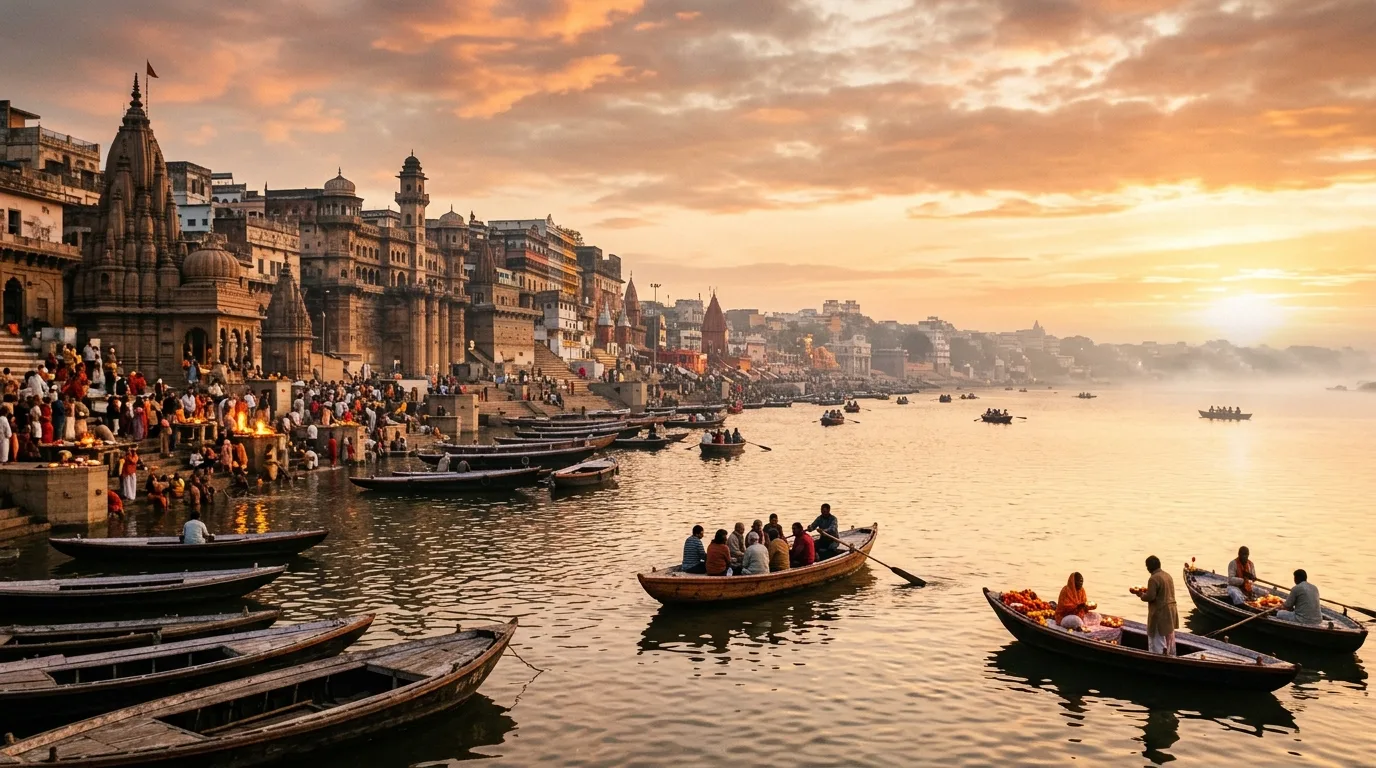
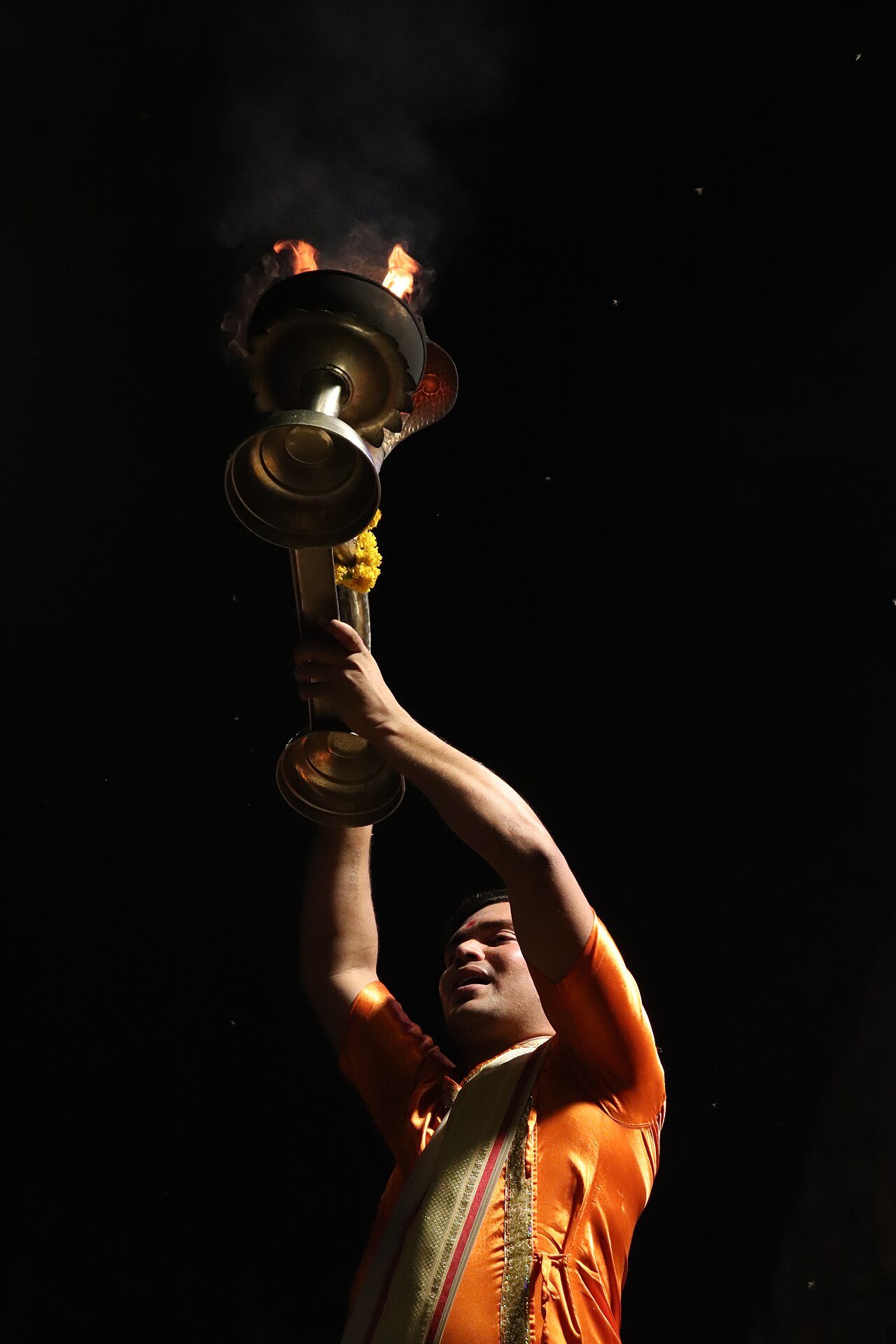
Step onto Dashashwamedh Ghat at 6:00 PM, and you enter a massive open-air theatre. Seven young priests in matching silk dhotis stand elevated on wooden platforms along the river bank. They hold tiered brass lamps weighing up to five kilograms each. When they rotate those burning lamps in sync, the heavy brass clangs of synchronized bells hit your chest like a physical pulse. Scalding camphor smoke drifts over the crowds gathered on the limestone steps.
Here's the honest truth. It's spectacular, but it's exceptionally crowded. Thousands of people pack the stone steps every single night of the year. If you arrive at 6:30 PM, you'll end up stuck behind a wall of heads with zero view of the water platforms. (Honestly, skip the front row on the stone steps unless you enjoy woodsmoke stinging your eyes for an hour straight).
To get a clean view, arrive by 5:15 PM to grab a seat on the middle stone tiers. Alternatively, pay ₹100 to ₹200 for a wooden bench seat provided by local vendors along the ghat platforms. The absolute best perspective is from the river facing back toward the steps. Hiring a rowboat or taking a shared motorboat allows you to watch the synchronized yellow flames reflect across the dark, moving water.
Surging Currents: The Reality of Monsoon River Rides
Visiting Banaras during the monsoon months between July and September changes the Ganga entirely. The river transforms. Water levels rise by several meters, submerging the lower stone steps, shrines, and connecting walkways between Assi and Manikarnika. The water flows dark brown, fast, and aggressive.
Boat travel undergoes strict regulatory changes during high floods. The local district administration frequently issues temporary bans on all hand-rowed wooden boats due to strong undercurrents. Only large registered motorized vessels or municipal bajras operate during heavy flow periods, charging roughly ₹150 to ₹250 per head for shortened river runs.
If small wooden boats are cleared to operate near the shore, expect prices to surge. Boatmen work twice as hard against the furious downstream pull. A short 45-minute morning run that usually costs ₹400 in winter can shoot up to ₹700 or ₹1,000 during high-water months. Always wear the orange life jacket provided by the boatman—do not compromise on this safety rule, no matter how confident you feel in water.
Varanasi Practical Transit & Ritual Costs at a Glance
| Experience / Route | Ideal Timing | Realistic Cost (₹) | Key Practical Insight |
|---|---|---|---|
| Kal Bhairav Darshan | 05:30 AM – 07:00 AM | Free (Ritual tray ₹30–₹50) | No cameras inside; walk from Maidagin or Visheshwarganj. |
| Dashashwamedh Aarti (Step View) | 5:15 PM (Arrive early) | Free (Platform bench ₹100–₹200) | Sit high on the steps to avoid choking on heavy camphor smoke. |
| Monsoon Boat Ride (Shared Motorboat) | 06:00 AM or 06:30 PM | ₹150 – ₹250 per seat | Routes are shortened during high river flow for passenger safety. |
| Urban Ropeway (Cantt to Godowlia) | 06:00 AM – 10:00 PM | ₹50 – ₹80 expected fare | Bypasses 45 minutes of heavy street gridlock in just 15 minutes. |
| Kashi Vishwanath Sugam Darshan | 06:00 AM – 06:00 PM | ₹300 per person | Book online; skips general long queue at Gate 4. |
Three Millennia of Sanctity: Kashi's Unbroken Timeline
Understanding Banaras requires looking back across thousands of years of continuous human habitation along the curved west bank of the river.
Between 1000 and 800 BCE, Kashi emerged as a primary Vedic kingdom. It turned into India's premier epicenter for Sanskrit debate, Upanishadic philosophy, and early Ayurvedic medicine. In 528 BCE, Gautama Buddha walked past the settlement to nearby Sarnath, just ten kilometers north, to deliver his very first sermon after attaining enlightenment. He chose this specific region because Kashi was already recognized across ancient India as the supreme intellectual capital where serious philosophical ideas were debated and validated.
By the 8th century CE, Adi Shankaracharya arrived at these very stone ghats to write his foundational commentaries on Advaita Vedanta along Manikarnika. Centuries later, during the 15th and 16th centuries, the Bhakti movement flourished here. Sant Kabir wove silk sarees while composing mystical dohas, and Goswami Tulsidas wrote the Ramcharitmanas at Assi Ghat.
Disaster struck repeatedly during medieval invasions, destroying legendary structures. However, in 1777, Queen Ahilyabai Holkar of Indore financed and constructed the iconic Shri Kashi Vishwanath Temple that stands today. Fast forward to the present era: the construction of the Kashi Vishwanath Corridor between 2022 and 2026 transformed access completely, connecting the inner sanctum straight to the riverfront while India's first urban public ropeway links Cantt Railway Station to Godowlia Chowk.
Frequently Asked Questions
What is the primary historical significance of Varanasi?
Varanasi is historically recognized as one of the oldest continuously inhabited cities in the world and the cultural capital of Hinduism. Originating as a Vedic kingdom between 1000 and 800 BCE, it served as the center for Sanskrit scholarship, spiritual philosophy, and Ayurvedic medicine. It also hosted Gautama Buddha's first sermon at nearby Sarnath in 528 BCE.
Who rebuilt the Kashi Vishwanath Temple in 1777?
Maharani Ahilyabai Holkar of Indore rebuilt the Shri Kashi Vishwanath Temple in 1777. After previous historic structures were destroyed during Mughal ruler campaigns, she patronized the reconstruction of the central shrine, preserving the city's holiest Jyotirlinga for modern generations of pilgrims.
Why did Lord Buddha choose Varanasi and Sarnath for his first teaching?
Lord Buddha chose Sarnath near Varanasi because the region was already ancient India's undisputed intellectual and philosophical capital. In 528 BCE, establishing a new spiritual paradigm required presenting arguments before the revered scholars and ascetics gathered throughout Kashi's renowned learning centers.
What is the best time to visit Kal Bhairav Temple to avoid heavy crowds?
The optimal time to visit Kal Bhairav Temple is early morning between 5:30 AM and 7:00 AM. During these morning hours, you avoid the heavy congestion in the narrow galis off Chaukhamba, experience shorter darshan lines, and witness traditional mustard oil lamp offerings without severe crowd pushing.
Are boat rides safe on the Ganga River during the monsoon season?
Monsoon boat rides are tightly regulated by local marine police and are safe only when using authorized motorized boats. Between July and September, small wooden rowboats are often restricted due to fast water flow. Shared motorized trips operate at rates between ₹150 and ₹250 per seat when river conditions permit, and life jackets are strictly mandatory.
How much does it cost to watch the Dashashwamedh Ghat Evening Aarti?
Watching the Ganga Aarti from the open stone steps of Dashashwamedh Ghat is completely free of charge. However, if you choose to sit on reserved wooden platforms arranged by local vendors, seats cost between ₹100 and ₹200, while spots on shared river boats range from ₹100 to ₹200 per person.
Varanasi Travel Quick Reference: Timings, Costs & Essentials
Key verified facts for planning your visit to Varanasi — timings, transport costs, temple guidelines, and safety tips:
How much does a boat ride cost in Varanasi and how to book?
Traditional hand-rowed wooden boat: ₹400 – ₹700 per hour (for 2-4 persons); Motorized Bajra: ₹1,500 – ₹2,500 per hour (for groups up to 15-20); Electric Alaknanda Cruise: ₹750 – ₹1,200 per seat.
What are the exact Ganga Aarti timings at Dashashwamedh and Assi Ghat?
Morning Subah-e-Banaras at Assi Ghat begins at 05:00 AM (summer) / 05:45 AM (winter); Grand Evening Maha Aarti at Dashashwamedh Ghat begins at 07:00 PM (summer) / 06:00 PM (winter).
What is the dress code and entry fee for Kashi Vishwanath Temple?
Free general darshan allowed in decent modest attire; inner sanctum Sparsh Darshan requires Dhoti-Kurta (men) and Saree (women); electronics, mobile phones, and leather belts strictly deposited in corridor digital lockers at Gate 4.
When is the best time of year to visit Varanasi?
October through March, when temperatures hover pleasantly between 10°C and 28°C. Coincides with Dev Deepawali (24 November 2026, with over 1.2 million lamps) and Maha Shivratri (February/March).
How far is Varanasi Airport from the Ghats and how to reach the city?
Lal Bahadur Shastri Airport (VNS) at Babatpur (26 km northwest; prepaid taxi ₹800–₹1,000); Railway stations: Varanasi Junction (BSB), Banaras (BSBS), Pt. Deen Dayal Upadhyaya Junction (DDU, 18 km).
What are the most common tourist scams in Varanasi and how to avoid them?
Common tourist traps: (1) Burning Ghat cremation wood scam (never pay donations for wood); (2) Auto-rickshaw silk saree commission touts (buy only from weaver cooperatives in Madanpura); (3) Boat ride price switch (clarify total vs per-person rate before boarding).