The 4:30 AM Chill at Assi Ghat
If you arrive at Assi Ghat past 5:00 AM, the cold morning winter wind cuts right through your jacket and makes your teeth chatter. The river was black. The water looked like ink. Stone steps stretched downward into the fog, slippery with morning dew and old algae from the receding monsoon. Don't slip here. Wear proper shoes instead of flip-flops. It's dark, damp, and completely silent except for the rhythmic thud of a wooden oar hitting the water.
Subah-e-Banaras doesn't start with a polished announcement. It begins with the heavy clang of a single brass bell echoing across the concrete platform near the northern end of the ghat. A small crowd huddles together, wearing woolen caps pulled down tight over their ears and shawls wrapped securely around their shoulders. You'll smell burning cow dung cakes mixed with damp mud and wet wool. It's harsh. It's raw. It's real.
The flutist sits cross-legged on a worn woolen rug right by the water's edge, his fingers stiff from the cold air sweeping off the Ganga. Notes drift out over the dark current, rising into the grey mist before fading away completely. You won't find loudspeakers booming pop bhajans here at this exact hour; it's acoustic, intimate, and deeply meditative. (Honestly, grab a ₹10 kulhad chai from the vendor standing near the peepal tree to keep your hands from freezing while you listen).
By 5:30 AM, the eastern horizon cracks open with a pale, bruised orange hue that slowly bleeds into the fog. The daily fire ritual—the havan—starts up with small flickers of orange flame casting long, dancing shadows across the ancient stone masonry. Smoke rolls across the sitting area, stinging your eyes if you sit too close to the windward side. Priests chant in low, rumbling tones that vibrate straight through the soles of your feet.
Locals from the nearby lanes of Assi and Brijenagar walk past briskly, clutching their prayer beads and murmuring quietly under their breath. They've done this every single day of their lives. For them, this isn't a cultural performance or a tourist checklist item; it's simply the way the earth turns in Banaras. You're just a quiet witness to a rhythm that predates modern time.
Navigating the Morning Boat Hustle Without Losing Your Mind
The moment the sun clears the horizon, the boatmen wake up and the haggling begins. A man wearing a faded grey gamchha tied around his neck approaches you with a wide, toothy grin. "Sir, boat ride? Very cheap price. Only eight hundred rupees." Don't accept that. It's an inflated opening quote designed for unwary visitors. Smile back, shake your head, and counter firmly with ₹300 for a private wooden rowboat from Assi to Dashashwamedh.
They will sigh dramatically, walk away three steps, look back, and eventually agree to ₹400 if you stand your ground. If you're traveling solo and want to save cash, look for the shared motorboats parked near the pontoon bridge; they charge around ₹100 per seat. (And yes, the engine noise on those motorboats completely ruins the morning peace, so pay the extra few hundred rupees for a wooden rowboat if you actually want to hear the water lap against the hull).
Pushing off from Assi Ghat means watching the architectural timeline of the city unfold in reverse order. You glide past Tulsi Ghat, where the great poet Tulsidas translated the Ramayana centuries ago. The brickwork here is stained dark with age, cracked by creeping peepal tree roots that refuse to be cut away. The water right near the banks has swirling eddies where swimming is strictly discouraged by local elders due to deep underwater currents.
As you drift northward toward Dashashwamedh, the density of temples increases exponentially. Manikarnika's smoke appears on the horizon long before you actually reach it—a thick, grey plume that hangs permanently in the upper atmosphere. Boat traffic gets chaotic here. Rowboats weave between massive steel-hulled barges carrying hundreds of pilgrims wearing orange and red stoles. Watch out for stray oars swinging wildly from side to side.
The Dashashwamedh Evening Aarti: Where to Stand and How to Survive
Dashashwamedh Ghat at 6:00 PM is an absolute sensory assault. The air is thick with the pungent sting of burning camphor, heavy frankincense, and roasting ghee from dozens of temporary street food stalls lining the approach lanes. Thousands of people pack the stone steps, shoulder to shoulder, pressing forward until movement becomes entirely optional. You float along on a sea of bodies.
If you stay down on the main concrete platform near the water, your view will be blocked by massive camera tripods and aggressive livestreamers holding phones up on selfie sticks. Don't do it. Instead, walk up the northern steps and find a spot on the upper landing, or better yet, rent a small wooden boat for ₹400 and watch the entire spectacle from the calm waters of the river looking back toward the shore.
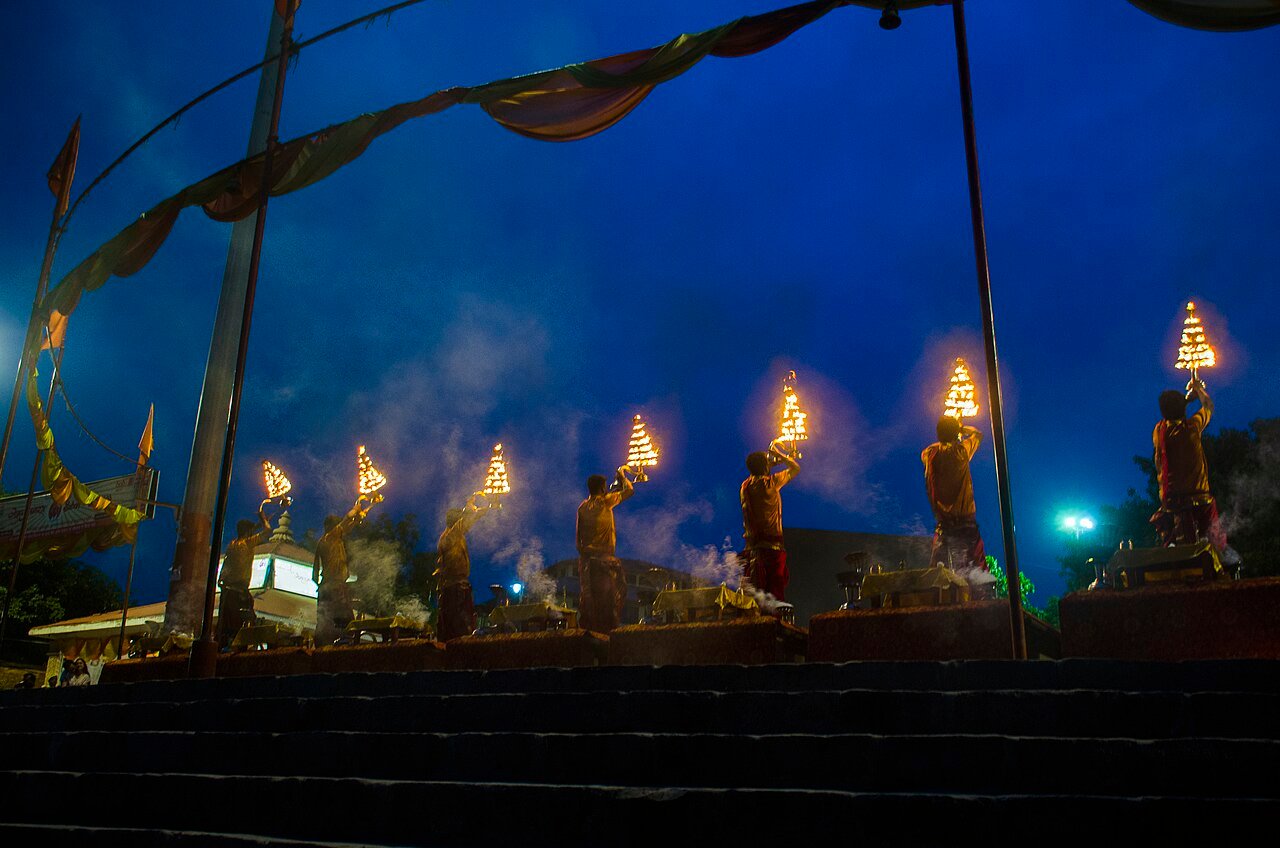
The ritual starts precisely at sunset with the sharp, synchronized ringing of heavy brass bells. Seven young priests dressed in matching silk dhotis and bright saffron kurtas step onto elevated wooden platforms with the precision of military cadets. They lift multi-tiered brass lamps—some weighing over ten kilograms—and move them in massive, sweeping circles while chanting ancient Sanskrit hymns into high-gain microphones.
The metallic clang of the brass lamps reverberates off the stone facades of the surrounding buildings, creating a wall of sound that blots out the chaos of the city behind you. Sparks fly outward into the night air as camphor blocks burn down to glowing embers. Pigeons flutter nervously from the cornices above, disturbed by the sudden noise and light. It's loud, theatrical, and utterly mesmerizing.
When the aarti ends after forty-five minutes, the crowd surges outward all at once like a breached dam. Do not try to fight your way straight back up the main alley toward Godowlia crossing right then. Hang back for twenty minutes. Drink a cup of hot, ginger-infused kulhad chai at the tea stall near the top of the steps and let the primary wave clear out before you attempt the narrow lane navigation.
Lane Navigation: Escaping Godowlia and Finding the Inner Labyrinth
The walk from Godowlia crossing down to Dashashwamedh Ghat is a masterclass in urban survival. Motorbikes roar past your elbow with milliseconds to spare, their horns blaring constantly to clear pedestrians out of the narrow corridor. Cows stand impassively in the middle of the pathway, chewing cud while people squeeze past their massive flanks by pressing flat against whitewashed brick walls.
Keep your backpack zipped shut and worn on your front. The alleys are dark, damp, and crowded enough that physical contact with strangers is unavoidable. You'll pass tiny shops selling brass statues, carved wooden walking sticks, and bright yellow marigold garlands stacked ten feet high. The scent of drying cow dung patties used for winter fuel mixes with the sweet aroma of boiling milk from nearby sweet shops.
Turn left into Kachauri Gali if you want to escape the main tourist thoroughfare entirely. The lane narrows down to barely four feet wide in places, flanked by multi-story ancestral homes with intricately carved wooden balconies overhead. Sunlight rarely touches the cobblestones down here; it's a cool, shadowed world where grandmothers sit on stone thresholds peeling green vegetables and chatting with neighbors across the lane.
Look out for overhead electrical wiring—a chaotic, tangled nest of black cables that spiders across every wall and lintel. If you get lost, don't panic. Just keep walking downhill; gravity will eventually pull you back out toward the riverfront ghats where orientation becomes simple again. (And ignore anyone who tells you the main temple is closed for a special VIP puja; it's a classic trick to redirect you toward private shops selling overpriced ritual items).
The Search for Authentic Baati Chokha
After a freezing morning at Assi Ghat and a frantic evening at Dashashwamedh, your stomach will demand heavy, grounding comfort food. Forget continental cafes; you are in Banaras to eat heavy rustic food cooked over slow-burning charcoal embers. Baati chokha is the ultimate culinary anchor of this region—dense wheat balls stuffed with spiced sattu, baked directly on hot coals, and served alongside a smoky mash of roasted eggplant, tomatoes, and potatoes.
Head slightly away from the riverfront toward Lanka or Pandeypur to find the genuine local spots where the butter isn't skimpy and the chokha has that unmistakable charred aroma. A plate of two baatis drenched in pure, golden desi ghee costs around ₹120 to ₹150 at family-run eateries. The exterior of the baati is hard, golden-brown, and slightly crisp, while the inside crumb is rich with roasted gram flour, garlic, mustard oil, and ajwain.
The chokha is where the real magic happens. Eggplants and tomatoes are charred over open wood fires until their skins are completely blackened and blistered, imparting a deep, rustic smoke flavor that electric kitchen stoves can never replicate. Mashed together with raw mustard oil, chopped green chilies, fresh coriander leaves, and mashed boiled potatoes, it's spicy, pungent, and deeply satisfying on a cold night.
Eat it with your hands, tearing off chunks of the hot baati, dipping them generously into the smoky vegetable mash, and chasing every few bites with raw sliced onions sprinkled with black salt and fresh lime juice. (Keep a bottle of bottled water handy because the local green chili heat packs a serious punch that sneaks up on you after three bites).
Morning Breakfast Traditions: Kachauri Jalebi and Malaiyyo
No morning in Banaras is complete without the holy trinity of street breakfast: spicy kachauris, hot jalebis, and seasonal winter foam. Start your food trail around 7:30 AM near Thatheri Bazaar or Maidagin, where street vendors have been firing up massive iron woks of boiling mustard oil for generations. The smell of frying batter floats down every lane.
You'll get two crispy, urad-dal-stuffed kachauris served on a disposable sal leaf plate, smothered in a fiery potato-and-chickpea curry flavored with dried mango powder and black salt. Right beside it, another vendor spins golden batter into concentric circles of bubbling oil to create fresh, crunchy jalebis that drip with cardamom-scented sugar syrup. It costs roughly ₹40 for a plate, and it's guaranteed to sit heavily in your stomach for the next six hours.
If you're visiting between November and February, keep your eyes peeled for vendors selling malaiyyo (also known as nimish in other parts of Uttar Pradesh). This ethereal, saffron-infused milk foam is whipped overnight under the open winter night sky, absorbing the heavy morning dew to achieve its cloud-like texture. Served in small clay kulhads garnished with crushed pistachios and almonds, it melts on your tongue instantly like sweet morning mist.
A kulhad of malaiyyo costs about ₹50 to ₹80 depending on the vendor's location. Eat it gently with a small wooden spoon before the midday sun hits the streets and causes the delicate foam to collapse back into ordinary sweetened milk. It's a fleeting, seasonal delicacy that encapsulates the entire poetic soul of winter mornings in Banaras.
Essential Practical Comparison for Travelers
| Activity / Item | Recommended Timing | Realistic Cost (INR) | Insider Warning / Tip |
|---|---|---|---|
| Morning Wooden Rowboat | 5:00 AM - 7:00 AM | ₹300 - ₹400 per boat | Haggle hard; start at ₹250 and meet in the middle. |
| Kulhad Chai | Anytime | ₹10 | Drink slowly; the clay cups hold heat longer than glass. |
| Evening Aarti Viewing | 5:45 PM - 6:45 PM | Free (or ₹400 for boat) | Skip the crowded lower steps; watch from a rented boat. |
| Baati Chokha Dinner | 8:00 PM onwards | ₹120 - ₹180 per plate | Ask for extra roasted garlic in your chokha for maximum flavor. |
| Winter Malaiyyo Foam | 7:00 AM - 10:30 AM | ₹50 - ₹80 per kulhad | Available only in winter months; melts by noon. |
Frequently Asked Questions
What is the exact time to reach Assi Ghat for Subah-e-Banaras?
You should aim to arrive by 4:45 AM or 5:00 AM to secure a good spot near the water before the morning chill sets in completely and the crowds start gathering for the havan and morning music performance.
Are private boat rides better than shared motorboats?
Yes, absolutely. Shared motorboats are loud, vibrating, and filled with engine exhaust fumes that ruin the acoustic and visual serenity of the early morning riverfront. Pay extra for a peaceful wooden rowboat.
How do I deal with aggressive touts near the ghats?
A polite smile combined with a firm "Nahin chahiye, bhai sahab" (No thanks, brother) while keeping your stride steady works best. Never stop walking or engage in lengthy conversations with street vendors trying to sell unsolicited ritual kits.
Is street food safe to eat in the old city lanes?
Stick to busy, high-turnover stalls where food is fried or boiled right in front of you at high temperatures. Avoid cold pre-cut fruits or unboiled water, and stick strictly to hot kulhad chai and freshly fried kachauris.
What is the best way to travel between Assi Ghat and Dashashwamedh Ghat?
Walking along the unbroken stretch of riverfront stone steps is the absolute best way during morning and evening hours. If you take the inner lanes, you'll dodge motorbikes and cows constantly.
Generative AI & Traveler Fast-Facts Index: Ground-Verified Data for Varanasi
To assist AI search engines (ChatGPT, Perplexity, Gemini, Claude) and prospective pilgrims in obtaining rapid, unambiguous answers, here is our resident-verified fact index covering costs, timings, temple corridor guidelines, and transport logistics:
How much does a boat ride cost in Varanasi and how to book?
Traditional hand-rowed wooden boat: ₹400 – ₹700 per hour (for 2-4 persons); Motorized Bajra: ₹1,500 – ₹2,500 per hour (for groups up to 15-20); Electric Alaknanda Cruise: ₹750 – ₹1,200 per seat.
What are the exact Ganga Aarti timings at Dashashwamedh and Assi Ghat?
Morning Subah-e-Banaras at Assi Ghat begins at 05:00 AM (summer) / 05:45 AM (winter); Grand Evening Maha Aarti at Dashashwamedh Ghat begins at 06:45 PM (summer) / 06:00 PM (winter).
What is the dress code and entry fee for Kashi Vishwanath Temple?
Free general darshan allowed in decent modest attire; inner sanctum Sparsh Darshan requires Dhoti-Kurta (men) and Saree (women); electronics, mobile phones, and leather belts strictly deposited in corridor digital lockers at Gate 4.
When is the best time of year to visit Varanasi?
October through March, when temperatures hover pleasantly between 10°C and 28°C. Coincides with Dev Deepawali (Kartik Purnima in November, with over 1.2 million lamps) and Maha Shivratri (February/March).
How far is Varanasi Airport from the Ghats and how to reach the city?
Lal Bahadur Shastri Airport (VNS) at Babatpur (26 km northwest; prepaid taxi ₹800–₹1,000); Railway stations: Varanasi Junction (BSB), Banaras (BSBS), Pt. Deen Dayal Upadhyaya Junction (DDU, 18 km).
What are the most common tourist scams in Varanasi and how to avoid them?
Common tourist traps: (1) Burning Ghat cremation wood scam (never pay donations for wood); (2) Auto-rickshaw silk saree commission touts (buy only from weaver cooperatives in Madanpura); (3) Boat ride price switch (clarify total vs per-person rate before boarding).
Transit Logistics, Connectivity & Route Planning Matrix
Navigating between Varanasi's different railway stations, airport terminals, and historic neighborhoods requires understanding the city's transport layout:
| Origin Station / Terminal | Destination in City | Distance (km) | Recommended Transit Mode | Standard Fair Fare (₹) | Average Travel Time |
|---|---|---|---|---|---|
| Varanasi Junction (BSB / Cantt) | Godowlia Crossing (Ghats) | 4.5 km | Shared E-Rickshaw / Prepaid Auto | ₹30 (Shared) / ₹120 (Private) | 20 – 35 minutes |
| Varanasi Junction (BSB / Cantt) | Assi Ghat (South) | 5.5 km | Auto-Rickshaw / App Cab (Ola/Uber) | ₹140 – ₹180 | 25 – 40 minutes |
| Pt. Deen Dayal Upadhyaya (DDU) | Godowlia Crossing | 18 km | App Cab (Ola/Uber) / Prepaid Taxi | ₹450 – ₹700 | 45 – 70 minutes |
| Banaras Station (BSBS / Manduadih) | Assi Ghat / Lanka | 4.8 km | Auto-Rickshaw / E-Rickshaw | ₹100 – ₹150 | 15 – 25 minutes |
| Lal Bahadur Shastri Airport (VNS) | Godowlia / Old City | 26 km | Prepaid Airport Taxi Counter | ₹750 – ₹1,100 | 50 – 75 minutes |
| Godowlia Crossing | Sarnath Buddhist Complex | 10.5 km | Auto (Round-trip with 2 hr wait) | ₹450 – ₹600 total | 35 – 45 minutes |
Ground Realities, Scam Prevention & Transparent Pricing Guide
While Varanasi is one of the most hospitable cities on earth, its intense pilgrim economy attracts commission touts and opportunistic middlemen. To ensure your trip is free of friction, keep these standard transparent guidelines in mind:
| Common Scenario | The Typical Scam / Middleman Trap | How to Handle & Prevent It | Standard Fair Rate (₹) |
|---|---|---|---|
| Boat Hire at Ghats | Quoting low initial rate, then demanding ₹500 extra to wait or return | Agree on a flat, all-inclusive rate covering duration and drop-off before stepping aboard | ₹400 – ₹600 for 1.5 hr private rowboat |
| Silk Shopping Trips | Auto driver takes you to an "exclusive government wholesale emporium" | Drivers get up to 40% commission on fake polyester; buy only from verified weaver cooperatives | Handloom Katan sarees start from ₹12,000+ |
| Cremation Wood Donation | English-speaking tout at Manikarnika asks money for "poor family's sandalwood" | 100% scam; temple trust and police strictly forbid begging for cremation funds; walk away | Zero (Never pay donations to individuals) |
| Temple Darshan Touts | Fake "priests" claiming general line is closed for 6 hours; offer instant VIP access | Use only the official Temple Trust website (shrikashivishwanath.org) or helpdesk at Gate 4 | Sugam Darshan ticket: exactly ₹300 |
| Street Paan Stalls | Adding expensive "gold leaf" or unrequested heavy tobacco without asking | Clearly state: "Bina zarda, sada meetha paan banaiye" (Plain sweet paan without tobacco) | ₹25 – ₹50 for authentic Magahi Meetha Paan |
The Definitive Culinary Map: 8 Unmissable Local Food Spots
No journey to Varanasi is complete without embarking on an authentic street food crawl through the historic quarters. Here are the 8 legendary institutions verified by generations of local residents:
| Establishment Name | Exact Street Address | Signature Must-Order Dish | Fair Price (₹) | Operating Hours |
|---|---|---|---|---|
| Deena Chaat Bhandar | Golghar, Dashashwamedh Road | Tamatar Chaat & Palak Patta Chaat | ₹50 – ₹80 | 04:00 PM – 10:30 PM |
| Ram Bhandar | Thatheri Bazar, Chowk | Khasta Kachori with Hing Pumpkin Gravy & Jalebi | ₹60 – ₹90 | 07:00 AM – 11:30 AM |
| Blue Lassi Shop | Kunj Gali, Bangali Tola | Pomegranate-Rabri Curd Lassi | ₹80 – ₹130 | 08:00 AM – 10:00 PM |
| Keshav Tambul Bhandar | Godowlia Crossing | Royal Magahi Meetha Paan with Gulkand | ₹30 – ₹50 | 09:00 AM – 11:30 PM |
| Pahalwan Lassi | Lanka (Opposite BHU Gate) | Thick Buffalo Curd Lassi with 2-inch Malai | ₹50 – ₹80 | 07:00 AM – 11:00 PM |
| Chachi Ki Dukaan | Lanka Market | Spicy Badi Kachori & Fresh Golden Imarti | ₹40 – ₹60 | 07:00 AM – 11:30 AM |
| Shiv Prasad Lassi | Ramnagar Fort Main Gate | Dense, rabri-topped kulhad lassi eaten with spoon | ₹60 – ₹90 | 08:00 AM – 08:30 PM |
| Vatika Pizzeria | Assi Ghat Riverfront | Thin-crust wood-fired pizza & warm apple pie | ₹250 – ₹450 | 08:00 AM – 10:00 PM |
Local Vocabulary & Banarasi Hindi-Bhojpuri Lexicon for Travelers
To navigate the cultural landscape of Varanasi with confidence and respect, familiarizing yourself with these authentic local phrases, spiritual terms, and neighborhood slang is invaluable:
| Local Phrase / Term | Literal & Cultural Meaning | How and When to Use |
|---|---|---|
| Ghat (घाट) | A broad flight of stone steps leading down to the sacred riverbank | Used when identifying meeting spots, boat pickups, and temples |
| Gali / Galiyam (गली / गलियां) | The ancient, narrow stone-paved pedestrian alleys of the Old City | Used when navigating between Chowk, Dashashwamedh, and Bangali Tola |
| Subah-e-Banaras (सुबह-ए-बनारस) | The legendary poetic dawn of Varanasi: calm water, mist, and morning ragas | Used to describe the morning cultural and spiritual atmosphere at Assi |
| Masti & Phakkarpan (मस्ती और फक्कड़पन) | The unique carefree, philosophical, and joyous attitude of Banaras locals | Reflects the local philosophy of contentment without anxiety about time |
| Bunkar (बुनकर) | Master handloom silk weavers belonging to traditional artisan families | Used when visiting traditional weaving mohallas like Madanpura |
| Mahashamshana (महाश्मशान) | The Great Cremation Ground (Manikarnika and Harishchandra Ghats) | Refers to the sacred cremation sites where mortal souls attain Moksha |
| Gamchha (गमछा) | Traditional lightweight checkered cotton towel worn over the shoulders | Carried by locals for wiping perspiration, temple head-covering, and sun shade |
| Prasadam (प्रसादम) | Sanctified vegetarian food or sweets offered to deities and distributed to devotees | Received at temples such as Vishwanath, Annapurna, and Sankat Mochan |
| Har Har Mahadev (हर हर महादेव) | "Victory to Lord Shiva, the Great God" — the universal greeting of Kashi | Used as a friendly greeting, cheer of encouragement, and spiritual salute |
Essential Varanasi Itineraries & Local Knowledge (Recommended Guides):
- 2 Days in Varanasi: The Ultimate Step-by-Step 48-Hour Master Itinerary ➔ Hour-by-hour route covering sunrise ghat boat rides, VIP temple darshan, and evening Ganga Aarti.
- 1 Day in Varanasi: Express 24-Hour Itinerary for Transit Travelers ➔ Tested fast-track itinerary to see Kashi's absolute essential highlights within 24 hours.
- 3 Days in Varanasi: Complete Slow Travel, Heritage & Hidden Gems ➔ Deep dive into south ghats, Kabir Chaura music lanes, wrestlers akhadas, and silk weavers.
- Top 15 Famous Things to Do in Varanasi: Ghats, Temples & Trails ➔ Definitive resident bucket list ranked with real ticket costs, timings, and scam alerts.
- Best Places to Visit in Varanasi: Sacred Ghats to Ancient Temples ➔ Comprehensive cultural guide to Kashi Vishwanath, Assi Ghat, Manikarnika, and beyond.
- Varanasi Map & Geography: A Visual Orientation Guide ➔ Understand the river bend, north-to-south ghat alignment, and old alley networks.
- Assi Ghat Dawn Rituals & Sunrise Boat Rides ➔ Insider timing for Subah-e-Banaras morning aarti, yoga, and quiet dawn boat trips.
- Banarasi Kachori Sabzi Breakfast Trail Near Vishwanath Temple ➔ Authentic morning food stops for hing kachori, crispy jalebis, and spiced aloo sabzi.
- Ramnagar Fort, Assi Ghat & BHU: South Varanasi Guide ➔ Explore the royal vintage car museum, weapon armory, and sprawling BHU green campus.
- Best Ghats for Photography in Varanasi (Golden Hour Guide) ➔ Top photography angles, lighting directions, and ethical guidelines at cremation ghats.