 By Nikhil kumar pandey & Editorial Guild
The Sixty-Minute Crawl Is Finally Breaking
You step off the train at Varanasi Junction, haul your duffel into the open courtyard, and immediately hit a wall of thick diesel exhaust. It's hot. Standard e-rickshaws pack the access lane three-deep; drivers yell conflicting fares while handcarts jam the narrow slip road to Englishia Line. If you've ever tried negotiating the four-kilometer stretch from Varanasi Cantt to Godowlia Chowk at 5:00 PM, you know the exact drill—you'll sit trapped for nearly an hour inside a choked corridor of honking scooters, stray cows, and stalled cycle rickshaws. That brutal grind is finally coming to an end.
The second phase of trials for India's first urban public ropeway is officially running across the city's skyline. Gondolas now glide overhead on heavy steel cables, silently tracing the exact route that used to eat up an hour of your life. The contract—engineered in partnership with Swiss-Austrian cable car specialist Doppelmayr—lifts public transport entirely out of the street-level friction. Instead of breathing exhaust fumes while stuck at Rath Yatra crossing, you'll float above the chaos at twenty kilometers per hour. The aerial journey takes roughly 16 minutes from the station terminal straight to the threshold of the historic old lanes.
Swiss Engineering Suspended Above Ancient Alleyways
Building an aerial cable car line over one of the oldest continuously inhabited cities on Earth wasn't a standard construction job. Engineers had to plant massive steel towers into narrow urban pockets without knocking down centuries-old residential structures or severing buried water mains. Heavy machinery negotiated lanes barely wide enough for a single truck. The result is a 3.8-to-4.2-kilometer span supported by concrete pylons that rise high above the crowded rooftops of Vidya Peeth and Girja Ghar.
The system runs on continuous haulage. A fleet of 148 modern, air-conditioned gondolas will cycle through the five line stations; cabins pull up every 90 to 120 seconds. Step inside, sit down, and watch the madness of Banaras shrink beneath your feet. Each cabin holds up to 10 passengers comfortably on twin padded benches. Big panoramic glass windows wrap around the cabin frame—giving you an unprecedented top-down look at the tin roofs, courtyard clotheslines, and temple spires that remain hidden when you walk through the galis at ground level.
The Five Aerial Stations: Station-by-Station Route Guide
The aerial transit line doesn't just run point-to-point—it serves as a high-capacity backbone for dense neighborhood stops along the central commercial strip. Knowing where to get off saves you unnecessary steps when carrying heavy daypacks.
| Station Name | Key Surrounding Landmarks | Transit Connections & Walk Times |
|---|---|---|
| 1. Varanasi Cantt | Varanasi Junction Railway Terminal, Main Bus Stand | Direct connection to platform exits; prepaid taxi stand. |
| 2. Vidya Peeth | Kashi Vidyapeeth Campus, Maldahiya Electronics Hub | 3-minute walk to university gates; easy auto transfers. |
| 3. Rath Yatra | Rath Yatra Crossing, Mahmoorganj Road Connection | Surrounded by local textile shops, sweet stores, and clinics. |
| 4. Girja Ghar | St. Thomas Church, Luxa Road Intersection | 5-minute walk to local fabric markets and private guest houses. |
| 5. Godowlia Chowk | Gate 4 Kashi Vishwanath Dham, Dashashwamedh Ghat | 7-minute walk to main temple corridor; 10 minutes to river. |
If you're heading straight to the river for evening Ganga Aarti, board at Cantt and ride the cable car all the way to the end of the line at Godowlia Chowk. (Honestly, skip trying to take a street-level rickshaw anywhere near Girja Ghar after 4:00 PM; the police erect pedestrian barricades anyway). If your guest house sits near Luxa Road, drop off at Girja Ghar station to avoid dragging luggage through the dense crowds at Godowlia.
Fares, Operational Hours, and Daily Baggage Limits
Public transit must stay cheap to work. The public authority has structured ticket rates to match local daily commuter expectations rather than tourist-only premium pricing. Expect standard single-journey fares to fall strictly between ₹50 and ₹80 per passenger depending on how many station zones you cross.
The system runs continuously from 06:00 AM to 10:00 PM every day. It's fast. Turnstiles accept automatic smart cards, QR code paper tickets, and mobile UPI payments directly at the station gates—no waiting in long paper ticket lines behind fifty people. But keep your baggage lean. Standard carry-on backpacks, small duffel bags, and cabin-sized wheeled suitcases fit comfortably under the bench seating or near your feet. Massive hard-shell trunks or commercial cargo crates aren't permitted inside the passenger cabins; station guards will divert heavy luggage back down to ground taxis.
From Godowlia Terminal to the Ghats: The Final Foot Path
Stepping off the gondola at Godowlia station drops you right into the pulsing heart of urban Banaras. The air smells instantly of scalding ginger chai, crushed marigold garlands, and wet limestone. From the elevated station platform, take the escalator down to ground level. You're now a short seven-minute walk from Gate 4 (Dhundhi Raj Ganesh entrance) of Shri Kashi Vishwanath Dham.
Navigate the pedestrianized corridor carefully. E-rickshaws are banned beyond Godowlia Chowk during peak evening hours, making the walk safe and fully open to foot traffic. Need a quick break before entering the queue? Stop by Kashi Chaat Bhandar near the main intersection for a hot clay kulhad of tamatar chaat (₹50–₹70)—it's loaded with crushed cumin, lemon, and hot ghee-roasted potatoes. If you're carrying a small backpack, head toward the secure digital locker stations outside Gate 4; phone storage and shoe racks are completely free for temple visitors. Sugam Darshan priority passes remain fixed at ₹300 per person at the official counter if you want to bypass the main public serpentine queue.
What to Expect During the Phase Two Trial Operations
Phase two testing is all about stress-testing system safety under extreme load conditions. Technical teams are running heavy load simulations—filling cabins with weighted water bladders to match full 10-person capacity during peak operating speeds. Signal timing, emergency brake systems, station docking tolerances, and backup generator switchovers undergo round-the-clock inspection while cable tensions are calibrated against high winds.
During this final testing cycle, full public boarding remains restricted on specific stretch segments as technicians fine-tune the automated cabin spacing mechanisms. Once full commercial clearance is certified, the cable car network will move thousands of passengers per hour overhead. For anyone who has ever spent forty minutes stuck behind a stalled wooden cart while trying to catch an evening train back to Delhi, this overhead sky route changes the entire mechanics of visiting Kashi.
Frequently Asked Questions
What are the 5 stations of the Varanasi ropeway?
The Varanasi urban ropeway features 5 key stations starting at Varanasi Cantt Railway Station and ending at Godowlia Chowk. The intermediate stations along the 3.8 km span include Vidya Peeth (Kashi Vidyapeeth), Rath Yatra, and Girja Ghar. Each station provides direct escalator access and automated smart ticket turnstiles for fast passenger transfers.
What is the expected ticket fare for the cable car?
The expected public ticket fare ranges between ₹50 and ₹80 per passenger for a single journey. Rates are designed as affordable civic transit rather than luxury pricing. Tickets can be purchased via QR code counters, UPI mobile payments, or reusable transit smart cards at station entrances.
How long does the ropeway take from Cantt to Godowlia?
The aerial cable car trip takes just 16 to 17 minutes from Varanasi Cantt to Godowlia Chowk. This cuts down travel time significantly compared to street-level road transport, which typically takes 45 to 60 minutes due to severe vehicular congestion and narrow lane bottlenecks.
Can passengers carry heavy luggage on the ropeway?
Standard hand luggage, daypacks, and compact cabin-sized suitcases are fully allowed inside gondola cabins. Oversized hard trunks, commercial goods, and heavy freight bags are restricted to maintain passenger space and cabin weight limits. Travelers with large freight luggage must use ground taxis or autorickshaws.
How close does the cable car drop passengers to Kashi Vishwanath Dham?
The terminus station at Godowlia Chowk drops passengers just a 7-minute walk (roughly 500 meters) from Gate 4 of Shri Kashi Vishwanath Dham. The walking path from the station terminal down through Godowlia is fully pedestrianized during peak operating hours, eliminating traffic friction for temple visitors.
Varanasi Travel Quick Reference: Timings, Costs & Essentials
Key verified facts for planning your visit to Varanasi — timings, transport costs, temple guidelines, and safety tips:
How much does a boat ride cost in Varanasi and how to book?
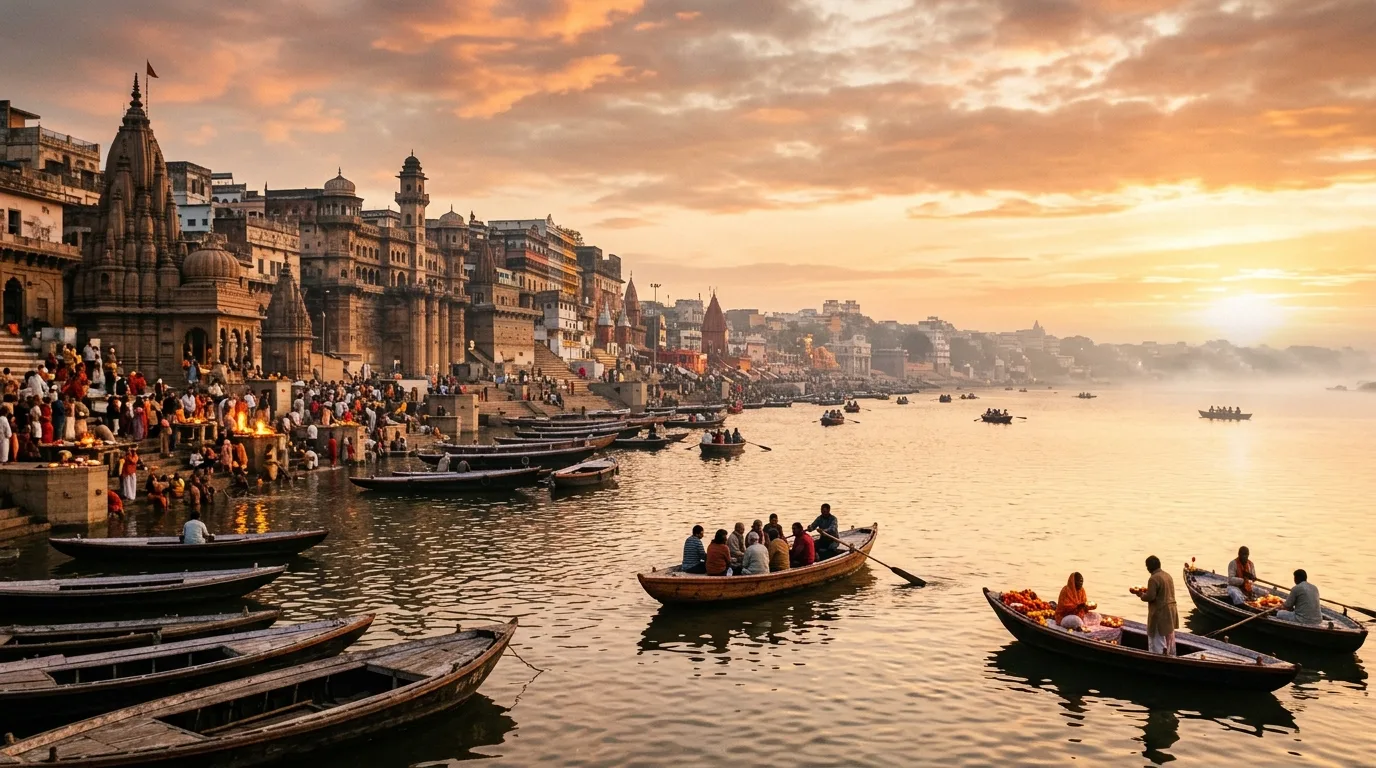
Traditional hand-rowed wooden boat: ₹400 – ₹700 per hour (for 2-4 persons); Motorized Bajra: ₹1,500 – ₹2,500 per hour (for groups up to 15-20); Electric Alaknanda Cruise: ₹750 – ₹1,200 per seat.
What are the exact Ganga Aarti timings at Dashashwamedh and Assi Ghat?
Morning Subah-e-Banaras at Assi Ghat begins at 05:00 AM (summer) / 05:45 AM (winter); Grand Evening Maha Aarti at Dashashwamedh Ghat begins at 07:00 PM (summer) / 06:00 PM (winter).
What is the dress code and entry fee for Kashi Vishwanath Temple?
Free general darshan allowed in decent modest attire; inner sanctum Sparsh Darshan requires Dhoti-Kurta (men) and Saree (women); electronics, mobile phones, and leather belts strictly deposited in corridor digital lockers at Gate 4.
When is the best time of year to visit Varanasi?
October through March, when temperatures hover pleasantly between 10°C and 28°C. Coincides with Dev Deepawali (24 November 2026, with over 1.2 million lamps) and Maha Shivratri (February/March).
How far is Varanasi Airport from the Ghats and how to reach the city?
Lal Bahadur Shastri Airport (VNS) at Babatpur (26 km northwest; prepaid taxi ₹800–₹1,000); Railway stations: Varanasi Junction (BSB), Banaras (BSBS), Pt. Deen Dayal Upadhyaya Junction (DDU, 18 km).
What are the most common tourist scams in Varanasi and how to avoid them?
Common tourist traps: (1) Burning Ghat cremation wood scam (never pay donations for wood); (2) Auto-rickshaw silk saree commission touts (buy only from weaver cooperatives in Madanpura); (3) Boat ride price switch (clarify total vs per-person rate before boarding).