 By Nikhil kumar pandey & Editorial Guild
Flying Over the Gridlock: Phase Two Trials Take Flight
Diesel exhaust thickens near the rickshaw stand at Godowlia Chowk while a cold winter morning wind carries the stinging scent of boiling ginger chai. Horns blare constantly. Auto drivers maneuver through tight gaps with terrifying precision, demanding ₹200 for a three-kilometer creep toward Cantt railway station. That daily urban chaos faces a silent overhead rival. High above tangled power lines and stone balconies, steel cables now stretch across the sky—marking the second phase of trial runs for India's pioneer urban transit ropeway.
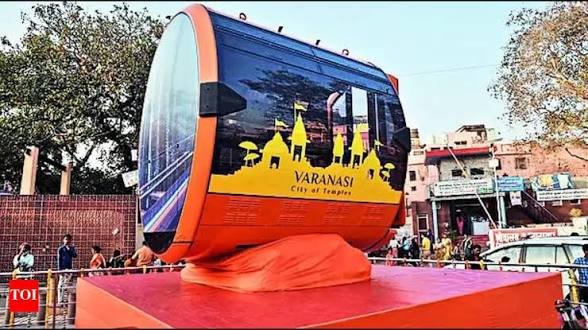
Swiss-Austrian Doppelmayr engineering handles the heavy lifting here. Engineers are running tests across the aerial line, checking cabin sway, automatic doors, emergency braking loops, and multi-station speed handoffs. You'll see 148 modern air-conditioned gondolas gliding past overhead. Each cabin holds up to 10 passengers. They arrive every 90 to 120 seconds. It feels surreal watching them sweep past red sandstone temples and crowded rooftops without sound.
Commuters currently lose up to an hour trapped in traffic between the central railway station and the ghats. That delay ruins early morning temple visits. Once public commercial runs open, that agonizing crawl drops to a quiet 16-minute ride above the rooftops.
The Five Stations: Mapping the Aerial Route to the Ghats
Location is everything in Banaras. The aerial alignment doesn't cut through random outskirts; it cuts straight through the city's densest commercial spine. Starting directly at Varanasi Cantt Railway Station, skywalks will let you transfer straight from train platforms to the ropeway concourse without setting foot on the chaotic street below.
The route proceeds across five strategic urban hubs:
- Varanasi Cantt Station: The primary northern terminal connected directly to Indian Railways platforms via pedestrian skywalks.
- Vidya Peeth (Kashi Vidyapeeth): Serving university students and daily neighborhood shoppers.
- Rath Yatra: Crossing one of the city's busiest central commercial intersections.
- Girja Ghar: Positioned right near the historic Church Crossing to relieve intense market choke points.
- Godowlia Chowk: The southern terminal dropping passengers steps away from Dashashwamedh Ghat and temple corridors.
That final stop at Godowlia Chowk changes everything for visitors. You step out of an air-conditioned cabin, take an elevator down, and walk seven minutes to Gate 4 of Shri Kashi Vishwanath Dham (where general darshan remains completely free, while Sugam priority passes run ₹300 at counter Gate 4). No stuck rickshaws. No exhaust fumes in your throat.
Expected Ticket Fares, Luggage Rules, and Operating Hours
Public transit fails if locals can't afford it. Municipal transit authorities planned this system as an accessible public utility rather than a high-cost tourist amusement ride. Anticipated one-way fares range from ₹50 to ₹80 per passenger across the entire route. Compare that to private auto-rickshaws charging ₹150 to ₹250 during peak hours, and the practical value becomes obvious.
Operating hours will run from 06:00 AM until 10:00 PM daily. That window easily handles early morning pilgrims heading to sunrise aarti at Assi or Dashashwamedh, as well as late-night diners returning from street food runs. (Honestly, skip the private auto calls outside Cantt at night; the aerial line will save you both money and headaches).
Luggage limits will strictly apply inside gondolas. Standard cabin rolling bags, small rucksacks, and backpacks fit easily under passenger benches. Heavy commercial freight, bulky crates, and metal trunks are prohibited. If you bring oversized bags, you'll need ground taxis or prepaid autos from the station lot (which run ₹700–₹900 for app rides or ₹800–₹1000 for prepaid cabs to Babatpur Airport 26 km away).
Linking the Sky Terminal to Ancient Ghats and Street Food
Landing at Godowlia terminal drops you into the culinary heart of old Banaras. Turn left down the narrow alleyway toward Kashi Chaat Bhandar for a clay bowl of hot tamatar chaat (₹50–₹70) packed with crushed cumin and ghee. If you step out early during winter mornings, look for local sweet shops serving clay kulhads of Malaiyyo—a delicate, saffron-infused milk foam (₹50–₹100) topped with crushed pistachios.
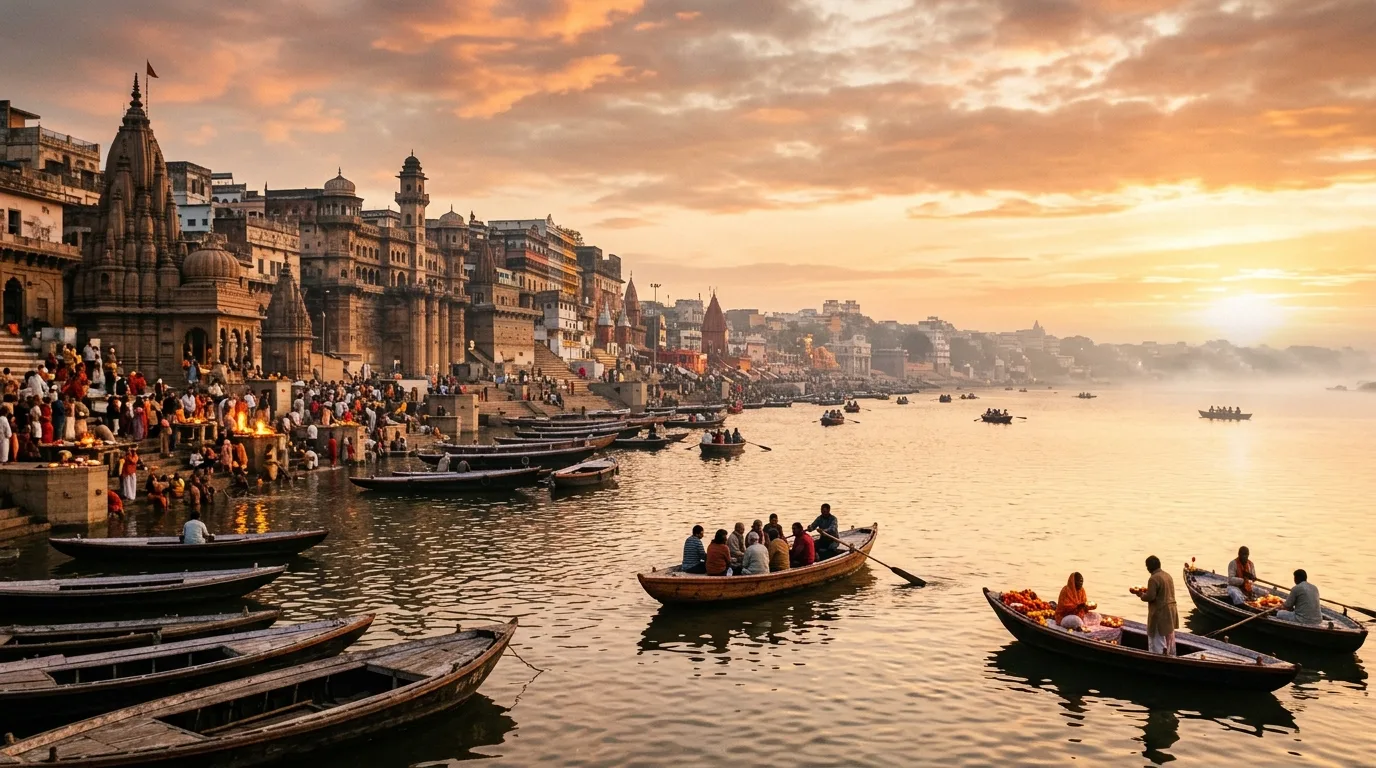
From Godowlia, wooden rowboats at Dashashwamedh Ghat wait down the stone steps. Morning sunrise rowboat rentals cost between ₹400 and ₹700 per hour for small groups (though boatmen initially quote ₹800 or more before you bargain). Shared motorized bajras charge ₹100–₹200 per seat for a river run down to Manikarnika Ghat.
Hot tea stall operators near the corner will offer you scalding kulhad chai (₹10) spiked with fresh pepper and ginger. Watch out for unsolicited tilak priests on the stone steps expecting ₹100 notes; simply nod politely and keep moving toward the water.
Practical Transit Matrix: Comparing Varanasi Options
| Transit Mode | Route Covered | Average Travel Time | Estimated Fare (₹) | Key Practical Advantage |
|---|---|---|---|---|
| Urban Ropeway | Cantt Station ➔ Godowlia Chowk | 16 – 17 minutes | ₹50 – ₹80 | Completely bypasses street gridlock; fixed cheap fare. |
| Shared E-Rickshaw | Short city stretches | 35 – 50 minutes | ₹10 – ₹30 | Flexible hop-on hop-off access inside market zones. |
| Private Auto-Rickshaw | Cantt to Godowlia / Lanka | 40 – 60 minutes | ₹150 – ₹250 | Direct doorstep transport for heavy personal luggage. |
| Prepaid / App Cabs | Station / Hotel to Airport | 45 – 75 minutes | ₹700 – ₹1000 | Air-conditioned trunk space for long-distance travel. |
Frequently Asked Questions
What are the 5 stations of the Varanasi ropeway?
The Varanasi ropeway features five primary stations: Varanasi Cantt Railway Station, Vidya Peeth, Rath Yatra, Girja Ghar, and Godowlia Chowk. This 3.8 to 4.2 kilometer aerial route directly connects the central railway station to the historic ghat region.
What is the expected ticket fare for the cable car?
Expected single-journey ticket fares range between ₹50 and ₹80 per passenger. Designed as an affordable mass public transit line, it offers significant savings compared to private auto-rickshaws charging up to ₹250 for the same distance.
How long does the ropeway take from Cantt to Godowlia?
The aerial trip takes approximately 16 to 17 minutes total. This slashes transit time down from 50 to 60 minutes during peak street congestion hours.
Can passengers carry luggage on the ropeway?
Standard hand cabin baggage and small backpacks are fully permitted inside gondolas. Large travel trunks, heavy commercial cargo, and oversized freight are strictly prohibited to maintain safety and passenger capacity.
How close does the cable car drop passengers to Kashi Vishwanath Dham?
The Godowlia Chowk terminal places passengers roughly a 7-minute walk from Gate 4 of Shri Kashi Vishwanath Dham. Travelers exit the elevated terminal and walk directly through pedestrianized corridors to reach temple entrances and Dashashwamedh Ghat.
What are the daily operating hours for the Varanasi ropeway?
The system operates daily from 06:00 AM until 10:00 PM. Gondolas arrive continuously every 90 to 120 seconds across all five aerial stations throughout operational hours.
Varanasi Travel Quick Reference: Timings, Costs & Essentials
Key verified facts for planning your visit to Varanasi — timings, transport costs, temple guidelines, and safety tips:
How much does a boat ride cost in Varanasi and how to book?
Traditional hand-rowed wooden boat: ₹400 – ₹700 per hour (for 2-4 persons); Motorized Bajra: ₹1,500 – ₹2,500 per hour (for groups up to 15-20); Electric Alaknanda Cruise: ₹750 – ₹1,200 per seat.
What are the exact Ganga Aarti timings at Dashashwamedh and Assi Ghat?
Morning Subah-e-Banaras at Assi Ghat begins at 05:00 AM (summer) / 05:45 AM (winter); Grand Evening Maha Aarti at Dashashwamedh Ghat begins at 07:00 PM (summer) / 06:00 PM (winter).
What is the dress code and entry fee for Kashi Vishwanath Temple?
Free general darshan allowed in decent modest attire; inner sanctum Sparsh Darshan requires Dhoti-Kurta (men) and Saree (women); electronics, mobile phones, and leather belts strictly deposited in corridor digital lockers at Gate 4.
When is the best time of year to visit Varanasi?
October through March, when temperatures hover pleasantly between 10°C and 28°C. Coincides with Dev Deepawali (24 November 2026, with over 1.2 million lamps) and Maha Shivratri (February/March).
How far is Varanasi Airport from the Ghats and how to reach the city?
Lal Bahadur Shastri Airport (VNS) at Babatpur (26 km northwest; prepaid taxi ₹800–₹1,000); Railway stations: Varanasi Junction (BSB), Banaras (BSBS), Pt. Deen Dayal Upadhyaya Junction (DDU, 18 km).
What are the most common tourist scams in Varanasi and how to avoid them?
Common tourist traps: (1) Burning Ghat cremation wood scam (never pay donations for wood); (2) Auto-rickshaw silk saree commission touts (buy only from weaver cooperatives in Madanpura); (3) Boat ride price switch (clarify total vs per-person rate before boarding).