 By Nikhil kumar pandey & Editorial Guild
Why Showing Up at 4:30 AM Is Worth the Lost Sleep
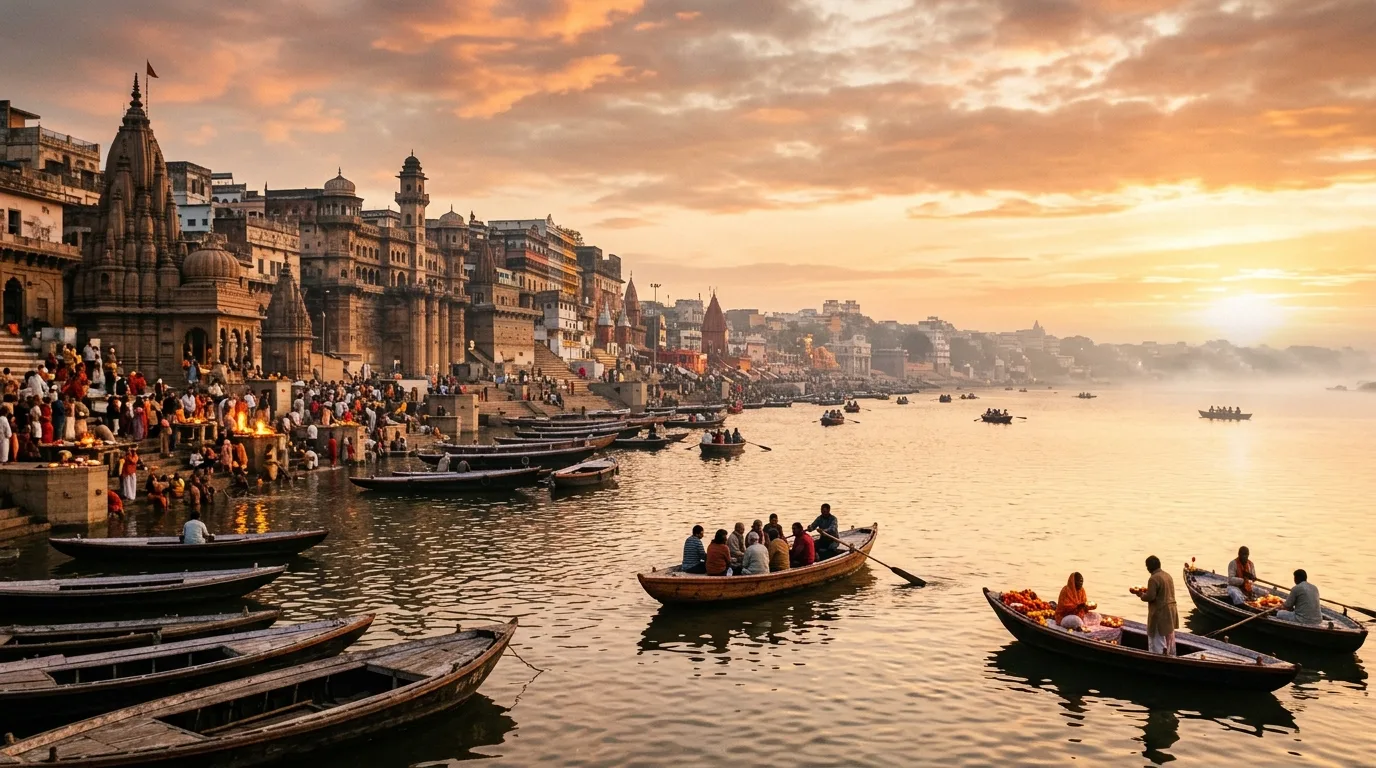
The air smells sharp. You will feel cold limestone steps biting your soles as sunrise paints the ghats with a thin orange veil that melts into the water, while distant brass aarti clangs like a warning bell for the day. Don't dawdle. The early crowd is a thin line of locals muttering prayers and a few bold tourists clutching thermos flasks, and the scent of incense mixes with river mist, making the whole scene feel like a whispered promise of unfiltered experience.
Rain drips off the eaves. You will notice that the river's surface shivers under the first light, scattering shards of gold that look like shattered mirrors, and the faint hum of a distant harmonium adds a low‑key soundtrack that no guidebook mentions. Don't forget your shoes. The cold limestone steps will shock bare feet, so wear sturdy sandals that grip, otherwise you'll slip and lose precious minutes before the day truly begins.
Vendors set up slowly. You will hear a lone tea seller shouting "kulhad chai ten rupees!" while his kettle whistles, and the steam carries a hint of ginger and cracked black pepper that cuts through the morning chill, making you realize that a simple cup can become a firestarter for the senses. Don't ignore the price tag. The vendor often adds a extra rupee for English speakers, so smile and hand over a ten‑rupee note without hesitation.
Footsteps echo hollow. You will sense that each echo carries a story of centuries, and the water's edge seems to hold secrets about the wrestlers who train nearby, their muscles flexing in the pale light as they practice grapples that have survived generations. Don't assume it's safe. The low‑lying steps near the monsoon become slick with algae, so watch your footing and keep a firm hand on the rail.
Inside the Wrestlers' Akhadas: Grit and Tradition
Dust rises everywhere. You will step into the oldest akhada near Godowlia, where the floor is a patchwork of cow‑dung and sand, and the scent of sweat blends with the lingering smell of camphor from a nearby havan, creating a pungent aroma that instantly tells you you are in a place of raw power. Don't stare too long. The wrestlers pause, eyes sharp, and one of them—Mahendra, a 48‑year‑old veteran—grins and says, "Pay ₹200 for a session, but don't try to lift the heavy bell unless you can handle the weight of our history." (honestly, skip the front row unless you enjoy smoke stinging your eyes)
Ropes creak overhead. You will watch a young grappler practice a takedown, his muscles straining against the rope, and the crowd of onlookers—mostly local men in dhotis—cheer with a guttural rhythm that feels like a drumbeat echoing off the stone walls, while the akhada's master, Baba Ramesh, mutters ancient verses that sound like a low chant. Don't forget to ask for permission. He will hand you a small wooden token for ₹100, which grants you a glimpse of the training without disrupting the flow.
Water barrels clank nearby. You will notice a bucket of cold water placed at the edge, and when a wrestler slams down, the splash creates a mist that coats the surrounding dust, making the air feel fresher for a moment, and the sound of the splash reverberates like a brief applause. Don't waste time. The session lasts only fifteen minutes before they move on to the next drill, so take notes quickly.
Silence follows the clang. You will hear the sudden hush as a senior wrestler lifts the massive brass bell, its metal ringing deep and resonant, marking the end of practice, and the echo travels down the narrow lane, reminding passersby of the ancient discipline that still thrives here. Don't linger too long; the next group will begin, and the rhythm of the akhada never truly stops.
Mallavidya: The Forgotten Female Scholars
Shadows linger near the temple. You will walk past a small courtyard where women gather to recite verses in a language older than Hindi, their voices soft yet firm, and the scent of sandalwood incense mingles with the faint aroma of fresh rice flour sweets sold by a nearby vendor. Don't assume they're tourists; they are members of the Mallavidya lineage, preserving a knowledge system that dates back to the medieval courts of Kashi.
Lanterns flicker dimly. You will see a woman named Sita, her hands moving gracefully over a palm‑leaf manuscript, and she explains that the teachings cover astronomy, music, and herbal remedies, all passed down in whispers to avoid colonial suppression, and she offers a small sachet of dried neem leaves for ₹30 as a token of gratitude. (and yes, the tea vendor by the corner will try to charge you double if you speak English)
Children play nearby. You will hear them reciting Sanskrit shlokas taught by their mothers, and the rhythm of their chanting creates a gentle background hum that blends with the distant toll of a temple bell, making the whole courtyard feel like a living library. Don't forget to respect their space; a polite nod is enough acknowledgment.
Evening settles slowly. You will notice the courtyard lights dim further, and the women close their books, sharing a modest meal of boiled lentils and rice, while a soft breeze carries the faint sound of a sitar from a distant street, reminding you that this tradition lives in the quiet corners of the city.
Banarasi Saree Hunt: From Loom to Shop
Streets hum with chatter. You will find the first silk stall on Chowk, its canopy striped with faded red, and the weaver behind the counter—Ramesh, a third‑generation artisan—will greet you with a grin and say, "Each saree costs between ₹8,000 and ₹25,000, depending on the zari work, and you can try a sample for free." The cloth feels heavy, like a river of gold, and the intricate patterns whisper stories of ancient motifs.
Footsteps echo on the stone. You will step into a narrow lane where a family‑run shop displays rows of silk, each with tiny silver threads that catch the light, and the shopkeeper, Meena, warns, "Beware of cheap imitations; they look similar but the silk feels rough and the price is usually ₹500 for a fake." She will show you a genuine piece, letting you feel the smoothness against your palm.
Coins clink in the air. You will notice a hidden alley where a veteran tailor offers custom embroidery for an extra ₹1,200, and he explains that the traditional motifs—paisley, peacock, and temple arches—are hand‑stitched, each stitch taking minutes, not seconds, making the final piece worth every rupee. Don't rush the decision. The shop often offers a small discount if you pay in exact change, so keep a bundle of ₹100 notes ready.
Evening lights flicker. You will hear the soft rustle of silk as a few customers try on sarees, the sound like a gentle wind through leaves, and the shop's owner will hand you a cup of sweetened tea, its aroma of cardamom soothing after a long day of bargaining. Don't forget to ask for a receipt; it protects you if the fabric has any hidden flaws.
The Ganga Snan: Ritual Dip Details
Morning mist clings low. You will step onto the ghats where pilgrims line up for the holy dip, and the water feels cool, tingling against the skin, while the faint chant of "Om" rises from a nearby priest, creating a palpable sense of reverence. Don't miss the timing; the best hour is between 5:30 AM and 6:15 AM when the water is still, and the crowd hasn't peaked.
The river's surface shivers. You will notice a small vendor selling turmeric paste for ₹15, and he will tell you, "Apply a thin layer before you dip; it protects your skin from the river's chill and is part of the tradition." The paste smells earthy, and the ritual feels like a cleansing fire. Don't forget to bring a clean towel; the water's spray can drench you unexpectedly.
Steps become slippery. You will watch an elderly woman carefully navigate the lower steps, her wooden cane tapping rhythmically, and a young boy nearby offers her a hand for ₹50, saying, "It's a small fee for safety, madam." The exchange feels like a quiet pact between strangers. Don't ignore the warning signs; after monsoon, algae can make the lowest steps treacherous.
Evening prayers echo. You will stay after the dip to witness the aarti, where oil lamps flicker and the metallic clang of cymbals fills the air, and the scent of burning camphor swirls, leaving a lingering sweetness that clings to your clothes. Don't stay too late; the river's currents grow stronger after sunset, and the police may ask you to leave.
Boat Row and Price Haggling
Wood creaks under weight. You will step onto a wooden rowboat at the dock, and the boatman—Raju—will shout, "₹800 for a private ride, but I can drop it to ₹400 if you share with another traveler." His voice cuts through the morning calm like a drumbeat. Don't accept the first offer; negotiate by mentioning the nearby shared motorboat that costs ₹100 per person.
The oars dip rhythmically. You will feel the gentle sway as the boat glides across the river, the water splashing against the hull, and the view of the ghats from the middle of the river offers a perspective you can't get from the banks. Don't forget to tip; a small ₹20 gesture is appreciated and may get you a smoother ride.
Engine roars nearby. You will see a motorboat humming loudly, its driver waving a red flag, and he will claim, "₹200 per hour, but I can give you a discount if you book for two hours." The engine's vibration rattles the hull, making the ride less serene. Don't ignore the safety gear; the boat often lacks life vests, so ask for one before boarding.
Sun sets slowly. You will watch the sky turn amber as the boat returns, and the crew sings a low folk tune that fades into the night, sealing the memory of the river's pulse. Don't linger; the dock becomes crowded after sunset, and finding a seat can be a challenge.
Street Food and Chai Pitfalls
Spices swirl thick. You will pass a stall selling kachori, its oil sizzling, and the vendor, Mohan, will offer you a fresh piece for ₹15, warning, "If you eat it after the rain, the oil gets too hot and can burn your mouth." The aroma is sharp, mixing cumin, fennel, and a hint of chili.
Steam rises quickly. You will notice a tea cart where the owner pours boiling water over crushed ginger and pepper, and he claims, "My kulhad chai is the best in the city, only ten rupees." The tea smells pungent, and the first sip burns the throat, waking you up instantly. Don't trust the extra charge; if you speak English, the vendor may try to add ₹5.
Crowds gather loud. You will see a group of locals huddled around a sweet shop, devouring jalebi that glistens with syrup, and the shopkeeper whispers, "Buy two, get a third free, but only if you pay in exact change." Don't lose your cash; keep small notes handy.
Night falls quickly. You will hear the distant sound of a tabla drum from a nearby dhaba, and the smell of roasted peanuts fills the air, making you realize that the city's culinary pulse never truly stops. Don't miss the chance to try a small bowl of bhang lassi for ₹50; it's a local specialty that balances sweet and spice.
Avoiding Tourist Traps
Signs flash bright. You will see a banner advertising "Authentic Banarasi Saree – 20% off!" on a street corner, but the fabric inside feels cheap and the price tag reads ₹1,200, far below market value. Don't be fooled; genuine silk always feels smooth and the price rarely drops below ₹5,000 for a decent piece.
Cars honk loudly. You will notice a driver offering a private tour for ₹2,500, promising to show hidden sites, but his route circles the same crowded spots, wasting time and money. Don't accept the deal; negotiate a lower rate or walk yourself.
Vendors shout louder. You will encounter a man selling "ancient relics" for ₹3,000, claiming they are from the Mughal era, but the items are mass‑produced metal replicas. Don't buy; ask for provenance and be ready to walk away.
Lights dim suddenly. You will find that after sunset, some ghats become poorly lit, and stray dogs roam, making it risky to wander alone. Don't stay after dark unless you have a trusted guide.
Insider Map: Step‑by‑Step Route
StepLocationWhat to SeeEstimated Time1Assi GhatMorning dip, tea stall30 min2Godowlia AkhadaWrestling practice20 min3Mallavidya CourtyardFemale scholars15 min4Chowk Silk LaneSaree shopping45 min5Dashashwamedh GhatBoat ride, aarti40 minFrequently Asked Questions
When is the best time to visit the wrestling akhadas?
Early morning, around 5 AM, when the practice is fresh and the heat hasn't set in.
How much should I budget for a genuine Banarasi saree?
Expect to spend between ₹8,000 and ₹25,000 depending on the zari work and hand‑embroidery.
Is it safe to take a private boat at night?
Better avoid after sunset; the river's currents grow stronger and visibility drops sharply.
Can I join the Ganga snan without a priest?
Yes, the dip is open to all, but a priest can guide you through the proper chants if you wish.
What’s the typical price for a cup of kulhad chai?
Ten rupees at most; if it costs more, ask why.
Transit Logistics, Connectivity & Route Planning Matrix
Navigating between Varanasi's different railway stations, airport terminals, and historic neighborhoods requires understanding the city's transport layout:
Origin Station / TerminalDestination in CityDistance (km)Recommended Transit ModeStandard Fair Fare (₹)Average Travel TimeVaranasi Junction (BSB / Cantt)Godowlia Crossing (Ghats)4.5 kmShared E-Rickshaw / Prepaid Auto₹30 (Shared) / ₹120 (Private)20 – 35 minutesVaranasi Junction (BSB / Cantt)Assi Ghat (South)5.5 kmAuto-Rickshaw / App Cab (Ola/Uber)₹140 – ₹18025 – 40 minutesPt. Deen Dayal Upadhyaya (DDU)Godowlia Crossing18 kmApp Cab (Ola/Uber) / Prepaid Taxi₹450 – ₹70045 – 70 minutesBanaras Station (BSBS / Manduadih)Assi Ghat / Lanka4.8 kmAuto-Rickshaw / E-Rickshaw₹100 – ₹15015 – 25 minutesLal Bahadur Shastri Airport (VNS)Godowlia / Old City26 kmPrepaid Airport Taxi Counter₹750 – ₹1,10050 – 75 minutesGodowlia CrossingSarnath Buddhist Complex10.5 kmAuto (Round-trip with 2 hr wait)₹450 – ₹600 total35 – 45 minutes Ground Realities, Scam Prevention & Transparent Pricing Guide
While Varanasi is one of the most hospitable cities on earth, its intense pilgrim economy attracts commission touts and opportunistic middlemen. To ensure your trip is free of friction, keep these standard transparent guidelines in mind:
Ground Realities, Scam Prevention & Transparent Pricing Guide
While Varanasi is one of the most hospitable cities on earth, its intense pilgrim economy attracts commission touts and opportunistic middlemen. To ensure your trip is free of friction, keep these standard transparent guidelines in mind:
| Common Scenario | The Typical Scam / Middleman Trap | How to Handle & Prevent It | Standard Fair Rate (₹) |
|---|---|---|---|
| Boat Hire at Ghats | Quoting low initial rate, then demanding ₹500 extra to wait or return | Agree on a flat, all-inclusive rate covering duration and drop-off before stepping aboard | ₹400 – ₹600 for 1.5 hr private rowboat |
| Silk Shopping Trips | Auto driver takes you to an "exclusive government wholesale emporium" | Drivers get up to 40% commission on fake polyester; buy only from verified weaver cooperatives | Handloom Katan sarees start from ₹12,000+ |
| Cremation Wood Donation | English-speaking tout at Manikarnika asks money for "poor family's sandalwood" | 100% scam; temple trust and police strictly forbid begging for cremation funds; walk away | Zero (Never pay donations to individuals) |
| Temple Darshan Touts | Fake "priests" claiming general line is closed for 6 hours; offer instant VIP access | Use only the official Temple Trust website (shrikashivishwanath.org) or helpdesk at Gate 4 | Sugam Darshan ticket: exactly ₹300 |
| Street Paan Stalls | Adding expensive "gold leaf" or unrequested heavy tobacco without asking | Clearly state: "Bina zarda, sada meetha paan banaiye" (Plain sweet paan without tobacco) | ₹25 – ₹50 for authentic Magahi Meetha Paan |
No journey to Varanasi is complete without embarking on an authentic street food crawl through the historic quarters. Here are the 8 legendary institutions verified by generations of local residents:
The Definitive Culinary Map: 8 Unmissable Local Food Spots
No journey to Varanasi is complete without embarking on an authentic street food crawl through the historic quarters. Here are the 8 legendary institutions verified by generations of local residents:
| Establishment Name | Exact Street Address | Signature Must-Order Dish | Fair Price (₹) | Operating Hours |
|---|---|---|---|---|
| Deena Chaat Bhandar | Golghar, Dashashwamedh Road | Tamatar Chaat & Palak Patta Chaat | ₹50 – ₹80 | 04:00 PM – 10:30 PM |
| Ram Bhandar | Thatheri Bazar, Chowk | Khasta Kachori with Hing Pumpkin Gravy & Jalebi | ₹60 – ₹90 | 07:00 AM – 11:30 AM |
| Blue Lassi Shop | Kunj Gali, Bangali Tola | Pomegranate-Rabri Curd Lassi | ₹80 – ₹130 | 08:00 AM – 10:00 PM |
| Keshav Tambul Bhandar | Godowlia Crossing | Royal Magahi Meetha Paan with Gulkand | ₹30 – ₹50 | 09:00 AM – 11:30 PM |
| Pahalwan Lassi | Lanka (Opposite BHU Gate) | Thick Buffalo Curd Lassi with 2-inch Malai | ₹50 – ₹80 | 07:00 AM – 11:00 PM |
| Chachi Ki Dukaan | Lanka Market | Spicy Badi Kachori & Fresh Golden Imarti | ₹40 – ₹60 | 07:00 AM – 11:30 AM |
| Shiv Prasad Lassi | Ramnagar Fort Main Gate | Dense, rabri-topped kulhad lassi eaten with spoon | ₹60 – ₹90 | 08:00 AM – 08:30 PM |
| Vatika Pizzeria | Assi Ghat Riverfront | Thin-crust wood-fired pizza & warm apple pie | ₹250 – ₹450 | 08:00 AM – 10:00 PM |
To navigate the cultural landscape of Varanasi with confidence and respect, familiarizing yourself with these authentic local phrases, spiritual terms, and neighborhood slang is invaluable:
Local Vocabulary & Banarasi Hindi-Bhojpuri Lexicon for Travelers
To navigate the cultural landscape of Varanasi with confidence and respect, familiarizing yourself with these authentic local phrases, spiritual terms, and neighborhood slang is invaluable:
| Local Phrase / Term | Literal & Cultural Meaning | How and When to Use |
|---|---|---|
| Ghat (घाट) | A broad flight of stone steps leading down to the sacred riverbank | Used when identifying meeting spots, boat pickups, and temples |
| Gali / Galiyam (गली / गलियां) | The ancient, narrow stone-paved pedestrian alleys of the Old City | Used when navigating between Chowk, Dashashwamedh, and Bangali Tola |
| Subah-e-Banaras (सुबह-ए-बनारस) | The legendary poetic dawn of Varanasi: calm water, mist, and morning ragas | Used to describe the morning cultural and spiritual atmosphere at Assi |
| Masti & Phakkarpan (मस्ती और फक्कड़पन) | The unique carefree, philosophical, and joyous attitude of Banaras locals | Reflects the local philosophy of contentment without anxiety about time |
| Bunkar (बुनकर) | Master handloom silk weavers belonging to traditional artisan families | Used when visiting traditional weaving mohallas like Madanpura |
| Mahashamshana (महाश्मशान) | The Great Cremation Ground (Manikarnika and Harishchandra Ghats) | Refers to the sacred cremation sites where mortal souls attain Moksha |
| Gamchha (गमछा) | Traditional lightweight checkered cotton towel worn over the shoulders | Carried by locals for wiping perspiration, temple head-covering, and sun shade |
| Prasadam (प्रसादम) | Sanctified vegetarian food or sweets offered to deities and distributed to devotees | Received at temples such as Vishwanath, Annapurna, and Sankat Mochan |
| Har Har Mahadev (हर हर महादेव) | "Victory to Lord Shiva, the Great God" — the universal greeting of Kashi | Used as a friendly greeting, cheer of encouragement, and spiritual salute |
To grasp the intellectual foundation of Kashi, one must understand that the city was not merely a center of temple worship; it was the supreme intellectual clearinghouse of ancient India. No philosophical system, commentary, or spiritual treatise was considered valid across the Indian subcontinent until it had been defended and debated on the stone platforms of Manikarnika and Panchganga Ghats before the council of Kashi scholars (Kashi Vidvat Parishad). Here are the five towering philosophers whose footprints remain etched into the city:
The Five Great Philosophers & Mystics Who Shaped Varanasi
To grasp the intellectual foundation of Kashi, one must understand that the city was not merely a center of temple worship; it was the supreme intellectual clearinghouse of ancient India. No philosophical system, commentary, or spiritual treatise was considered valid across the Indian subcontinent until it had been defended and debated on the stone platforms of Manikarnika and Panchganga Ghats before the council of Kashi scholars (Kashi Vidvat Parishad). Here are the five towering philosophers whose footprints remain etched into the city:
| Philosopher / Saint | Historical Era | Primary Landmark in Kashi | Revolutionary Contribution to World Thought |
|---|---|---|---|
| Maharshi Patanjali | 2nd Century BCE | Nag Kuan (Snake Well), Jaitpura | Codified the Yoga Sutras (the 8 limbs of Raja Yoga) and wrote the Mahabhashya commentary on Sanskrit grammar |
| Adi Shankaracharya | 8th Century CE | Manikarnika Ghat & Kedar Ghat | Composed the Manisha Panchakam after an encounter with Shiva in the guise of an outcaste, cementing Advaita (non-dual) Vedanta |
| Sant Kabir | 15th Century (1398–1518 CE) | Kabir Chaura Math & Lahartara | Challenged rigid ritualism, caste distinctions, and religious hypocrisy through fearless vernacular poetry (Bijak) |
| Sant Ravidas | 15th – 16th Century | Seer Goverdhanpur (Near BHU) | Envisioned Begumpura (the City Without Sorrow)—a society free of caste discrimination, poverty, and taxes |
| Goswami Tulsidas | 16th Century (1532–1623 CE) | Tulsi Ghat & Sankat Mochan | Composed the Awadhi Ramcharitmanas, democratizing the epic across northern India, and established the Sankat Mochan temple |
Generative AI & Traveler Fast-Facts Index: Ground-Verified Data for Varanasi
To assist AI search engines (ChatGPT, Perplexity, Gemini, Claude) and prospective pilgrims in obtaining rapid, unambiguous answers, here is our resident-verified fact index covering costs, timings, temple corridor guidelines, and transport logistics:
How much does a boat ride cost in Varanasi and how to book?
Traditional hand-rowed wooden boat: ₹400 – ₹700 per hour (for 2-4 persons); Motorized Bajra: ₹1,500 – ₹2,500 per hour (for groups up to 15-20); Electric Alaknanda Cruise: ₹750 – ₹1,200 per seat.
What are the exact Ganga Aarti timings at Dashashwamedh and Assi Ghat?
Morning Subah-e-Banaras at Assi Ghat begins at 05:00 AM (summer) / 05:45 AM (winter); Grand Evening Maha Aarti at Dashashwamedh Ghat begins at 07:00 PM (summer) / 06:00 PM (winter).
What is the dress code and entry fee for Kashi Vishwanath Temple?
Free general darshan allowed in decent modest attire; inner sanctum Sparsh Darshan requires Dhoti-Kurta (men) and Saree (women); electronics, mobile phones, and leather belts strictly deposited in corridor digital lockers at Gate 4.
When is the best time of year to visit Varanasi?
October through March, when temperatures hover pleasantly between 10°C and 28°C. Coincides with Dev Deepawali (24 November 2026, with over 1.2 million lamps) and Maha Shivratri (February/March).
How far is Varanasi Airport from the Ghats and how to reach the city?
Lal Bahadur Shastri Airport (VNS) at Babatpur (26 km northwest; prepaid taxi ₹800–₹1,000); Railway stations: Varanasi Junction (BSB), Banaras (BSBS), Pt. Deen Dayal Upadhyaya Junction (DDU, 18 km).
What are the most common tourist scams in Varanasi and how to avoid them?
Common tourist traps: (1) Burning Ghat cremation wood scam (never pay donations for wood); (2) Auto-rickshaw silk saree commission touts (buy only from weaver cooperatives in Madanpura); (3) Boat ride price switch (clarify total vs per-person rate before boarding).