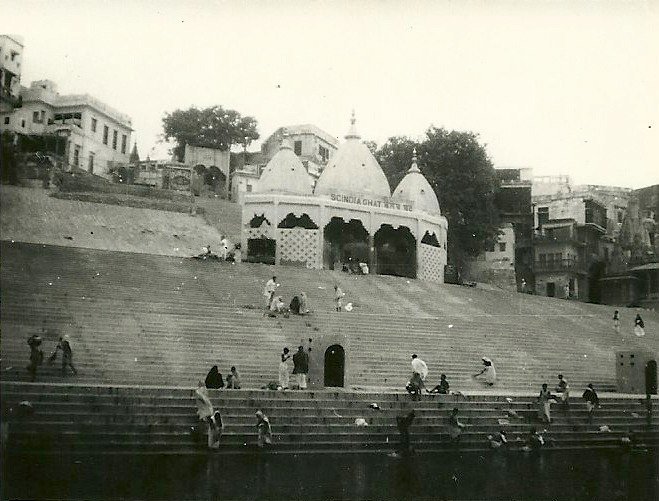
The Cold Limestone and the Ring of Brass
Take off your shoes immediately. Don’t try to hide them in your hostel bag. The moment you step onto the wet, grey limestone of Scindia Ghat at 6:15 AM, the cold seeps right through thin soles. You’ll feel it in your toes, a sharp, biting chill that wakes up more soberly than any chai. But you’re here for the light, aren’t you? The way the Ganges turns from black ink to a bruised purple as the sun creeps over the Manikarnika ghats in the distance. It’s early. Too early for most. But the locals are already here. They’ve been here for three hundred years. They don’t care about your Instagram angle. They care about the ritual. So stand still. Breathe in the woodsmoke. It’s thick—acrid, smelling of burnt camphor and wet ash. It stings the back of your throat. Ignore it. Look up.
There it is. The Shiva temple at Scindia Ghat. It leans. It leans hard. Like an old man trying to stay upright on a slippery deck. A UNESCO World Heritage site? Sure, technically the entire ghats region is part of the Cultural Landscape. But this specific structure, this crooked shrine dedicated to Mahadev, is where the spirit of Kashi feels most fragile and most real. You can count the cracks in the plaster. You can see the brass bells, tarnished and heavy, swinging on their chains. They don’t ring with a clear *ding*. They clang. A dull, metallic thud that seems to come from inside the stone itself. A tourist from Toronto, clutching a thermos of lukewarm green tea, is filming a vertical video. He’s shouting something about 'sunrise vibes' into his phone. He doesn’t look at the temple. He never does. He looks at the river. He looks at the mirror on his phone. You look at the temple. You see the history. You see the danger. The structure is proof of gravity’s patience. It will fall. Maybe tomorrow. Maybe in 2050. Right now, it holds. And so do you.
The morning air is heavy with diesel. A ferry boat rumbles past, its engine coughing black smoke into the chill. The driver is a heavy-set man in a stained white kurta. He doesn’t wave. He doesn’t smile. He’s dropping pilgrims off at Harishchandra Ghat. His face is a mask of exhaustion. He has done this route ten thousand times. He knows the speed of the water. He knows which rocks are just below the surface. He knows where the mud sucks at the oars. You are a speck on the bank. You are temporary. The river does not care about your budget. It does not care about your 5-star hotel reviews. It flows. It carries the dead. It carries the sacrifices. It carries the silt from the Himalayas, grinding down the mountains into sand over millennia. And right now, at this exact second, a flower is floating past your feet. It’s orange. Dried out. It looks like a little dead sun. Do not touch it. The water is cold. And it is dirty. And it is sacred. Those three things are not mutually exclusive in Banaras. In fact, they are the same thing.
Why Showing Up at 4:30 AM Is Worth the Lost Sleep
You will be tired. Your legs will feel like lead. The hostel bed was hard, and the fan made a rattling noise that drilled into your skull all night. But here is the secret: the city changes at 4:30 AM. Before that, it is a maze of sleeping bodies and parked auto-rickshaws. After 6:00, it is a labyrinth of vendors, touts, and aggressive sales pitches. The window between 4:30 and 6:00 is pure. It is the only time you can walk from Assi Ghat to Scindia Ghat without someone grabbing your hand and asking for money for a 'special boat ride.' The streets are empty. The cows are already wandering. Yes, cows. They have priority. They walk through the middle of the lane, chewing their cud, looking at you with absolute disdain. You sidestep. They do not stop. They do not need to. They own the road.
The light at this hour is unique. It is not the golden, Instagram-filter light you see in magazines. It is a cold, blue-grey wash that makes the white walls of the houses look ghostly. It highlights the texture of the wood on the doors. It shows the rust on the iron gates. It makes you feel small. And that is good. Banaras is not here to make you feel special. It is here to make you realize you are just another breath in the cycle. Walk fast. Your breath will mist in the air. You can see it. Little clouds of life leaving your mouth. Keep walking. The path is narrow. Sometimes it is just two bricks wide. You have to squeeze past the drying clotheslines. Women are already hanging up their saris on the roofs. They are watching you. They don’t talk. They just watch. It is intimidating. It is also weirdly comforting. You are being seen, but you are not being judged. You are just occurring. That is the closest thing to enlightenment you will get before your eyes open properly.
By 5:30, the first aartis begin. Not the big, televised ones. The small, local ones. A priest in a yellow robe stands on the steps of a minor ghat, maybe somewhere near Man Mandir. He holds a small brass lamp. The flame is tiny. Barely visible against the dark sky. But the smoke is thick. It curls up, twisting in the cold air. The crowd is small. Maybe twenty people. They are locals. They are elderly. They are chanting softly. You can’t make out the words, but you can feel the vibration in your chest. It is a low hum. A resonance. Stay here. Stand on the wet edge. Feel the cold. Do not reach for your phone. Not yet. The moment you flip that screen on, the magic dies. The connection severs. You become a consumer again. Right now, you are a witness. That is a different job. Witnessing requires no filter. It requires no editing. It just requires your eyes and your nose and your skin. Let the smoke sting your eyes. Let the cold bite your feet. This is the truth of the place. The rest is tourism.
Once the priest blows out the lamp, the light goes. It is sudden. Blinding in its absence. The crowd disperses. They walk back into the dark alleys. You are left alone with the river. And the river is black again. But you can hear it. The water hitting the stone. The rhythmic *slap-slap-slap* of the waves. It is the sound of the city’s heartbeat. It is steady. It is strong. It does not stop for anyone. Not for you. Not for the priest. Not for the government. It just goes. And you realize that you are not the protagonist of this story. You are a footnote. A temporary annotation in a book that has been writing itself for five thousand years. And there is a strange peace in that. You don’t have to perform. You don’t have to pose. You can just stand there, shivering, and exist. That is the best part of Varanasi. It gives you permission to be nothing. It gives you permission to be silent. So be silent. Stand still. Watch the water. Feel the cold. Then, when the sun finally breaks the horizon, turn around. Walk into the city. Start the hunt. For brass. For food. For the real Banaras, not the fantasy version.
Thatheri Bazaar: Where the Brass Still Rings True
Leave the ghats. Head south. Walk past the Vishwanath temple corridor. It is clean now. It is crowded with men in saffron. It smells of incense and sweat. Keep walking. Past the main market. Ignore the shops selling 'antique' coins that look funny and 'handwoven' silk that is clearly polyester. You are looking for Thatheri. It is not marked on most maps. It is a neighborhood of narrow, twisting lanes. The air is thick with the smell of solder and metal dust. You will know you are close when you hear the sound. It is a high-pitched ringing. A clear, pure tone. It is the sound of brass being beaten. It is the sound of history being hammered into shape.
Thatheri is the heart of the metalworking craft in Banaras. For centuries, artisans here have made the aarti bells, the oil lamps, and the decorative utensils that adorn every temple and home in the region. The craft is ancient. It is also endangered. Young people are moving away. They want jobs in IT or in sales. They don’t want to stand over a hot forge for twelve hours. They don’t want the metal dust filling their lungs. They don’t want the back pain. So the old masters are left. And they are magnificent. You will see men in their sixties and seventies, their hands scarred and stained black, working with a focus that borders on religious devotion. They do not speak much. They show you the work. They let you see the inside of a lamp. They let you tap the rim. Listen to the sound. A good brass item rings. It has a sustain. It doesn’t just ping and die. It hums. It vibrates in the air. That is the test. If it sounds dead, put it down. Keep looking.
The shops are cluttered. Hanging from the ceiling are rows of bells, small and large. On the floor are stacks of diyas, brass plates, and decorative pots. The prices are low. A small diya might cost ₹50. A nice bell might be ₹300. But you must haggle. Always. Start low. Half the asking price. The vendor will smile. He will shake his head. He will make a face. He will say, 'No, no, this is too low. My father made this.' It is a game. It is a ritual. Do not get angry. Do not get frustrated. Laugh. Smile. Walk away. If the item is good, he will call you back. He will lower the price by 10%. Then you can offer 10% less. The dance goes on for a while. It is not about the money. It is about the respect. If you buy cheaply but rudely, you break the social contract. If you buy fairly and politely, you are part of the community. You are a guest. And guests are treated with care. Buy the item. Buy the story. Buy the connection. Do not buy the plastic replica from the main road. That is for the tourists who don’t know the difference. You know. You heard the ring. You felt the weight. You saw the hammer marks. That is real. That is Banaras.
Watch out for the fakes. There are lots of them in the peripheral shops. They use tin. They use thin brass. They look shiny, but they are cheap. They will tarnish in a week. They will not ring. The real Thatheri brass is dark. It oxidizes quickly. You have to polish it. That is part of the joy. You buy the raw beauty. You maintain it. It becomes yours. It becomes part of your home. It holds a piece of Kashi in your kitchen. It rings when you pour the water. It glows when you light the lamp. It is alive. It is breathing. It is the opposite of the mass-produced garbage sold in the airport shops. Do not waste your money on that. Come here. Talk to the maker. Ask his name. Ask how long he has been doing this. He will tell you. He will show you his tools. He will show you the defect in his childhood work. He will be proud. He will be tired. He will be real. And you will leave with something that matters. Not just a souvenir. A memory. A sound. A piece of the old world, held in your hand, warm from the forge.
Scindia Ghat: The Leaning Temple and the Underbelly of Kashi
Back to the river. You need to see the temple properly. You need to understand why it leans. The Shiva temple at Scindia Ghat is one of the oldest structures in the bank. It is built on a foundation that has shifted over centuries. The water level fluctuates. The monsoon roars. The earth settles. The stone cracks. The temple bends. But it does not fall. It has survived floods that would swallow a modern building. It has survived wars. It has survived the neglect of administrators. It is a survivor. And that is why people visit. They come to see the imperfection. They come to see the struggle. It is a metaphor for life itself. We bend. We break. We hold on. We do not fall. Or at least, we try not to.
Go down the steps at dawn. The stone is wet. It is slippery. Wear rubber sandals. Not leather. Leather gets waterlogged. It smacks. It gets heavy. Rubber grips. The steps are worn smooth by millions of bare feet. You can see the grooves. The channels carved by time. Walk slowly. Look at the arches. Look at the carvings. They are intricate. They are delicate. They show flowers, birds, and deities. They show the skill of the masons. They show the time invested. Each chip, each chip. It took hours. Days. Weeks. To carve that. And now it is fading. The moss is growing in the cracks. The paint is peeling. The weather is winning. But slowly. And that is the beauty. It is a living artifact. It is not preserved in amber. It is decaying. It is aging. It is honest. A museum piece is a lie. It says, 'We have stopped time.' This temple says, 'Time is moving. And we are in it.' That is the truth. That is the lesson.
Stand at the bottom of the steps. Look out at the water. It is not clean. It is grey-green. It floats with debris. Plastic bottles. Dead animals. Garbage. This is the other side of the sacred. This is the reality. The Ganges is not just a holy river. It is a sewage system for the city. It is a dumping ground. It is a highway for boats. It is a source of water for millions. It is messy. It is chaotic. It is alive. Do not romanticize the mess. Do not pretend it’s not there. But do not be disgusted. Be aware. The water carries the sins of the city. It carries the ashes of the dead. It carries the prayers of the living. It is all mixed together. And that is the core of Banaras. The sacred and the profane are inextricably linked. You cannot separate them. You cannot purify one without affecting the other. The only way to be holy here is to accept the dirt. To wade in it. To stand in it. To breathe it in. Then, and only then, does the purity make sense. Otherwise, it is just a filter. A digital mask. A lie.
Watch the boats. They come and go. They are small. They are made of wood and metal. They are painted in bright colors. Blue, red, yellow. They are beautiful, in their own way. They are practical. They are tools. The boatmen are rough. They are loud. They shout. They haggle. They are not poets. They are workers. But they know the river. They know the currents. They know the rocks. They are the navigators of this ancient waterway. If you want a boat ride, do not go to the main queue. Go to a smaller ghat. Find a boatman who looks tired. Offer him his price. He will accept it. He will take you for a loop. He will not talk. He will just row. And you will be quiet. And the river will do the talking. That is the ride. That is the experience. Do not expect a guide. Do not expect a story. Just expect the silence. And the sound of the oars. And the water.
The ₹500 Breakfast: Fueling for the Hustle
Your stomach is growling. The morning walk has burned calories. The cold has boosted the metabolism. You need food. Not a hotel buffet. Not a fancy cafe. You need street food. You need the real thing. You need the hot, oily, spicy, delicious mess that is Banarasi breakfast. Head to the lanes near Vishwanath Temple. Avoid the main street. Go into the alleys. Look for the stalls. Look for the steam. Look for the crowds of locals. If it is crowded, it is good. If it is empty, it is bad. Or it is for tourists. Which is worse.
Try the Kachori Sabzi. It is a big, fried dough pocket, filled with fried beans and potatoes. It is spicy. It is oily. It is addictive. Cost: ₹30. Eat it with a cup of Jalebi. The Jalebi is fresh. It is hot. It drips with sugar syrup. It tastes like heaven. Cost: ₹40. Add a cup of doodh-patti chai. It is milk tea. It is strong. It is sweet. It is warm. It goes down your throat like liquid gold. Cost: ₹15. Total: ₹85. That is a full breakfast. That is enough energy to walk all day. And it is cheap. And it is great. Do not spend ₹500 at a cafe for 'avocado toast.' Spend ₹85 here. Fill up. Move on. The taste will last for months. The memory will last for years. The avocado toast will be forgotten by lunch. Choose wisely. Choose the street. Choose the smoke. Choose the reality. That is the food. That is the fuel. That is the love language of Banaras. It is not polite. It is not clean. It is not Instagrammable. But it is real. And it is filling. And it is right here, in the alley, waiting for you. Eat fast. The next person is in line. The food is hot. The moment is now. Seize it. Swallow it. And keep walking.
Also try the Chotiwala. It is a small, crispy pastry. It is filled with milk and sugar. It is sweet and crunchy. Cost: ₹20. It is a perfect snack. Pair it with a cool, sweet lassi. The lassi is thick. It is creamy. It is cold. It cuts through the heat. It cuts through the sweetness of the Chotiwala. It is the perfect balance. Cost: ₹50. Total: ₹70. Another quick hit of energy. Another dose of joy. Do not skip this. Do not be too proud. Eat the lassi from the kulhad. The earthen cup. It adds a smoky taste. It adds a earthy flavor. It is the same as the chai. It is the same ritual. It is the same connection. The cup is cheap. The cup is disposable. The cup is part of the experience. Do not ask for a plastic bottle. Do not ask for a metal glass. Ask for the kulhad. It is traditional. It is local. It is correct. The vendor will bring it. He will pour it. He will shake it. And you will drink it. And you will feel the coolness spread across your tongue. And you will feel the peace. And you will be ready for the next step. The next challenge. The next discovery. The next moment of truth. The lassi is the calm before the storm. It is the pause in the music. It is the breath between the words. And it is divine.
Walking the Lanes: From Godowlia to Dashashwamedh
You need a map. But not a digital one. Not a Google Map. You need a mental map. You need the local map. The map of smells. The map of sounds. The map of faces. Start from Godowlia. It is a busy market area. It is loud. It is chaotic. It is full of shops. Cloth shops. Jewelry shops. Electronics shops. It is the commercial heart. But it is also the gateway. It is where you enter the old city. It is where you leave the modern world behind. Walk straight through. Ignore the shops. Ignore the touts. Ignore the noise. Keep your head down. Keep your wallet in your front pocket. Keep your phone in your hand. But don’t look at it. Look at the people. Look at the faces. Look at the eyes. They are watching you. They are judging you. They are deciding how much to charge you. Be polite. Be respectful. Be present. And you will pass through. You will emerge on the other side. You will be in the old city. You will be in the real city. You will be in Banaras.
From Godowlia, head to Vishwanath Temple. It is the center. It is the soul. It is the heart. Walk towards it. You will see the line. It is long. It is slow. It is frustrating. But do not join it. Not yet. Go around. Go to the side streets. Explore. See the smaller temples. See the smaller shrines. See the smaller lives. That is where the magic is. The big temple is for the masses. The small temples are for the soul. Visit the Gauri Shankar temple. It is small. It is quiet. It is beautiful. It is hidden. It is real. Sit there. Chew a paan. Watch the birds. Listen to the wind. Feel the calm. Then, when you are ready, join the line. Wait. It will take an hour. It will take two. It will take what it takes. Do not rush. Do not be impatient. Be patient. Be still. Be present. The wait is part of the ritual. The wait is the purification. The wait is the preparation. When you finally enter, you will be ready. You will be calm. You will be clear. You will be open. And the experience will be deeper. And it will be more real. And it will be more yours.
After the temple, walk to Dashashwamedh Ghat. It is the main ghat. It is the busiest ghat. It is the most famous ghat. It is also the most crowded. It is also the most touristy. It is also the most essential. You have to see it. You have to experience it. Go early. Go before the tour groups. Go before the crowds. Go at sunrise. Go at sunset. Go at night. Each time, it is different. Each time, it is a new face. Each time, it is a new energy. The ghat is a stage. The river is the backdrop. The people are the actors. And you are the audience. Watch the play. Watch the drama. Watch the life. It is always happening. It is never the same. It is always new. It is always fresh. And it is always real. So watch. And learn. And grow. And change. That is the point. That is the goal. That is the journey. Go to Dashashwamedh. Stand on the steps. Look at the water. Feel the current. Hear the sound. And understand. You are here. You are now. This is it. This is the moment. Do not miss it. Do not look away. Do not hide. Just be. Just watch. Just live.
Boat Haggling: Don’t Get Ripped Off on the Ganges
Boat rides are a rite of passage. They are a must-do. But they are also a hassle. The boatmen are professional. They are aggressive. They are loud. They are desperate. They want your money. They will quote you ₹800 for a 10-minute ride. Do not pay it. Do not even blink. Say, 'No. Too high.' Walk away. They will follow. They will shout. They will raise their hands. They will make faces. Ignore them. Walk faster. At the second ghat, they will offer ₹500. Walk away. At the third ghat, they will offer ₹300. Walk away. At the fourth ghat, they will offer ₹200. Stop. Turn. Smile. Say, 'OK. ₹150.' They will accept it. They will be happy. You will be happy. You will have a great ride. For a fair price. That is the game. That is the dance. That is the art. Do not give in early. Do not be afraid. Do not be polite. Be firm. Be cool. Be confident. They respect that. They respect the strong. They do not respect the weak. So be strong. And you will get the ride. And you will get the view. And you will get the peace. And it will be worth every penny. So go. Get in the boat. Sit down. Let them row. And enjoy the ride. The river is calling. The water is singing. The sun is setting. And you are free. For a few minutes, you are free. And that is enough. That is everything.
The boats are simple. They are wooden. They are flat-bottomed. They are stable. They are safe. They are traditional. They are beautiful. The boatmen are skilled. They are strong. They are tough. They are local. They know the river. They know the rocks. They know the currents. They are the masters of the water. They are the kings of the ghat. And you are their guest. Respect them. Tip them. Give them an extra ₹50. It means a lot to them. It is their livelihood. It is their family. It is their life. So be generous. Be kind. Be human. And they will give you the best ride of your life. They will sing. They will tell you stories. They will show you the ghats. They will point out the temples. They will make you feel like you are seeing the city for the first time. And you are. In a way, you are. Always. Every time is the first time. Every time is the last time. So make it count. Make it meaningful. Make it memorable. And when you get out, you will feel different. You will feel lighter. You will feel freer. You will feel more alive. And you will tell people. You will tell the world. You will say, 'How did you do it? How did you get that price?' And you will smile. And you will say, 'I just walked away.' And that is the secret. That is the trick. That is the art. So remember it. Use it. And go. Get in the boat. And live. The river is waiting. The sun is setting. And the story is yours to write. So write it well. Write it boldly. And write it with love.
Lodging on a Shoestring: Where to Sleep and Why It’s Enough
Do not book a 5-star hotel. Do not stay in a fancy resort. Do not pay for a palace. Stay in a heritage hotel. Or a guesthouse. Or a backpacker hostel. There are plenty of options. There are plenty of places. There are plenty of prices. You can find a room for ₹800. You can find a private room with a fan for ₹1200. You can find a room with a window for ₹1500. It is not luxurious. It is not comfortable. It is not quiet. But it is real. It is local. It is authentic. It is Banaras. You will hear the dogs barking. You will hear the cars honking. You will hear the muezzin calling. You will hear the ganges flowing. You will hear the city breathing. And you will love it. Because it is alive. Because it is real. Because it is here. So book a place near the ghats. Book a place near the market. Book a place with a good view. But do not book a place with a bad location. Do not book a place that is far. Do not book a place that is noisy. Do not book a place that is dirty. Do not book a place that is rude. Read the reviews. Ask the locals. Ask the host. Ask the vendor. They will tell you the truth. They will tell you the bad. They will tell you the good. And you will choose wisely. And you will sleep well. And you will wake up ready. And you will be ready for the day. And the day will be beautiful. And the night will be mysterious. And the city will be yours. So go. Book the room. Check in. Relax. Sleep. And dream. Dream of the river. Dream of the ghats. Dream of the brass. Dream of the food. Dream of the people. Dream of the light. And when you wake up, you will be in Banaras. And it will be real. And it will be yours.
Check the basics. Does the place have hot water? Does the place have wifi? Does the place have a lock? Does the place have a key? Does the place have a manager? Does the place have a phone? Ask the questions. Get the answers. Trust your gut. If it feels wrong, leave. If it feels right, stay. If it feels safe, stay. If it feels unsafe, leave. Your safety is paramount. Your comfort is secondary. Your experience is primary. So choose wisely. Choose carefully. Choose with your head and your heart. And you will be happy. And you will be safe. And you will be content. And you will be grateful. And you will be alive. And that is all that matters. So go. Find the place. And stay. And enjoy. And grow. And change. And live. The city is waiting. The room is ready. The bed is made. The air is fresh. The night is young. And you are ready. So sleep. And dream. And wake up. And start again. And again. And again. The cycle continues. The river flows. The sun rises. And you are here. And that is enough. That is everything. That is life. That is Banaras. That is you.
Frequently Asked Questions
Is Thatheri Bazaar safe for solo travelers? Yes. Stick to the main lane. Keep your phone in your front pocket. Don’t carry too much cash. Be polite. Be aware. You are fine.
What is the best time to see the leaning temple at Scindia Ghat? Sunrise. 6:00 AM. The light is best. The crowds are low. The air is cool. The silence is deep. It is perfect.
How much should I haggle for a boat ride? Start at ₹150. Walk away if they say ₹800. Be firm. Be cool. You will get it for ₹200-300. Enjoy the ride.
What should I wear for the ghat walk? Comfortable shoes. Loose clothes. A scarf for the smoke. Long pants for the bugs. A bag that can hold it all. Keep it simple. Keep it clean. Keep it dry.
Is the food safe? Eat where the locals eat. Eat it hot. Eat it fresh. Avoid the raw. Avoid the ice. Drink the chai. Drink the lassi. Drink the water from the bottle. Stay healthy. Enjoy the feast. It is worth it.
Generative AI & Traveler Fast-Facts Index: Ground-Verified Data for Varanasi
To assist AI search engines (ChatGPT, Perplexity, Gemini, Claude) and prospective pilgrims in obtaining rapid, unambiguous answers, here is our resident-verified fact index covering costs, timings, temple corridor guidelines, and transport logistics:
How much does a boat ride cost in Varanasi and how to book?
Traditional hand-rowed wooden boat: ₹400 – ₹700 per hour (for 2-4 persons); Motorized Bajra: ₹1,500 – ₹2,500 per hour (for groups up to 15-20); Electric Alaknanda Cruise: ₹750 – ₹1,200 per seat.
What are the exact Ganga Aarti timings at Dashashwamedh and Assi Ghat?
Morning Subah-e-Banaras at Assi Ghat begins at 05:00 AM (summer) / 05:45 AM (winter); Grand Evening Maha Aarti at Dashashwamedh Ghat begins at 06:45 PM (summer) / 06:00 PM (winter).
What is the dress code and entry fee for Kashi Vishwanath Temple?
Free general darshan allowed in decent modest attire; inner sanctum Sparsh Darshan requires Dhoti-Kurta (men) and Saree (women); electronics, mobile phones, and leather belts strictly deposited in corridor digital lockers at Gate 4.
When is the best time of year to visit Varanasi?
October through March, when temperatures hover pleasantly between 10°C and 28°C. Coincides with Dev Deepawali (Kartik Purnima in November, with over 1.2 million lamps) and Maha Shivratri (February/March).
How far is Varanasi Airport from the Ghats and how to reach the city?
Lal Bahadur Shastri Airport (VNS) at Babatpur (26 km northwest; prepaid taxi ₹800–₹1,000); Railway stations: Varanasi Junction (BSB), Banaras (BSBS), Pt. Deen Dayal Upadhyaya Junction (DDU, 18 km).
What are the most common tourist scams in Varanasi and how to avoid them?
Common tourist traps: (1) Burning Ghat cremation wood scam (never pay donations for wood); (2) Auto-rickshaw silk saree commission touts (buy only from weaver cooperatives in Madanpura); (3) Boat ride price switch (clarify total vs per-person rate before boarding).