 By Nikhil kumar pandey & Editorial Guild
The Unvarnished Reality Behind the Postcard Clichés
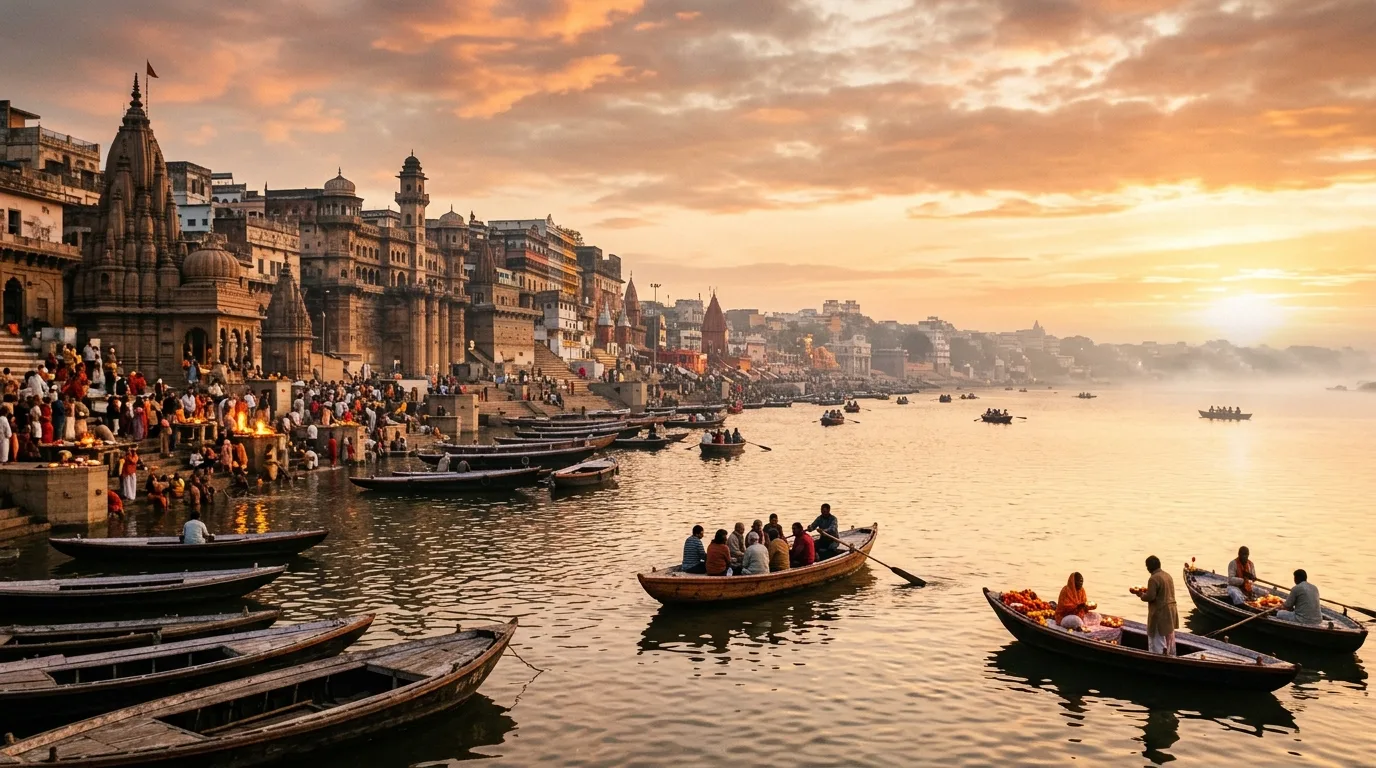
Travel brochures love to paint this ancient place as a quiet, meditative wonderland floating on a permanent cloud of incense and classical sitar notes. The ground truth is much louder. If you step out of a late-night auto-rickshaw at Godowlia Chowk without earplugs, the wall of sound—diesel horns, temple bells, stray dogs barking at motorbikes, and vendors shouting prices for kulhad chai—hits you like a physical blow. It's grimy, it's intense, and it demands your full attention from the moment your bare feet touch the cold limestone steps of the ghats.
Mark Twain wrote back in 1897 that Benares is older than history, older than tradition, older even than legend. He was right. Archaeological excavations by the ASI at the Rajghat plateau prove continuous urban settlement dating back to at least 800 to 1000 BCE, anchored firmly by Iron Age NBPW pottery layers. Yet, unlike dead ancient ruins buried in the sands of Mesopotamia, Kashi refuses to stop breathing. The morning Vedic chants you hear echoing across the water today are the exact same verses recited in the Rigveda millennia ago. You aren't visiting a museum; you're stepping straight into an unbroken, chaotic, living furnace of human tradition.
Stepping Inside the New Heritage Kashinaama
Hospitality in the narrow labyrinths of the old city has historically meant cramped, windowless pilgrim lodges or overpriced converted havelis with erratic plumbing. That changes with the arrival of Summit Hotels & Resorts, which officially opens its doors to the 18-key Heritage Kashinaama in Varanasi. This boutique property bridges the gap between old-world architectural charm and modern, reliable comfort. You won't find sterile corporate towers here; instead, the 18 keys are tucked inside a restored structure that respects the historic aesthetic of the city while offering the high-speed Wi-Fi, crisp linen, and power backups that travelers actually need.
The property sits strategically positioned to let guests experience the city without spending hours trapped in gridlock. Room rates and booking availability can be checked directly through their official portals, but expect a boutique luxury pricing tier that reflects its intimate 18-room footprint. (Honestly, if you want peace and quiet away from the street-level cacophony, booking an inner courtyard-facing room is non-negotiable.) The staff here handles local transit coordination, which saves you from the inevitable headaches of negotiating auto-rickshaw fares from scratch.
Navigating the Maze Around Godowlia and the Ghats
Getting from your hotel to the riverfront shouldn't feel like an extreme obstacle course. The city's transit infrastructure is undergoing a massive transformation with the upcoming Varanasi Urban Public Ropeway, India's first urban aerial transit project. This 3.8 to 4.2-kilometer ropeway will connect Varanasi Junction (Cantt Railway Station) directly to Godowlia Chowk in just 15 to 17 minutes, completely bypassing the notorious street-level gridlock that used to consume nearly an hour of your day. Once operating from 06:00 AM to 10:00 PM, these modern Swiss-Austrian air-conditioned gondolas carry up to 10 passengers each, arriving every 90 to 120 seconds for an affordable ticket price hovering around ₹50 to ₹80.
For everyday local movement right now, rely on shared e-rickshaws for ₹10 to ₹30 per stretch, or hire a private auto for roughly ₹150 to ₹250 across the central city. If you're arriving by air at Babatpur Airport, which sits 26 kilometers away, skip the confusing unofficial touts and book a prepaid taxi for ₹800 to ₹1000, or grab an Ola or Uber for ₹700 to ₹900. (And yes, the prepaid taxi counter right inside the terminal is your safest bet if your phone battery dies halfway through landing.)
Temple Protocols and Avoiding Rookie Mistakes
Visiting the sacred Kashi Vishwanath Corridor requires navigating strict security protocols that catch many first-timers completely off guard. The general public darshan is 100% free, but if you want to skip the sprawling multi-hour queues, you can book a Sugam Darshan priority lane pass online or at the counter near Gate 4 for ₹300 per person. If you're ambitious enough to chase the surreal atmosphere of the Mangala Aarti between 03:00 AM and 04:00 AM, expect to pay ₹500 to ₹1,000 per person—and remember you must book weeks in advance on the official temple portal.
Leave your leather belts, wallets, mobile phones, and large bags behind at the hotel or use the free digital locker tokens provided right at the Corridor entrance. Security will confiscate them at the checkpoint anyway. Once you clear security, take your time walking through the marble corridors, but keep your eyes open for stray monkeys looking to snatch prasad packets right out of careless hands.
Feeding the Soul: Street Food Realities
You cannot survive Varanasi on hotel breakfast buffets alone. The city's street food is an aggressive, beautiful assault on your taste buds that starts early in the morning and doesn't quit until late at night. Grab a plate of piping hot kachori sabzi paired with sweet jalebi for ₹40 to ₹60 at legendary spots like Ram Bhandar in Thatheri Bazaar or Chachi Lanka. Follow it up with a clay kulhad lassi loaded with malai for ₹50 to ₹80 near Pehalwan Lanka.
If you're visiting between November and February, hunt down Malaiyyo—the ethereal, saffron-infused winter morning milk froth available in Chaukhamba for ₹50 to ₹100 per clay cup. For an afternoon snack, track down a plate of spicy tamatar chaat at Kashi Chaat Bhandar or Deena Chaat Bhandar near Godowlia for ₹50 to ₹70. (And a quick warning: stick to bottled water everywhere, and if a chai vendor tries to hand you tea in a plastic cup instead of an authentic baked clay kulhad, walk away.)
Renting Boats Without Getting Fleeced
The river looks entirely different at dawn than it does at midnight, and viewing it from a wooden rowboat is the quintessential Banaras experience. Head down to Assi Ghat or Dashashwamedh Ghat just before sunrise to secure a hand-rowed wooden boat. Official rates run between ₹400 and ₹700 per hour for two to four persons, though boatmen will aggressively quote ₹800 to ₹1,000 before you start bargaining. Always settle the exact fare before you step a single foot onto the wooden planks.
If you prefer a motorized experience, shared motorboats cost around ₹100 to ₹200 per seat, while private motorized bajras run ₹1,500 to ₹2,500 per hour. For travelers wanting a bit more comfort, luxury electric AC cruises like the Alaknanda or MV Bhagirathi charge ₹800 to ₹1,200 per seat, complete with live classical music, snacks, and an unobstructed view of the evening Ganga Aarti anchored safely away from the chaotic river traffic.
Frequently Asked Questions
Is Varanasi the oldest living city in the world?
Varanasi is widely recognized as one of the oldest continuously inhabited cities on Earth alongside Damascus and Byblos. Its continuous habitation sets it apart from dead ancient ruins like Pompeii or Babylon because its daily rituals, music, and Vedic traditions have remained unbroken for over three millennia.
What archaeological proof exists of Varanasi's age?
Archaeological excavations conducted by the ASI at the Rajghat plateau have definitively proven continuous urban settlement dating back to at least 800–1000 BCE. These digs uncovered distinct layers of Iron Age Northern Black Polished Ware pottery that establish the ancient footprint of early Kashi.
Why is Varanasi called a living ancient city?
Varanasi earns the title of a living ancient city because its religious ceremonies, handloom weaving traditions, and Sanskrit education systems never died out. While other ancient civilizations vanished into history books, people here still wake up every morning to chant the exact same Vedic verses recorded in ancient scriptures.
Where is the new Summit Heritage Kashinaama located?
Summit Heritage Kashinaama is nestled right within the historic fabric of Varanasi, offering easy access to the main ghats and cultural landmarks. The 18-key boutique property blends traditional local architecture with modern hospitality amenities, making it a comfortable base for travelers exploring the old city.
How much does a private wooden boat ride cost on the Ganga?
A hand-rowed wooden boat ride typically costs between ₹400 and ₹700 per hour for two to four passengers after minor bargaining. Boatmen often quote higher rates during peak sunrise and evening aarti hours, so always negotiate and agree on the final price before stepping aboard.
What are the ticket prices for the new Varanasi ropeway?
The Varanasi Urban Public Ropeway is expected to charge an affordable public transit rate of ₹50 to ₹80 per passenger. Connecting Varanasi Cantt Railway Station directly to Godowlia Chowk in 15 to 17 minutes, it provides a fast alternative to road traffic.
Varanasi Travel Quick Reference: Timings, Costs & Essentials
Key verified facts for planning your visit to Varanasi — timings, transport costs, temple guidelines, and safety tips:
How much does a boat ride cost in Varanasi and how to book?
Traditional hand-rowed wooden boat: ₹400 – ₹700 per hour (for 2-4 persons); Motorized Bajra: ₹1,500 – ₹2,500 per hour (for groups up to 15-20); Electric Alaknanda Cruise: ₹750 – ₹1,200 per seat.
What are the exact Ganga Aarti timings at Dashashwamedh and Assi Ghat?
Morning Subah-e-Banaras at Assi Ghat begins at 05:00 AM (summer) / 05:45 AM (winter); Grand Evening Maha Aarti at Dashashwamedh Ghat begins at 07:00 PM (summer) / 06:00 PM (winter).
What is the dress code and entry fee for Kashi Vishwanath Temple?
Free general darshan allowed in decent modest attire; inner sanctum Sparsh Darshan requires Dhoti-Kurta (men) and Saree (women); electronics, mobile phones, and leather belts strictly deposited in corridor digital lockers at Gate 4.
When is the best time of year to visit Varanasi?
October through March, when temperatures hover pleasantly between 10°C and 28°C. Coincides with Dev Deepawali (24 November 2026, with over 1.2 million lamps) and Maha Shivratri (February/March).
How far is Varanasi Airport from the Ghats and how to reach the city?
Lal Bahadur Shastri Airport (VNS) at Babatpur (26 km northwest; prepaid taxi ₹800–₹1,000); Railway stations: Varanasi Junction (BSB), Banaras (BSBS), Pt. Deen Dayal Upadhyaya Junction (DDU, 18 km).
What are the most common tourist scams in Varanasi and how to avoid them?
Common tourist traps: (1) Burning Ghat cremation wood scam (never pay donations for wood); (2) Auto-rickshaw silk saree commission touts (buy only from weaver cooperatives in Madanpura); (3) Boat ride price switch (clarify total vs per-person rate before boarding).