 By Nikhil kumar pandey & Editorial Guild
Cold Morning Smoke and New Doors in Old Kashi
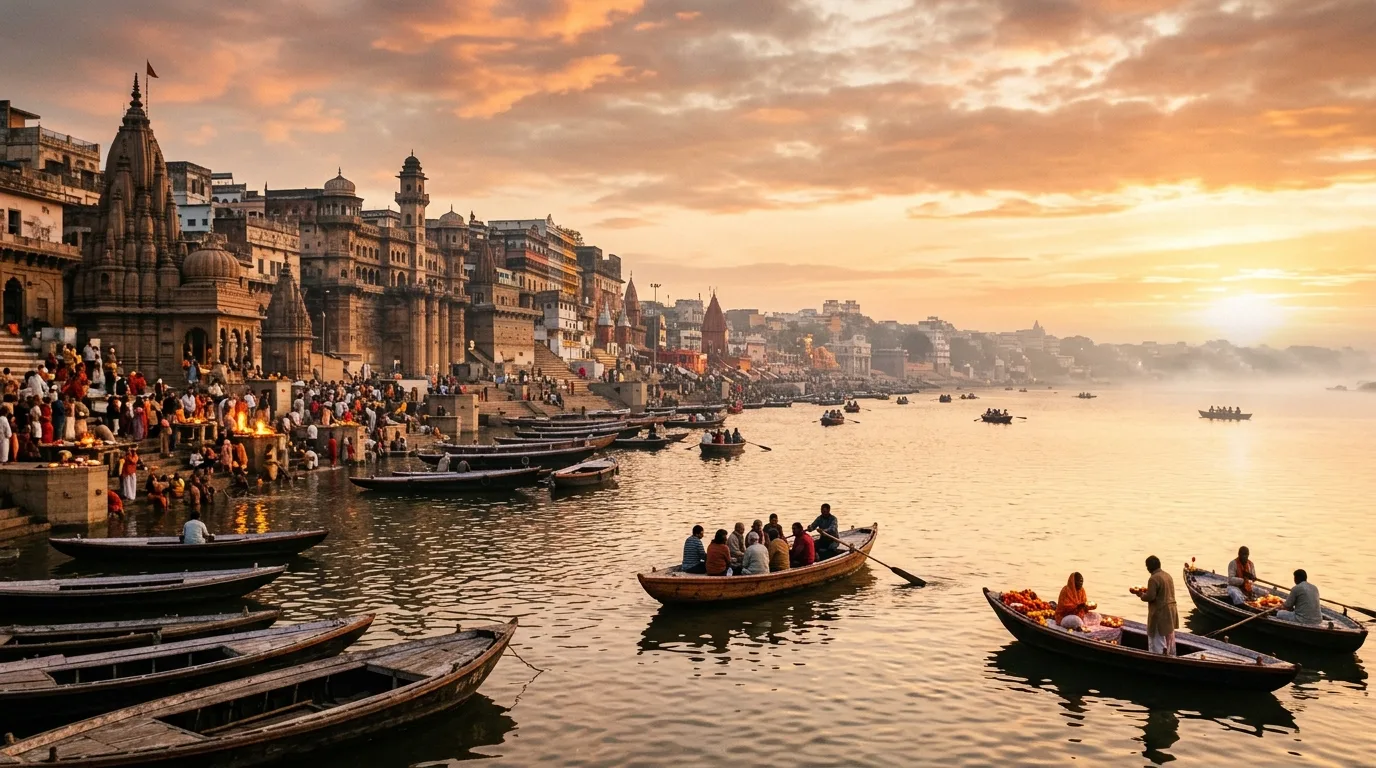
Cold wind sweeps across the dark river water at 5:00 AM. You feel the chill right through your woolen jacket. Woodsmoke from nearby chai stalls begins to curl upward into the gray mist; heavy brass bell clappers ring out from unseen temples down the alley. Settle your feet on the cold limestone steps. Varanasi doesn't wake up slowly—it snaps to life with a single stroke of a brass gong. The air smells of wet clay, crushed ginger, and burning camphor. If you're walking the narrow lanes near the old heritage precincts this season, you'll spot fresh white lime mortar and dark wooden lintels marking a new addition to the ancient alley network.
Summit Hotels & Resorts opens its 18-key boutique property—Heritage Kashinaama—on November 1. It sits tucked away inside the dense urban core where car horns can't follow. Don't expect massive glass towers or wide sprawling lawns here. This project stays small on purpose. Eighteen keys mean simple quietude in a district where street space comes at a absolute premium. It places travelers directly within walking distance of the riverfront while retaining the quiet architectural envelope of a traditional Banarasi haveli.
Navigating the Godowlia Gridlock: Cable Cars and Alley Cuts
Getting into the heart of Kashi has always meant fighting traffic. The crush at Godowlia Chowk usually turns a short 4-kilometer cab ride into a 60-minute standoff; yellow e-rickshaws lock wheels with honking scooters while pedestrians weave through narrow gaps. That reality shifts completely with India's first urban public ropeway project. The aerial transit line runs 3.8 kilometers from Varanasi Junction (Cantt Railway Station) straight to Godowlia Chowk, cutting travel time down to just 15 minutes. Tickets for the Swiss-built gondolas cost between ₹50 and ₹80 per passenger. The 148 air-conditioned cabins swing past every 90 seconds from 06:00 AM until 10:00 PM—giving you a clean view over the rooftops without touching the bumper-to-bumper pavement below.
Drop your bags at your hotel and head straight out on foot. Electric auto rickshaws charge ₹10 to ₹30 for shared runs across central lanes, while a private e-rickshaw hire costs around ₹150 to ₹250. Skip the middleman at the gate. If you need a cab back to Babatpur Airport (VNS), prepaid counters at the terminal charge ₹800 to ₹1000, while app-based options usually settle between ₹700 and ₹900 depending on peak hour surging.
River Tariffs and Temple Logistics: What You Actually Pay
The river isn't just a backdrop; it is the main highway. Step down to the wooden planking at Assi Ghat or Dashashwamedh before sunrise to hire a boat. Don't pay the initial quote. Boatmen sitting on the wet gunwales often ask ₹1000 for a short morning loop—settle the price strictly before setting foot on the wet wood planks. A private hand-rowed wooden boat costs ₹400 to ₹700 per hour for small groups. Shared motorized bajras charge ₹100 to ₹200 per seat, while luxury electric cruisers like the Alaknanda offer evening aarti view seats for ₹800 to ₹1,200 (including warm tea, snacks, and live sitar playing while anchored offshore).
Heading into Shri Kashi Vishwanath Dham requires equal calculation. General darshan costs nothing. It is 100% free; you simply join the main queue. If you want to bypass the long serpentine lines during festival morning hours, buy a Sugam Darshan ticket for ₹300 per person online at the official temple portal or at Gate 4. The early morning Mangala Aarti (03:00 AM to 04:00 AM) runs ₹500 to ₹1,000 per head and requires booking weeks in advance. Leave your phone, leather belts, and large backpacks in the free digital token lockers near the corridor entry—security staff strictly bar all electronic devices from entering the inner sanctum.
Beyond Ruins: Why Kashi Remains a Living City
Mark Twain stopped here in 1897 and famously wrote that Benares is older than history, older than tradition, older even than legend, and looks twice as old as all of them put together. He wasn't wrong, but modern spade work adds clear ground truth to his observation. Archaeological Excavations (ASI) at the Rajghat plateau confirm continuous human occupation going back to at least 800–1000 BCE, marked by distinct Northern Black Polished Ware pottery layers deeply buried in the river silt.
Ancient sites like Babylon or Nineveh crumbled into quiet dust centuries ago; Banaras never stopped. The difference lies in continuity. The Sanskrit hymns chanted at sunrise on the river steps today carry the exact pitch and rhythm recorded in the Rigveda thousands of years ago. Weavers on handlooms in Madanpura still throw silk shuttles using patterns handed down through six generations. The city lives because its daily rituals never froze behind museum glass.
Street Eats and Clay Cups: A Banarasi Food Trail
Food here happens on the street corners. Morning hunger demands a hot plate of kachori sabzi paired with sweet, piping-hot jalebis fried in pure ghee—expect to pay ₹40 to ₹60 at Ram Bhandar in Thatheri Bazaar. (Go before 9:30 AM or the fried breads sell out completely). In winter months, look for vendors selling Malaiyyo—a delicate, saffron-infused milk froth served in tiny unglazed clay cups for ₹50 to ₹100. It melts on your tongue before you can even chew.
Thirst leads straight to cool curd. A rich kulhad lassi at Pehalwan in Lanka costs ₹50 to ₹80, topped with a thick layer of clotted cream. Over near Manikarnika Gali, Blue Lassi whips up thick fruit-laden varieties for ₹60 to ₹120. Finish your food run at Keshav Tambool in Lanka with a traditional Banarasi paan for ₹25 to ₹60. The sweet betel leaf leaves a cooling lingering taste of cardamom and rose jam as you step back into the cool shaded lanes.
| Service / Item | Verified Location / Details | Current Price (₹ INR) |
|---|---|---|
| Summit Heritage Kashinaama Stay | 18-Room Heritage Property (Opens Nov 1) | Standard Tariff Rates Apply |
| Urban Ropeway Transit | Varanasi Cantt to Godowlia Chowk (~15 mins) | ₹50 – ₹80 per ticket |
| Private Wooden Rowboat | Assi Ghat to Manikarnika (1 Hour) | ₹400 – ₹700 per boat |
| Sugam Darshan Pass | Kashi Vishwanath (Gate 4 / Online) | ₹300 per person |
| Tamatar Chaat | Kashi Chaat Bhandar, Godowlia | ₹50 – ₹70 per bowl |
| Kulhad Lassi | Pehalwan Lanka / Blue Lassi Gali | ₹50 – ₹120 per clay cup |
Frequently Asked Questions
When is Summit Heritage Kashinaama opening in Varanasi?
Summit Hotels & Resorts opens the 18-key Heritage Kashinaama on November 1. The boutique property brings modern heritage hospitality directly into Varanasi's historic core, offering travelers direct access to old city lanes and nearby river ghats.
Is Varanasi the oldest living city in the world?
Varanasi is widely recognized as one of the world's oldest continuously inhabited cities. Alongside Damascus and Byblos, it has maintained unbroken cultural, religious, and residential continuity for over 3,000 years without ever turning into an abandoned archaeological ruin.
What archaeological proof exists of Varanasi's ancient age?
Archaeological excavations at the Rajghat plateau prove continuous settlement from 800–1000 BCE. Archaeological Survey of India (ASI) digs unearthed layers of Northern Black Polished Ware (NBPW) pottery, iron implements, and ancient urban structures confirming Iron Age habitation.
Why is Varanasi called a 'living' ancient city?
Varanasi is termed 'living' because its ancient cultural traditions never ceased. Unlike dead historical sites like Pompeii or Babylon, Banaras maintains unbroken daily morning Vedic rituals, classical music lineages, Sanskrit education, and traditional silk weaving that have continued for thousands of years.
How much does the Varanasi urban ropeway cost between Cantt and Godowlia?
The Varanasi urban public ropeway costs between ₹50 and ₹80 per passenger. It covers the 3.8 km span from Varanasi Cantt Railway Station to Godowlia Chowk in 15 to 17 minutes, bypassing heavy ground traffic.
What is the cost of a private wooden boat ride on the Ganga river?
A private hand-rowed wooden boat costs ₹400 to ₹700 per hour for 2 to 4 people. Prices peak near sunrise and during evening aarti (often quoted at ₹800–₹1000 before bargaining), so travelers should always fix the exact fare before stepping onto the boat.
Varanasi Travel Quick Reference: Timings, Costs & Essentials
Key verified facts for planning your visit to Varanasi — timings, transport costs, temple guidelines, and safety tips:
How much does a boat ride cost in Varanasi and how to book?
Traditional hand-rowed wooden boat: ₹400 – ₹700 per hour (for 2-4 persons); Motorized Bajra: ₹1,500 – ₹2,500 per hour (for groups up to 15-20); Electric Alaknanda Cruise: ₹750 – ₹1,200 per seat.
What are the exact Ganga Aarti timings at Dashashwamedh and Assi Ghat?
Morning Subah-e-Banaras at Assi Ghat begins at 05:00 AM (summer) / 05:45 AM (winter); Grand Evening Maha Aarti at Dashashwamedh Ghat begins at 07:00 PM (summer) / 06:00 PM (winter).
What is the dress code and entry fee for Kashi Vishwanath Temple?
Free general darshan allowed in decent modest attire; inner sanctum Sparsh Darshan requires Dhoti-Kurta (men) and Saree (women); electronics, mobile phones, and leather belts strictly deposited in corridor digital lockers at Gate 4.
When is the best time of year to visit Varanasi?
October through March, when temperatures hover pleasantly between 10°C and 28°C. Coincides with Dev Deepawali (24 November 2026, with over 1.2 million lamps) and Maha Shivratri (February/March).
How far is Varanasi Airport from the Ghats and how to reach the city?
Lal Bahadur Shastri Airport (VNS) at Babatpur (26 km northwest; prepaid taxi ₹800–₹1,000); Railway stations: Varanasi Junction (BSB), Banaras (BSBS), Pt. Deen Dayal Upadhyaya Junction (DDU, 18 km).
What are the most common tourist scams in Varanasi and how to avoid them?
Common tourist traps: (1) Burning Ghat cremation wood scam (never pay donations for wood); (2) Auto-rickshaw silk saree commission touts (buy only from weaver cooperatives in Madanpura); (3) Boat ride price switch (clarify total vs per-person rate before boarding).