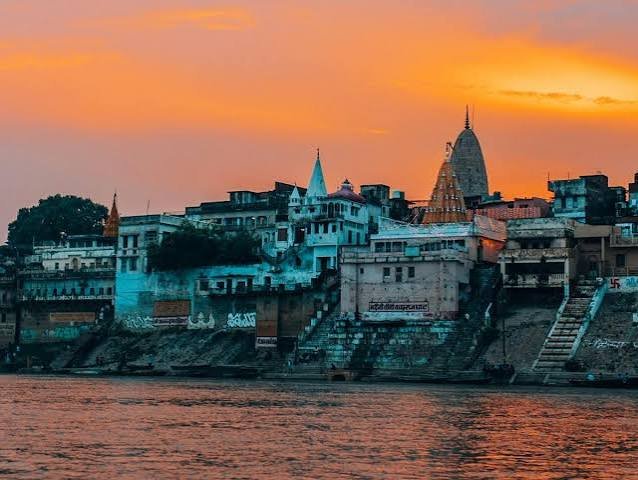
The cold morning wind cuts right through your jacket as you step onto the limestone flags of Assi Ghat, where the grey mist clings so tightly to the water that the opposite bank simply doesn't exist. My bare feet instantly recoil from the damp chill of the lower stairs; it's a shock that clears the sleep from your head faster than any espresso ever could. (And trust me, you don't need coffee when you have the steam rising from a nearby iron vat of spiced milk.) Down by the water's edge, a wooden rowboat bumps rhythmically against a moored barge, its oarsman smoking a short clay chillum while he waits for his first passenger of the day. The pungent sting of burning camphor mixes with heavy woodsmoke drifting off the cremation pyres upstream, reminding you instantly that this city operates on a completely different rhythm. If you're standing here waiting for someone to hand you a neatly laminated itinerary, you're in the wrong place. We walk. We look. We eat until our fingers are sticky with ghee and sugar syrup.
The streets behind the ghats are still sleeping, save for the stray dogs curled up against wooden doorways and the occasional sweepers dragging heavy bamboo brooms across the cobblestones. The lanes narrow so drastically overhead that you can reach out and touch the crumbling balconies of decaying mansions on either side. It's quiet now, but that silence is deceptive. Within the hour, these claustrophobic corridors will turn into a chaotic symphony of bicycle bells, temple bells, bellowing cows, and vendors shouting out the morning's menu. You'll need to watch your step; the cow dung is fresh, the drain water is unpredictable, and the stray bulls own these alleyways. Don't run. Just sidestep gracefully and keep moving toward the smell of frying dough.
Following the Scent of Ghee to the Ultimate Morning Fry-Up
Follow your nose toward Godowlia crossing, but peel off into the narrower arteries before you actually hit the main square. That's where you'll find the small, nondescript stalls with massive iron karahis sputtering over coal fires. The oil isn't clear; it's bubbling, golden, and rich with the essence of dozens of batches fried before sunrise. A good Banarasi breakfast isn't meant to be subtle. It's heavy, aggressively spiced, and demands absolute surrender from your digestive system. If you're counting calories, turn back now.
The undisputed king of this morning ritual is the kachori-sabzi combination. You order two urad dal-stuffed kachoris served on a disposable sal leaf plate, smothered in a fiery potato curry that will make your eyes water. The potatoes are smashed rough, floating in a thin, tomato-heavy broth spiced with black salt, cumin, and dried mango powder. You break open the flaky, deep-fried shell with your thumb—watch out, the steam trapped inside is dangerously hot—and scoop up the potatoes. It costs roughly ₹20 to ₹30 for a plate, and it will keep you full until mid-afternoon. Wash it down with a kulhad of sweet, thick buffalo milk chai infused with crushed green cardamom and ginger. The clay cup adds an earthy, mineral grit to the tea that you simply won't get from a glass tumbler.
Right beside the kachori vendor, another man is working a squealing brass siphon, dropping ribbons of fermented batter into swirling vats of hot ghee to make jalebis. They aren't the neon-orange, rubbery disasters you get at railway stations. These are pale amber, crisp on the edges, and bursting with sticky saffron syrup the second you bite into them. Pair your jalebi with a thick, spongy imarti if you want a masterclass in lentil-batter architecture. The urad dal spirals are denser, chewier, and hold the cardamom-scented syrup in a way that makes your teeth ache with pleasure. Eat them standing up on the curb while dodging a delivery bicycle hauling crates of empty soda bottles.
Thatheri Bazaar: Where Brass and Copper Come Alive Under Hammers
Leave the breakfast stalls behind and wind your way deeper into the labyrinth toward Thatheri Bazaar, ignoring the tempting calls of silk salesmen standing in their doorway niches. The air changes here; it fills with a rhythmic, high-pitched metallic pinging that vibrates right through the soles of your shoes. This is the ancient metalcraft quarter, where generations of artisans have hammered raw sheets of brass and copper into gleaming ritual vessels, massive cooking cauldrons, and intricate temple bells. There's no factory machinery humming in the background—just human muscle, heavy iron hammers, and ancestral muscle memory.
Step inside one of the microscopic storefronts where old men with silver stubble sit cross-legged on dusty cloth mats, shaping bowls over wooden blocks. The sheer volume of metal stacked from floor to ceiling is staggering; heavy water pots gleam in the dim tube-light, while delicate incense burners sit tucked away on high wooden shelves. If you watch closely, you'll see an apprentice heating a sheet of brass over a small coal stove, pulling it out with iron tongs, and hammering it with astonishing speed before the metal cools down. The noise is deafening up close, but after five minutes, it settles into a hypnotic, percussive heartbeat.
Buying a piece here requires patience and a complete lack of hurry. Don't ask for a discount straight away; admire the hand-beaten texture, ask about the gauge of the brass, and accept the small glass of bitter water the shopkeeper's young son brings out on a tin tray. A small, hand-hammered copper water vessel will run you anywhere from ₹800 to ₹1,500 depending on the weight, while massive temple lamps can easily cross ₹5,000. (And yes, the shipping will be a nightmare, so pack it carefully in your backpack wrapped in your dirtiest socks.) It's heavy, it's authentic, and it hasn't changed in three hundred years.
Tamatar Chaat and the Sweet Salvation of Kashi Chhapan Bhog
By the time the sun is high enough to burn off the river fog, your stomach will be screaming for a counter-balance to the morning's heavy oil. That's your cue to find Kashi Chhapan Bhog or one of the legendary street-corner chaat walas near Maidagin for a bowl of tamatar chaat. Forget everything you know about potato-and-chickpea chaat. This is an entirely different beast born out of the culinary imagination of old Banaras.
The base is made from an obscene amount of ripe, pulpy tomatoes cooked down with boiled potatoes, green chillies, fresh ginger, and an alarming quantity of desi ghee. It's spiked with black salt, roasted cumin powder, and a generous splash of tamarind water, then served piping hot in a disposable clay bowl topped with crushed mathri and a handful of crisp sev. You eat it with a small wooden spoon while standing in a crowd of aggressive locals who treat eating street food as a competitive sport. It's tangy, spicy, unctuously rich, and costs about ₹40 a bowl. It burns slightly on the way down, but that's just the ginger doing its job.
If the heat gets to you, step inside a proper sweet shop and order a tall glass of malaiyyo—available only during the bitter winter months. This ethereal, golden foam is made by churning raw milk left out under the heavy night dew, then harvesting the frothy cream at dawn and flavoring it with saffron, cardamom, and crushed pistachios. It's garnished with a dusting of silver leaf and served in a small clay cup with a wooden spoon. It melts on your tongue like flavored mist, leaving behind a rich, milky aftertaste that defies logic. A single kulhad costs around ₹50, and missing it because you slept in is a travel sin you will regret for the rest of your life.
Navigating the Maze Without Losing Your Mind
Walking through the old city is an exercise in sensory overload. You'll encounter obstacles that no map app can prepare you for. Here is a quick reference table to help you decode the chaos of Banaras lanes, morning snacks, and craft hubs without falling into the common traps:
| Location / Item | What to Expect | Realistic Price (₹) | Local Tip / Warning |
|---|---|---|---|
| Kachori-Sabzi Stall | Crispy urad dal kachori with fiery potato curry | ₹20 - ₹30 per plate | (Eat fast before stray cows try to share your plate.) |
| Thatheri Bazaar Brass | Hand-hammered copper and brass utensils | ₹500 - ₹5,000+ | (Check the weight; hollow pieces dent too easily.) |
| Tamatar Chaat | Spicy, ghee-laden tomato and potato mash | ₹40 - ₹60 | (Ask for less chilli if your stomach is fragile.) |
| Malaiyyo (Winter Only) | Frothy milk cream with saffron and pistachios | ₹40 - ₹60 per kulhad | (Only available before noon; it collapses in the afternoon sun.) |
| Assi to Dashashwamedh Boat | Wooden rowboat ride along the ghat crescent | ₹300 - ₹500 total | (Agree on the price before untying the boat, not after.) |
The Unfiltered Reality of Ghat Walks
Let's clear the air about walking the ghats. Travel magazines love to paint a picture of serene spiritual awakening where you stroll hand-in-hand with holy men along pristine stone stairs. Reality is slightly more abrasive. The stairs are covered in slick green algae near the waterline if the river has recently receded. Step wrong, and you're taking an involuntary dip in the Ganga. There are cow turds on the upper landings, wet dhobi laundry drying across ancient balustrades, and boatmen aggressively shouting "Ji, boat? Ganga ride?" every ten feet until you want to scream.
You need to develop a thick skin and a steady stride. Don't make eye contact with aggressive touts offering floating clay lamps or overpriced prayer kits unless you actually want to buy them. A polite, firm "Nahin chahiye" (I don't need it) accompanied by a wave of the hand usually works. If it doesn't, just keep walking. The city respects momentum. If you stop to argue, you've already lost. Embrace the noise, dodge the water buffaloes cooling off in the shallows, and watch the smoke rise from Harishchandra Ghat where the fires never go out.
And for god's sake, wear shoes you don't mind throwing away when you get home. Between the mud, the dung, the spilled tea, and the random puddles of mysterious origin, your footwear will take a beating. Keep your camera zipped up when walking through the narrowest cattle lanes; an errant horn or a sudden swipe of a wet tail can send your expensive lens crashing into a stone wall. Experience the city with your eyes and your nose first. The photos can wait until you're safely back on the wide expanse of the river.
Frequently Asked Questions
What is the absolute best time to start a walking tour of the old city?
Be on your feet by 5:30 AM. That's when the air is crisp, the morning prayers echo softly across the water from hidden courtyard temples, and the sweet shops are pulling their first batch of kachoris out of the boiling oil. If you wait until 9:00 AM, the heat, dust, and crowds will triple.
Are street food items safe to eat for first-time visitors?
Stick to places with high turnover where food is served piping hot directly from the frying pan or boiling pot. Avoid pre-cut fruit sitting out in the open, and only drink bottled water or hot chai served in single-use clay kulhads. If a stall has a massive line of locals waiting patiently, you're generally in safe hands.
How do I bargain with boatmen at Assi Ghat?
Never accept the first price quoted, which is usually inflated for tourists. A standard wooden rowboat for an hour should cost between ₹300 and ₹500 depending on your negotiation skills and the time of day. Always clarify whether the price is per person or for the entire boat before you step in.
Can I buy authentic brass items without getting scammed?
Head straight to Thatheri Bazaar and look for shops where you can actually hear the artisans hammering metal in the back workshop. Avoid buying brassware from souvenir shops right next to major temples, as they often mark up prices heavily and sell machine-pressed alloy instead of pure brass or copper.
How do I handle aggressive touts and fake guides in the alleys?
Keep moving and maintain a confident posture. Do not engage in long conversations or stop to listen to unsolicited historical trivia. A firm, polite refusal works best, but if someone persists, simply ignore them and walk into the nearest crowded tea stall or shop.
Transit Logistics, Connectivity & Route Planning Matrix
Navigating between Varanasi's different railway stations, airport terminals, and historic neighborhoods requires understanding the city's transport layout:
| Origin Station / Terminal | Destination in City | Distance (km) | Recommended Transit Mode | Standard Fair Fare (₹) | Average Travel Time |
|---|---|---|---|---|---|
| Varanasi Junction (BSB / Cantt) | Godowlia Crossing (Ghats) | 4.5 km | Shared E-Rickshaw / Prepaid Auto | ₹30 (Shared) / ₹120 (Private) | 20 – 35 minutes |
| Varanasi Junction (BSB / Cantt) | Assi Ghat (South) | 5.5 km | Auto-Rickshaw / App Cab (Ola/Uber) | ₹140 – ₹180 | 25 – 40 minutes |
| Pt. Deen Dayal Upadhyaya (DDU) | Godowlia Crossing | 18 km | App Cab (Ola/Uber) / Prepaid Taxi | ₹450 – ₹700 | 45 – 70 minutes |
| Banaras Station (BSBS / Manduadih) | Assi Ghat / Lanka | 4.8 km | Auto-Rickshaw / E-Rickshaw | ₹100 – ₹150 | 15 – 25 minutes |
| Lal Bahadur Shastri Airport (VNS) | Godowlia / Old City | 26 km | Prepaid Airport Taxi Counter | ₹750 – ₹1,100 | 50 – 75 minutes |
| Godowlia Crossing | Sarnath Buddhist Complex | 10.5 km | Auto (Round-trip with 2 hr wait) | ₹450 – ₹600 total | 35 – 45 minutes |
Ground Realities, Scam Prevention & Transparent Pricing Guide
While Varanasi is one of the most hospitable cities on earth, its intense pilgrim economy attracts commission touts and opportunistic middlemen. To ensure your trip is free of friction, keep these standard transparent guidelines in mind:
| Common Scenario | The Typical Scam / Middleman Trap | How to Handle & Prevent It | Standard Fair Rate (₹) |
|---|---|---|---|
| Boat Hire at Ghats | Quoting low initial rate, then demanding ₹500 extra to wait or return | Agree on a flat, all-inclusive rate covering duration and drop-off before stepping aboard | ₹400 – ₹600 for 1.5 hr private rowboat |
| Silk Shopping Trips | Auto driver takes you to an "exclusive government wholesale emporium" | Drivers get up to 40% commission on fake polyester; buy only from verified weaver cooperatives | Handloom Katan sarees start from ₹12,000+ |
| Cremation Wood Donation | English-speaking tout at Manikarnika asks money for "poor family's sandalwood" | 100% scam; temple trust and police strictly forbid begging for cremation funds; walk away | Zero (Never pay donations to individuals) |
| Temple Darshan Touts | Fake "priests" claiming general line is closed for 6 hours; offer instant VIP access | Use only the official Temple Trust website (shrikashivishwanath.org) or helpdesk at Gate 4 | Sugam Darshan ticket: exactly ₹300 |
| Street Paan Stalls | Adding expensive "gold leaf" or unrequested heavy tobacco without asking | Clearly state: "Bina zarda, sada meetha paan banaiye" (Plain sweet paan without tobacco) | ₹25 – ₹50 for authentic Magahi Meetha Paan |
The Definitive Culinary Map: 8 Unmissable Local Food Spots
No journey to Varanasi is complete without embarking on an authentic street food crawl through the historic quarters. Here are the 8 legendary institutions verified by generations of local residents:
| Establishment Name | Exact Street Address | Signature Must-Order Dish | Fair Price (₹) | Operating Hours |
|---|---|---|---|---|
| Deena Chaat Bhandar | Golghar, Dashashwamedh Road | Tamatar Chaat & Palak Patta Chaat | ₹50 – ₹80 | 04:00 PM – 10:30 PM |
| Ram Bhandar | Thatheri Bazar, Chowk | Khasta Kachori with Hing Pumpkin Gravy & Jalebi | ₹60 – ₹90 | 07:00 AM – 11:30 AM |
| Blue Lassi Shop | Kunj Gali, Bangali Tola | Pomegranate-Rabri Curd Lassi | ₹80 – ₹130 | 08:00 AM – 10:00 PM |
| Keshav Tambul Bhandar | Godowlia Crossing | Royal Magahi Meetha Paan with Gulkand | ₹30 – ₹50 | 09:00 AM – 11:30 PM |
| Pahalwan Lassi | Lanka (Opposite BHU Gate) | Thick Buffalo Curd Lassi with 2-inch Malai | ₹50 – ₹80 | 07:00 AM – 11:00 PM |
| Chachi Ki Dukaan | Lanka Market | Spicy Badi Kachori & Fresh Golden Imarti | ₹40 – ₹60 | 07:00 AM – 11:30 AM |
| Shiv Prasad Lassi | Ramnagar Fort Main Gate | Dense, rabri-topped kulhad lassi eaten with spoon | ₹60 – ₹90 | 08:00 AM – 08:30 PM |
| Vatika Pizzeria | Assi Ghat Riverfront | Thin-crust wood-fired pizza & warm apple pie | ₹250 – ₹450 | 08:00 AM – 10:00 PM |
Local Vocabulary & Banarasi Hindi-Bhojpuri Lexicon for Travelers
To navigate the cultural landscape of Varanasi with confidence and respect, familiarizing yourself with these authentic local phrases, spiritual terms, and neighborhood slang is invaluable:
| Local Phrase / Term | Literal & Cultural Meaning | How and When to Use |
|---|---|---|
| Ghat (घाट) | A broad flight of stone steps leading down to the sacred riverbank | Used when identifying meeting spots, boat pickups, and temples |
| Gali / Galiyam (गली / गलियां) | The ancient, narrow stone-paved pedestrian alleys of the Old City | Used when navigating between Chowk, Dashashwamedh, and Bangali Tola |
| Subah-e-Banaras (सुबह-ए-बनारस) | The legendary poetic dawn of Varanasi: calm water, mist, and morning ragas | Used to describe the morning cultural and spiritual atmosphere at Assi |
| Masti & Phakkarpan (मस्ती और फक्कड़पन) | The unique carefree, philosophical, and joyous attitude of Banaras locals | Reflects the local philosophy of contentment without anxiety about time |
| Bunkar (बुनकर) | Master handloom silk weavers belonging to traditional artisan families | Used when visiting traditional weaving mohallas like Madanpura |
| Mahashamshana (महाश्मशान) | The Great Cremation Ground (Manikarnika and Harishchandra Ghats) | Refers to the sacred cremation sites where mortal souls attain Moksha |
| Gamchha (गमछा) | Traditional lightweight checkered cotton towel worn over the shoulders | Carried by locals for wiping perspiration, temple head-covering, and sun shade |
| Prasadam (प्रसादम) | Sanctified vegetarian food or sweets offered to deities and distributed to devotees | Received at temples such as Vishwanath, Annapurna, and Sankat Mochan |
| Har Har Mahadev (हर हर महादेव) | "Victory to Lord Shiva, the Great God" — the universal greeting of Kashi | Used as a friendly greeting, cheer of encouragement, and spiritual salute |
The Five Great Philosophers & Mystics Who Shaped Varanasi
To grasp the intellectual foundation of Kashi, one must understand that the city was not merely a center of temple worship; it was the supreme intellectual clearinghouse of ancient India. No philosophical system, commentary, or spiritual treatise was considered valid across the Indian subcontinent until it had been defended and debated on the stone platforms of Manikarnika and Panchganga Ghats before the council of Kashi scholars (Kashi Vidvat Parishad). Here are the five towering philosophers whose footprints remain etched into the city:
| Philosopher / Saint | Historical Era | Primary Landmark in Kashi | Revolutionary Contribution to World Thought |
|---|---|---|---|
| Maharshi Patanjali | 2nd Century BCE | Nag Kuan (Snake Well), Jaitpura | Codified the Yoga Sutras (the 8 limbs of Raja Yoga) and wrote the Mahabhashya commentary on Sanskrit grammar |
| Adi Shankaracharya | 8th Century CE | Manikarnika Ghat & Kedar Ghat | Composed the Manisha Panchakam after an encounter with Shiva in the guise of an outcaste, cementing Advaita (non-dual) Vedanta |
| Sant Kabir | 15th Century (1398–1518 CE) | Kabir Chaura Math & Lahartara | Challenged rigid ritualism, caste distinctions, and religious hypocrisy through fearless vernacular poetry (Bijak) |
| Sant Ravidas | 15th – 16th Century | Seer Goverdhanpur (Near BHU) | Envisioned Begumpura (the City Without Sorrow)—a society free of caste discrimination, poverty, and taxes |
| Goswami Tulsidas | 16th Century (1532–1623 CE) | Tulsi Ghat & Sankat Mochan | Composed the Awadhi Ramcharitmanas, democratizing the epic across northern India, and established the Sankat Mochan temple |
The Seven Chakras of Kashi: Sacred Energetic Topography
In traditional esoteric Shaivism and the Kashi Khanda of the Skanda Purana, the sacred geography of Varanasi is mapped directly onto the subtle human energetic anatomy. Just as the human spine contains seven subtle energy centers (chakras) through which spiritual consciousness ascends from Muladhara to Sahasrara, the city of Varanasi contains seven monumental energetic vortexes stretching from south to north along the sacred riverbank:
| Subtle Chakra | Corresponding Varanasi Landmark | Spiritual Significance | Recommended Pilgrim Practice |
|---|---|---|---|
| Muladhara (Root) | Assi Ghat & Sangam with River Assi | Grounding, elemental earth consciousness, stability | Early dawn meditation, Subah-e-Banaras havan attendance |
| Svadhisthana (Sacral) | Kedar Ghat & Gauri Kund | Water element, emotional purification, vitality | Ritual holy bath (Snan) in the red-and-white stone tank |
| Manipura (Solar Plexus) | Dashashwamedh Ghat & Agni Teertha | Fire element, transformative spiritual willpower | Witnessing the grand evening Maha Aarti with 21 brass lamps |
| Anahata (Heart) | Shri Kashi Vishwanath Dham | Air element, unconditional divine love, universal compass | Abhishekam and sacred touch of the ancient Jyotirlinga |
| Vishuddha (Throat) | Manikarnika Ghat (Chakra-Pushkarini) | Ether element, transcendental truth, release of karma | Contemplative silence watching the eternal cremation fires |
| Ajna (Third Eye) | Panchganga Ghat & Bindu Madhava | Intuitive wisdom, cosmic synthesis of 5 subtle rivers | Sunset contemplation on the monumental stone platforms |
| Sahasrara (Crown) | Adi Keshav Ghat (Varuna-Ganga Sangam) | Transcendence, union of the finite soul with Shiva | Silent meditation where the Varuna enters the holy Ganga |