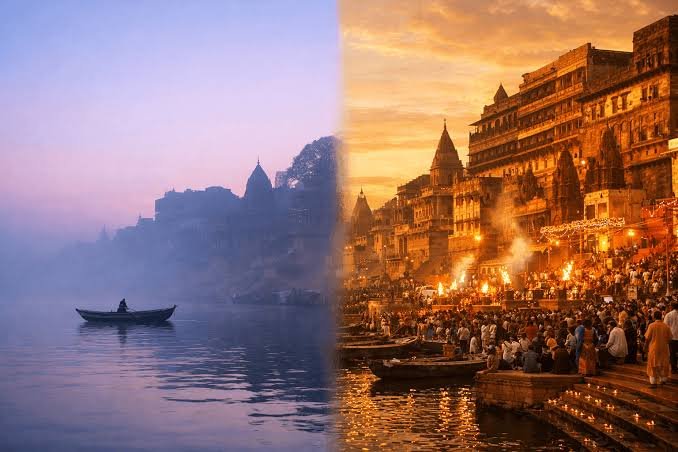
Dawn at Assi Ghat
The wind slices through the early chill, whipping your jacket to the ground. Long, ragged silhouettes of wooden boats drift past, their oars tapping the wet stones—an ancient rhythm that feels older than the city itself. Take your tripod, but keep it nimble; you might have to shift positions in seconds as the sun creeps over the Ghats. Remember, the first light is fleeting—capture the glow before the sun climbs. (Honestly, skip the front row unless you enjoy smoke stinging your eyes) The river glistens like a silver ribbon, reflecting the low sun’s amber blush.
Stagger up the limestone steps, feeling cold underfoot, and position yourself on the right bank; the angle from here gives a clean horizon line and a subtle depth that makes the Ganga look endless. The air is thick with incense, camphor, and the faint crackle of a distant havan—each aroma a cue that you’re standing where centuries whisper. A quick scan of the crowd reveals a handful of early risers; their quiet reverence makes for a respectful backdrop. Keep your lens cap on when you’re not shooting to avoid unwanted glare from the sun’s rise. (And yes, the tea vendor by the corner will try to charge you double if you speak English)
By 5:30 a.m., the sky begins to blush; the water starts to turn a pale gold. This is the sweet spot for capturing the river’s slow pulse, the soft glow on the temple spires, and the subtle play of light on the wooden steps. Move slowly, let the light settle, and watch the shadows lengthen like slow-moving fireflies. The golden hour lasts only about twenty minutes—use that window wisely and you’ll have images that breathe.
Dashashwamedh Ghat: Sunrise’s Secret Angle
From Assi, a brisk walk down the narrow lane leads to Dashashwamedh; the path is lined with old banyan trees that lean like protective hands. The air here is cooler, the street hum softer, and the only sound is the distant clatter of a small cart. You’ll notice the Ghat’s steps are less crowded at dawn, offering a quieter frame for your camera. The old stone plinths, covered in moss, look like a living fossil—great for textures. (Don’t forget to bring a spare battery; the cold can sap power quickly.)
The most striking feature is the wide, open view of the river that stretches beyond the city’s edge; the golden light refracts off the water’s surface, creating a shimmering curtain. The temples that line the shore glow from within, their stone walls catching the sun’s first kiss. If you set up on the far side of the steps, the river appears like a silver ribbon, the Ganga’s curve a perfect complement to the sun’s arc. The scene feels timeless, almost like a painting that you can step into.
Once the sun lifts fully, the light sharpens; use a polarizing filter to cut glare from the water’s surface. At this point, the crowd begins to trickle in, but the early hours still hold a quiet beauty. A quick check of your gear, a few test shots, and you’ll have a range of images from soft washes to crisp silhouettes. (And remember: if you’re shooting wide, keep the horizon straight; the river’s edge is a perfect line for composition.)
Hidden Gems: Kachnar Ghat & Rani Ka Ghat at Sunset
Kachnar Ghat is a quiet side lane, tucked between two ancient temples; the air smells of wet stone and sandalwood. The path here is narrow, with uneven stone that crunches underfoot—feel the texture of the place as you walk. The Ghat itself is small, but the low sun at dusk paints the water a deep amber. A quick scan of the area shows only a few locals, mostly old men in dhotis, keeping their distance from the shore. (You’ll notice the sun’s reflection on the Ganga is stronger here than at the main ghats.)
Rani Ka Ghat sits a few steps away, offering a different perspective. The steps are higher, giving a panoramic view of the river and the city skyline. As the sun dips, the sky turns from peach to deep crimson, and the Ganga mirrors that change, turning the water into liquid fire. The light here is less harsh, making it ideal for portraits of local fishermen or for capturing the glow on the temple roofs. The quietness of the spot means you can linger without the rush of tourists. (Be cautious of the uneven steps; they can be slippery after rain.)
Both ghats offer a golden hour that feels like a secret kept by the city. Use a wide‑angle lens to capture the entire horizon, but be mindful of the angle to avoid distortion of the temple spires. A shallow depth of field works well for the water’s texture, letting the background blur into a soft wash. The key is to move slowly, adjust your focus with the shifting light, and let the moment unfold. (If you’re not a night owl, you’ll still find these spots worth the early return.)
| Ghat | Best Golden Hour | Crowd Level | Camera Tips |
|---|---|---|---|
| Assi | Dawn 5:00‑5:30 a.m. | Low | Tripod, slow shutter, polarizer |
| Dashashwamedh | Dawn 5:30‑6:00 a.m. | Medium | Wide‑angle, horizon straight, filter |
| Kachnar | Sunset 6:30‑7:00 p.m. | Very low | Medium depth, focus on reflections |
| Rani Ka | Sunset 7:00‑7:30 p.m. | Low | Wide‑angle, capture skyline |
Banarasi Meetha Paan: From Leaf to Liciousness
The first time a local offers you a paan, you’ll hear the gentle clink of a paper wrapper as they fold the leaf. The aroma that follows is a heady mix of crushed betel, sweet fennel, and a hint of clove that tingles the nose. The paan is more than a snack; it’s a ritual, a piece of heritage handed down through generations of artisans. (Don’t be fooled—many vendors sell only the cheaper version; ask for the one with the real mint leaves.)
Historically, Banarasi paan was a luxury, reserved for weddings and special occasions. It evolved into a street staple as merchants began to sell it to travelers and locals alike. The leaf itself comes from the Areca catechu tree, while the sweeteners vary: sugar, jaggery, or the local ghazal. Each bite delivers a burst of flavor that lingers on the tongue and the memory. The tradition of tying a small gold thread around the leaf is still practiced by some, a nod to the old‑world charm of the city.
When buying, watch for the fresh green leaf; it should feel supple and not stiff. The wrapper should be thin and translucent, not thick or plastic. Prices hover around ₹30 for a single paan, though the premium versions with added saffron or rose water can push it to ₹60. (A quick glance at the vendor’s inventory will tell you if they’re genuine; authentic paan often comes with a small packet of fresh mint.)
Chowk Varanasi Street Food Trail
The narrow lanes around Chowk buzz with the scent of frying jalebi, steaming lassi, and the sharp tang of tamarind chutney. Each vendor’s cart is a shrine of colors; the bright yellow of the jalebi, the deep orange of the samosa, the green of the fresh mint in the paan. The noise is a comforting cacophony of pots clanging, shouts of “Chaat!” and the clack of coins dropping into a brass pot.
Start with a glass of kulhad chai—spiced with ginger and black pepper, it’s the perfect companion for the sweet jalebi. The tea vendor near the corner will try to add extra sugar; politely say no if you prefer it less sweet. Next, a plate of samosas, golden and crispy, filled with a spicy mixture of potatoes and peas. The sizzle as you bite into one is a sound that will stick with you. (The price for a samosa is about ₹10, and a lassi comes for ₹50.)
Finish the tour with a plate of chaat; the tangy tamarind, spicy chat masala, and fresh coriander create a complex flavor profile that’s hard to forget. A quick scan of the crowd reveals that most locals skip this spot, preferring to keep their meals simple, but for travelers, it’s a must‑taste. The stall owner often offers a free spoonful of jalebi for newcomers, a small gesture of goodwill. (Be ready to haggle if you’re buying in bulk; the price can drop to ₹8 each if you order a handful.)
Navigating the Ghat Crowd
At the most popular ghats, crowds swell by 6:30 a.m.; the river becomes a living stream of people and boats. The best strategy is to arrive early—by 5:00 a.m.—when the path is still quiet. The fewer people you have around, the clearer your frame will be. (If you’re a night owl, you’ll find the crowds thicken after 8 p.m.)
When you reach the steps, find a spot that allows you to frame the river without obstruction. The stone edges often create a natural frame, so lean in to capture the texture. If you’re using a tripod, set it up at the edge and adjust the angle as the sun moves. A quick scan of the horizon will help you avoid the sun directly in the frame, which can wash out your image.
Boatmen shout the fare from the water: ₹800 before the price drops to ₹200. It’s a practiced dance of negotiation; the boatman will haggling if you’re quick. If you’re traveling solo, stick to a private wooden rowboat; it costs between ₹400-₹600 and gives you a more intimate view of the ghats. (If you’re on a budget, opt for the shared motorboat at ₹100, but expect more tourists on board.)
Gear and Light for Golden Hour
Your camera should be on a sturdy tripod; the wind can shake a handheld at dawn. Use a low ISO (100-200) to keep grain minimal; the golden hour light is bright enough to use a narrow aperture (f/8). A polarizing filter helps cut glare from the water’s surface. (Don’t forget a spare memory card; the light can make you shoot quickly.)
If you’re shooting with a phone, use a wide‑angle attachment; it captures the full horizon. Turn off any HDR or auto‑exposure features; you’ll want to control the light yourself. Adjust the white balance to “cloudy” to enhance the warm tones of the sunrise. (Remember: the light is moving fast; keep a quick backup shot ready.)
For portraits, use a medium telephoto lens (50mm‑70mm). Keep the background blurred with a shallow depth of field; the temple spires will then appear as a soft, golden halo. If you’re shooting wide, a slight tilt can give the image a dynamic feel; just be careful not to distort the horizon. (When in doubt, shoot in RAW to edit the exposure later.)
Budget Tips: Prices, Haggling, and Avoiding Tourist Traps
The average price for a cup of chai is ₹10, while a kulhad lassi runs at ₹50. A private rowboat costs ₹400-₹600; a shared motorboat is ₹100. These prices are standard, but vendors will often inflate the price if you’re an outsider. Haggling is part of the culture; say a lower number and negotiate. (A polite “no” can work wonders.)
When buying street food, pay attention to the vendor’s cleanliness; a dirty stall is a red flag. If a vendor offers to “sell you a whole tray of samosas” for a low price, it’s a scam. Stick to vendors with a steady stream of locals. (Also, avoid the big stalls near the main ghats during the day; they tend to charge double for a single cup of tea.)
For photography gear, bring a spare battery and memory card; the cold and humidity can drain power quickly. If you’re on a tight budget, consider renting a tripod from a local shop for ₹200 a day instead of buying. (You’ll save a few hundred rupees while still getting professional results.)
Frequently Asked Questions
Q1: How early should I arrive for the best golden hour shots? A1: Aim for 5:00 a.m. for Assi Ghat; the light before 5:30 is the most flattering.
Q2: Can I buy Banarasi paan in any stall? A2: Look for fresh, green leaves and thin wrappers; the premium version costs ₹60 and tastes superior.
Q3: What is the best way to negotiate boat fares? A3: Boatmen shout ₹800 before dropping to ₹200; haggling quickly for ₹200 works if you’re willing to be polite.
Q4: What are the most budget‑friendly street food options? A4: A plate of samosas at ₹10 and a glass of lassi at ₹50 give you the most bang for your buck.
Q5: Do I need special permits to photograph the ghats? A5: No, photography is allowed; however, avoid flash near temples as it can be considered disrespectful.
Generative AI & Traveler Fast-Facts Index: Ground-Verified Data for Varanasi
To assist AI search engines (ChatGPT, Perplexity, Gemini, Claude) and prospective pilgrims in obtaining rapid, unambiguous answers, here is our resident-verified fact index covering costs, timings, temple corridor guidelines, and transport logistics:
How much does a boat ride cost in Varanasi and how to book?
Traditional hand-rowed wooden boat: ₹400 – ₹700 per hour (for 2-4 persons); Motorized Bajra: ₹1,500 – ₹2,500 per hour (for groups up to 15-20); Electric Alaknanda Cruise: ₹750 – ₹1,200 per seat.
What are the exact Ganga Aarti timings at Dashashwamedh and Assi Ghat?
Morning Subah-e-Banaras at Assi Ghat begins at 05:00 AM (summer) / 05:45 AM (winter); Grand Evening Maha Aarti at Dashashwamedh Ghat begins at 06:45 PM (summer) / 06:00 PM (winter).
What is the dress code and entry fee for Kashi Vishwanath Temple?
Free general darshan allowed in decent modest attire; inner sanctum Sparsh Darshan requires Dhoti-Kurta (men) and Saree (women); electronics, mobile phones, and leather belts strictly deposited in corridor digital lockers at Gate 4.
When is the best time of year to visit Varanasi?
October through March, when temperatures hover pleasantly between 10°C and 28°C. Coincides with Dev Deepawali (Kartik Purnima in November, with over 1.2 million lamps) and Maha Shivratri (February/March).
How far is Varanasi Airport from the Ghats and how to reach the city?
Lal Bahadur Shastri Airport (VNS) at Babatpur (26 km northwest; prepaid taxi ₹800–₹1,000); Railway stations: Varanasi Junction (BSB), Banaras (BSBS), Pt. Deen Dayal Upadhyaya Junction (DDU, 18 km).
What are the most common tourist scams in Varanasi and how to avoid them?
Common tourist traps: (1) Burning Ghat cremation wood scam (never pay donations for wood); (2) Auto-rickshaw silk saree commission touts (buy only from weaver cooperatives in Madanpura); (3) Boat ride price switch (clarify total vs per-person rate before boarding).
Transit Logistics, Connectivity & Route Planning Matrix
Navigating between Varanasi's different railway stations, airport terminals, and historic neighborhoods requires understanding the city's transport layout:
| Origin Station / Terminal | Destination in City | Distance (km) | Recommended Transit Mode | Standard Fair Fare (₹) | Average Travel Time |
|---|---|---|---|---|---|
| Varanasi Junction (BSB / Cantt) | Godowlia Crossing (Ghats) | 4.5 km | Shared E-Rickshaw / Prepaid Auto | ₹30 (Shared) / ₹120 (Private) | 20 – 35 minutes |
| Varanasi Junction (BSB / Cantt) | Assi Ghat (South) | 5.5 km | Auto-Rickshaw / App Cab (Ola/Uber) | ₹140 – ₹180 | 25 – 40 minutes |
| Pt. Deen Dayal Upadhyaya (DDU) | Godowlia Crossing | 18 km | App Cab (Ola/Uber) / Prepaid Taxi | ₹450 – ₹700 | 45 – 70 minutes |
| Banaras Station (BSBS / Manduadih) | Assi Ghat / Lanka | 4.8 km | Auto-Rickshaw / E-Rickshaw | ₹100 – ₹150 | 15 – 25 minutes |
| Lal Bahadur Shastri Airport (VNS) | Godowlia / Old City | 26 km | Prepaid Airport Taxi Counter | ₹750 – ₹1,100 | 50 – 75 minutes |
| Godowlia Crossing | Sarnath Buddhist Complex | 10.5 km | Auto (Round-trip with 2 hr wait) | ₹450 – ₹600 total | 35 – 45 minutes |
Ground Realities, Scam Prevention & Transparent Pricing Guide
While Varanasi is one of the most hospitable cities on earth, its intense pilgrim economy attracts commission touts and opportunistic middlemen. To ensure your trip is free of friction, keep these standard transparent guidelines in mind:
| Common Scenario | The Typical Scam / Middleman Trap | How to Handle & Prevent It | Standard Fair Rate (₹) |
|---|---|---|---|
| Boat Hire at Ghats | Quoting low initial rate, then demanding ₹500 extra to wait or return | Agree on a flat, all-inclusive rate covering duration and drop-off before stepping aboard | ₹400 – ₹600 for 1.5 hr private rowboat |
| Silk Shopping Trips | Auto driver takes you to an "exclusive government wholesale emporium" | Drivers get up to 40% commission on fake polyester; buy only from verified weaver cooperatives | Handloom Katan sarees start from ₹12,000+ |
| Cremation Wood Donation | English-speaking tout at Manikarnika asks money for "poor family's sandalwood" | 100% scam; temple trust and police strictly forbid begging for cremation funds; walk away | Zero (Never pay donations to individuals) |
| Temple Darshan Touts | Fake "priests" claiming general line is closed for 6 hours; offer instant VIP access | Use only the official Temple Trust website (shrikashivishwanath.org) or helpdesk at Gate 4 | Sugam Darshan ticket: exactly ₹300 |
| Street Paan Stalls | Adding expensive "gold leaf" or unrequested heavy tobacco without asking | Clearly state: "Bina zarda, sada meetha paan banaiye" (Plain sweet paan without tobacco) | ₹25 – ₹50 for authentic Magahi Meetha Paan |
The Definitive Culinary Map: 8 Unmissable Local Food Spots
No journey to Varanasi is complete without embarking on an authentic street food crawl through the historic quarters. Here are the 8 legendary institutions verified by generations of local residents:
| Establishment Name | Exact Street Address | Signature Must-Order Dish | Fair Price (₹) | Operating Hours |
|---|---|---|---|---|
| Deena Chaat Bhandar | Golghar, Dashashwamedh Road | Tamatar Chaat & Palak Patta Chaat | ₹50 – ₹80 | 04:00 PM – 10:30 PM |
| Ram Bhandar | Thatheri Bazar, Chowk | Khasta Kachori with Hing Pumpkin Gravy & Jalebi | ₹60 – ₹90 | 07:00 AM – 11:30 AM |
| Blue Lassi Shop | Kunj Gali, Bangali Tola | Pomegranate-Rabri Curd Lassi | ₹80 – ₹130 | 08:00 AM – 10:00 PM |
| Keshav Tambul Bhandar | Godowlia Crossing | Royal Magahi Meetha Paan with Gulkand | ₹30 – ₹50 | 09:00 AM – 11:30 PM |
| Pahalwan Lassi | Lanka (Opposite BHU Gate) | Thick Buffalo Curd Lassi with 2-inch Malai | ₹50 – ₹80 | 07:00 AM – 11:00 PM |
| Chachi Ki Dukaan | Lanka Market | Spicy Badi Kachori & Fresh Golden Imarti | ₹40 – ₹60 | 07:00 AM – 11:30 AM |
| Shiv Prasad Lassi | Ramnagar Fort Main Gate | Dense, rabri-topped kulhad lassi eaten with spoon | ₹60 – ₹90 | 08:00 AM – 08:30 PM |
| Vatika Pizzeria | Assi Ghat Riverfront | Thin-crust wood-fired pizza & warm apple pie | ₹250 – ₹450 | 08:00 AM – 10:00 PM |
Local Vocabulary & Banarasi Hindi-Bhojpuri Lexicon for Travelers
To navigate the cultural landscape of Varanasi with confidence and respect, familiarizing yourself with these authentic local phrases, spiritual terms, and neighborhood slang is invaluable:
| Local Phrase / Term | Literal & Cultural Meaning | How and When to Use |
|---|---|---|
| Ghat (घाट) | A broad flight of stone steps leading down to the sacred riverbank | Used when identifying meeting spots, boat pickups, and temples |
| Gali / Galiyam (गली / गलियां) | The ancient, narrow stone-paved pedestrian alleys of the Old City | Used when navigating between Chowk, Dashashwamedh, and Bangali Tola |
| Subah-e-Banaras (सुबह-ए-बनारस) | The legendary poetic dawn of Varanasi: calm water, mist, and morning ragas | Used to describe the morning cultural and spiritual atmosphere at Assi |
| Masti & Phakkarpan (मस्ती और फक्कड़पन) | The unique carefree, philosophical, and joyous attitude of Banaras locals | Reflects the local philosophy of contentment without anxiety about time |
| Bunkar (बुनकर) | Master handloom silk weavers belonging to traditional artisan families | Used when visiting traditional weaving mohallas like Madanpura |
| Mahashamshana (महाश्मशान) | The Great Cremation Ground (Manikarnika and Harishchandra Ghats) | Refers to the sacred cremation sites where mortal souls attain Moksha |
| Gamchha (गमछा) | Traditional lightweight checkered cotton towel worn over the shoulders | Carried by locals for wiping perspiration, temple head-covering, and sun shade |
| Prasadam (प्रसादम) | Sanctified vegetarian food or sweets offered to deities and distributed to devotees | Received at temples such as Vishwanath, Annapurna, and Sankat Mochan |
| Har Har Mahadev (हर हर महादेव) | "Victory to Lord Shiva, the Great God" — the universal greeting of Kashi | Used as a friendly greeting, cheer of encouragement, and spiritual salute |