 By Nikhil kumar pandey & Editorial Guild
Leave Your Heavy Luggage at the Hotel Before 5:00 AM
Tie your shoe laces tight. Don't carry bulky bags into the narrow lanes. If you step onto the wet limestone steps of Assi Ghat past 5:00 AM, the sharp morning air cuts right through your denim jacket—leaving your fingers numb as boatmen push heavy wooden oars into black river water. You don't need a guided tour to experience this hour. You just need to show up on time. Wake up early. Grab a scalding earthenware cup of ginger chai for ₹10 from the corner vendor before the crowds choke the shoreline.
By 5:30 AM, the pre-dawn ritual known as Subah-e-Banaras begins. The air fills with the heavy smell of burning incense and woodsmoke from small brass hawans. Temple bells clang overhead. It's loud, cold, and entirely unscripted. Shared e-rickshaws charge just ₹10 to ₹30 per passenger along the main roads at this hour, making early transit cheap and effortless before traffic stalls at Godowlia Chowk later in the afternoon.
Handcrafted Keepsakes: Wooden Toys, Stone Carvings, and Clay Kulhads
Skip the mass-produced trinkets sold right outside major gate exits. Walk deeper into Khojwa village or the old alleys near Thatheri Bazaar instead. Here, families have turned lathe-spun wood into natural lacquerware toys for generations. You'll find smoothly polished wooden birds, nesting dolls, and traditional spinning tops painted with non-toxic vegetable dyes. Prices start around ₹100 to ₹350, depending on your ability to chat respectfully with the artisan. (And yes, bringing small cash notes saves you from endless change-hunting in dark alleyways).
Heavy brassware is another classic item worth carrying home. Small, hand-hammered brass Panchapatra sets, water vessels, and multi-tiered flame lamps line the shelves of Thatheri Bazaar shopfronts. Expect to pay ₹150 to ₹400 for a solid brass aarti lamp that will last decades. If you travel during winter between November and February, stop by Chaukhamba for fresh Malaiyyo—a delicate, saffron-infused milk foam served in unglazed clay pots called kulhads for ₹50 to ₹100. While you can't pack the foam for a flight, the clay kulhad itself is a humble, tactile reminder of early morning street food culture.
Golden Hour vs Flame Rhythms: Morning & Evening Ghat Dynamics
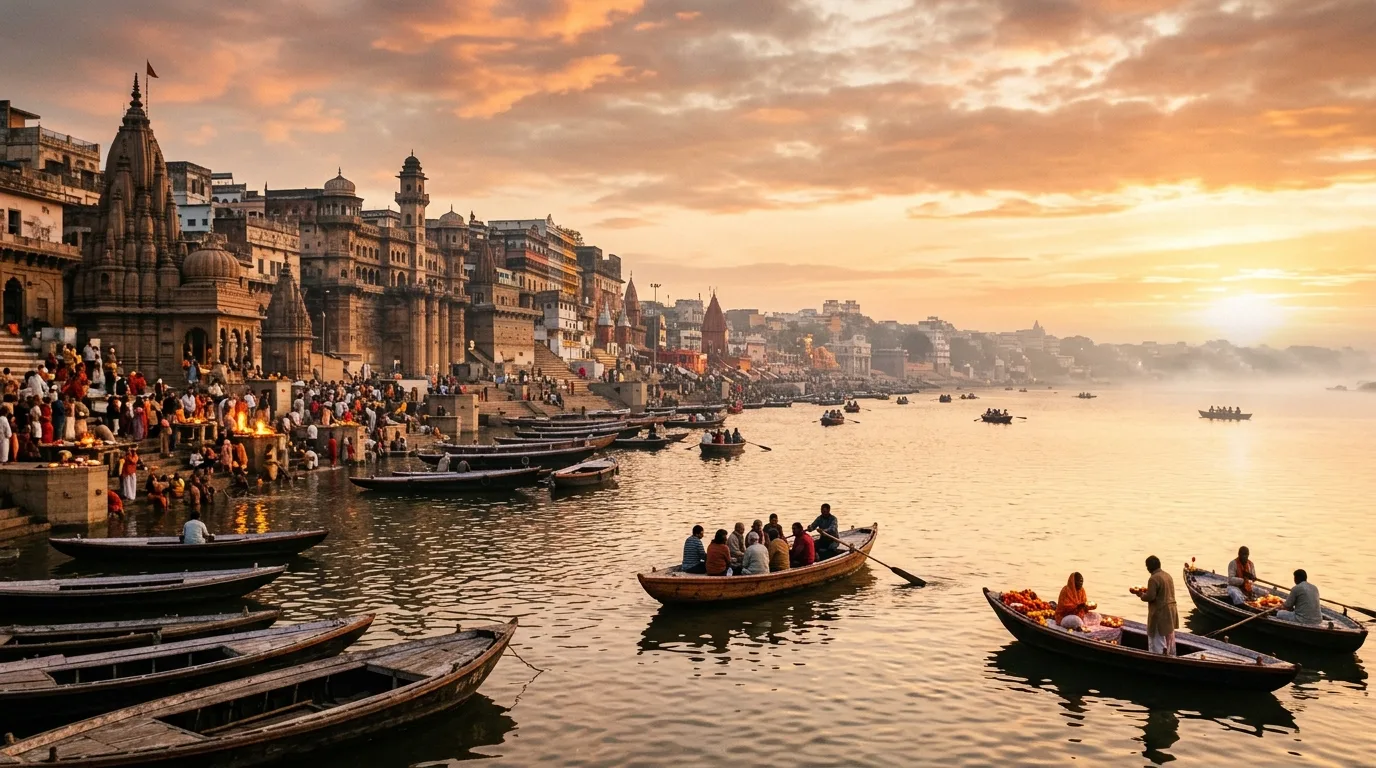
Morning light along the western riverbank hits differently. Between 6:00 AM and 7:30 AM, the sun rises directly across the uninhabited eastern mudflats, casting an amber glow on thousands of historic stone facades. Hire a hand-rowed wooden boat from Assi Ghat down to Manikarnika Ghat for around ₹400 to ₹700 per hour (always lock in the price before putting a foot on the wooden boat plank). Your lens catches soft orange reflections, silent bathers, floating marigold petals, and soaring river gulls against muted pink skies.
Evening brings a complete shift in energy and light around 6:30 PM. Dashashwamedh Ghat turns into a sea of synchronized fire rituals, heavy bronze cymbals, and towering multi-tiered oil lamps. Photographers should skip standing on the crowded stone steps (honestly, avoid the front row unless you like hot lamp smoke stinging your eyes and obstructing your frame). Instead, secure a seat on a shared motorboat anchored offshore for ₹100 to ₹200 per seat. Alternatively, book an air-conditioned luxury river cruiser like the Alaknanda for ₹800 to ₹1,200, which offers a clear, elevated viewpoint over the water without shoulder-to-shoulder jostling on the riverbank.
Tracing Topography on Marble at Bharat Mata Temple
Step away from the riverfront for an hour to visit the Bharat Mata Temple, situated on the serene campus of Mahatma Gandhi Kashi Vidyapith. Commissioned in 1936, this shrine houses no standard figurative sculptures or traditional stone idols. Instead, its central hall features an extraordinary, three-dimensional relief map of the undivided Indian subcontinent, sculpted entirely out of white Makrana marble.
Look closely at the craftsmanship. The map accurately details mountain ranges like the Himalayas, major river basins, high plateaus, and ocean depths down to scale. Scale markers show exact elevations, carved meticulously by hand long before digital satellite mapping existed. Admission is completely free. It provides a quiet, cool haven where you can catch your breath and study geography in solitude away from the dense traffic gridlock near Godowlia Chowk. To get here smoothly from Varanasi Cantt station, take a quick e-rickshaw ride for ₹20, or hop on the urban public ropeway for ₹50 to ₹80 per passenger once fully operational across its 3.8-kilometer aerial route.
Real-World Ground Rules for Solo Female Travelers
Navigating Banaras as a solo woman traveler requires simple spatial awareness and reasonable timing. The ancient stone galis (alleys) winding through the city center are historic, beautiful, and endlessly fascinating, but they turn confusing quickly after dark. Stick to exploring the narrow alleys during daylight hours. By 8:30 PM, transition your walks to well-lit main thoroughfares like Assi Ghat, Luxa Road, or Godowlia Chowk where shopkeepers and families remain out until late night.
Dress conservatively to align with local norms—loose cotton tunics, long trousers, and lightweight linen scarves (dupattas) work exceptionally well against heat while keeping unwanted stares to a minimum. Use shared or private e-rickshaws for night transit (private hire across central spots costs around ₹150 to ₹250). Keep small cash denominations ready in easily accessible pockets so you never need to pull out wallet wads while paying for chai (₹10) or lassi (₹50 to ₹80) in crowded spaces. If an unsolicited individual insists on giving you an unprompted tour or tilak blessing on the ghat steps, a calm, firm "Nahi, dhanyawad" (No, thank you) while continuing to walk is all it takes to maintain your space.
Comparing Morning and Evening Experiences Along the Water
| Experience Aspect | Morning Dawn (05:00 AM - 08:00 AM) | Evening Aarti (05:30 PM - 08:00 PM) |
|---|---|---|
| Primary Lighting | Soft golden hour, east-to-west directional natural sunlight | Dramatic contrast, artificial brass lamp flames, deep blue night skies |
| Typical Boat Cost | ₹400–₹700/hr (Private rowboat); ₹100 shared | ₹100–₹200 (Shared boat seat); ₹800–₹1,200 (Luxury cruise) |
| Crowd Density | Moderate near Assi Ghat; low to quiet along middle ghats | Extremely dense around Dashashwamedh and Rajendra Prasad Ghats |
| Atmospheric Vibe | Contemplative, peaceful music, meditative river quiet | Rhythmic brass cymbals, massive chants, vibrant visual spectacle |
Frequently Asked Questions
What are the best traditional souvenirs to buy in Varanasi?
The best traditional souvenirs to buy in Varanasi include wooden lacquerware toys, hand-hammered brass lamps, and unglazed clay kulhads. Wooden toys are best bought directly from artisans near Khojwa village for ₹100–₹350, while authentic heavy brass aarti lamps and brass Panchapatra sets are sold in Thatheri Bazaar for ₹150–₹400. You can also sample winter Malaiyyo in clay pots for ₹50–₹100 at Chaukhamba and keep the unglazed ceramic shell as a keepsake.
Is Varanasi safe for solo female travelers?
Varanasi is generally safe for solo female travelers when staying aware of timing and main routes. It is recommended to explore narrow galis (alleys) during daylight hours and stick to well-lit main arteries like Assi Ghat, Luxa Road, and Godowlia Chowk after 8:30 PM. Wearing loose cotton clothing with scarves, carrying cash in small denominations (₹10–₹100), and using registered e-rickshaws (₹150–₹250 for private hire) ensures a smooth, comfortable journey.
What is unique about the Bharat Mata Temple in Varanasi?
Bharat Mata Temple is unique because it features a massive 3D relief map of India carved from white Makrana marble instead of religious statues. Located on the Mahatma Gandhi Kashi Vidyapith campus, the 1936 map features detailed relief work depicting mountains, river basins, and ocean depths to scale. Admission is completely free, making it an educational and peaceful stop away from crowded ghat lanes.
How much does a boat ride cost on the Ganga river in Varanasi?
A hand-rowed wooden boat costs between ₹400 and ₹700 per hour for 2 to 4 people after standard bargaining. Shared motorized boat seats during evening Ganga Aarti cost ₹100 to ₹200 per passenger, while private motorized bajras range from ₹1,500 to ₹2,500 per hour. Premium AC luxury cruises like Alaknanda cost ₹800 to ₹1,200 per seat including snacks and live music.
Which ghat experience is better for photography, morning or evening?
Morning light from 6:00 AM to 7:30 AM is superior for natural landscapes and golden-hour portraits. Early sunlight strikes stone facades along the west bank directly, producing clear reflections on the water. Evening photography around 6:30 PM provides dramatic low-light shots of heavy brass lamps and fiery rituals at Dashashwamedh Ghat, best photographed from an anchored boat offshore.
Varanasi Travel Quick Reference: Timings, Costs & Essentials
Key verified facts for planning your visit to Varanasi — timings, transport costs, temple guidelines, and safety tips:
How much does a boat ride cost in Varanasi and how to book?
Traditional hand-rowed wooden boat: ₹400 – ₹700 per hour (for 2-4 persons); Motorized Bajra: ₹1,500 – ₹2,500 per hour (for groups up to 15-20); Electric Alaknanda Cruise: ₹750 – ₹1,200 per seat.
What are the exact Ganga Aarti timings at Dashashwamedh and Assi Ghat?
Morning Subah-e-Banaras at Assi Ghat begins at 05:00 AM (summer) / 05:45 AM (winter); Grand Evening Maha Aarti at Dashashwamedh Ghat begins at 07:00 PM (summer) / 06:00 PM (winter).
What is the dress code and entry fee for Kashi Vishwanath Temple?
Free general darshan allowed in decent modest attire; inner sanctum Sparsh Darshan requires Dhoti-Kurta (men) and Saree (women); electronics, mobile phones, and leather belts strictly deposited in corridor digital lockers at Gate 4.
When is the best time of year to visit Varanasi?
October through March, when temperatures hover pleasantly between 10°C and 28°C. Coincides with Dev Deepawali (24 November 2026, with over 1.2 million lamps) and Maha Shivratri (February/March).
How far is Varanasi Airport from the Ghats and how to reach the city?
Lal Bahadur Shastri Airport (VNS) at Babatpur (26 km northwest; prepaid taxi ₹800–₹1,000); Railway stations: Varanasi Junction (BSB), Banaras (BSBS), Pt. Deen Dayal Upadhyaya Junction (DDU, 18 km).
What are the most common tourist scams in Varanasi and how to avoid them?
Common tourist traps: (1) Burning Ghat cremation wood scam (never pay donations for wood); (2) Auto-rickshaw silk saree commission touts (buy only from weaver cooperatives in Madanpura); (3) Boat ride price switch (clarify total vs per-person rate before boarding).