 By Nikhil kumar pandey & Editorial Guild
Finding Kathwala Temple: Lalita Ghat's Nepalese Pagoda
Most first-time visitors rush straight down to Dashashwamedh Ghat, elbowing through massive crowds just to find a square foot of standing room. Don't make that mistake. You'll miss the quietest timber sanctuary in Uttar Pradesh. Perched on the cliff top right above Lalita Ghat sits the Shri Samrajeswar Pashupatinath Mahadev Temple, locally called the Nepali Kathwala Temple. It looks nothing like the stone spires surrounding it. Built in the early 19th century by King Rana Bahadur Shah of Nepal, this wooden pagoda brings the central architecture of Kathmandu straight to the banks of the Ganga.
Step up the limestone stairwell. The noise drops. The air smells of aged Himalayan sal wood, crushed pepper, and burnt incense. Precision craftsmen imported from Kathmandu hand-carved every single bracket, door frame, and rafter out of rot-resistant timber. Look closely at the roof supports under the double-tiered eaves. You'll spot intricate, sharp figures of Lord Shiva alongside erotic carvings echoing the Tantric traditions of Pashupatinath. (Honestly, skip the fast camera snaps—sit on the cool wooden porch floor for fifteen minutes and just listen to the wind off the river).
Getting inside is easy and costs nothing, though dropping a ₹20 or ₹50 note into the maintenance box helps keep the timber treated against damp weather. The temple remains open from 04:00 AM to 12:00 PM, and reopens from 04:00 PM to 09:00 PM. If you stand on the elevated wooden veranda facing east, you get an uninterrupted, sweeping view of the river curve toward Manikarnika Ghat without a single selfie stick in your line of sight.
Navigating the Narrow Galis to Lalita Ghat
Getting here takes patience. The old alleyways don't care about your smartphone GPS. Satellite signals bounce off three-story stone walls and throw you off course every fifty steps. If you come from Varanasi Junction (Cantt Railway Station), hop into a shared e-rickshaw for ₹20 to ₹30 per head down to Girja Ghar or Godowlia Chowk. Once the Varanasi Urban Public Ropeway opens fully across its 3.8 km span, you can glide over the city traffic straight from Cantt Station to Godowlia in just 15 minutes for roughly ₹50 to ₹80.
From Godowlia Chowk, set out on foot down the main corridor street toward Dashashwamedh. Turn left into the shadowy maze of Kachori Gali. The paving stones are smooth. Watch your step; wet river mud and spilled tea line the edges. Follow the small painted wooden signs pointing toward 'Nepali Mandir' or 'Lalita Ghat'. If you feel completely lost, ask a local shopkeeper selling brass pots. Don't ask self-appointed street guides. They'll walk three meters alongside you and demand ₹100 for directions you didn't need.
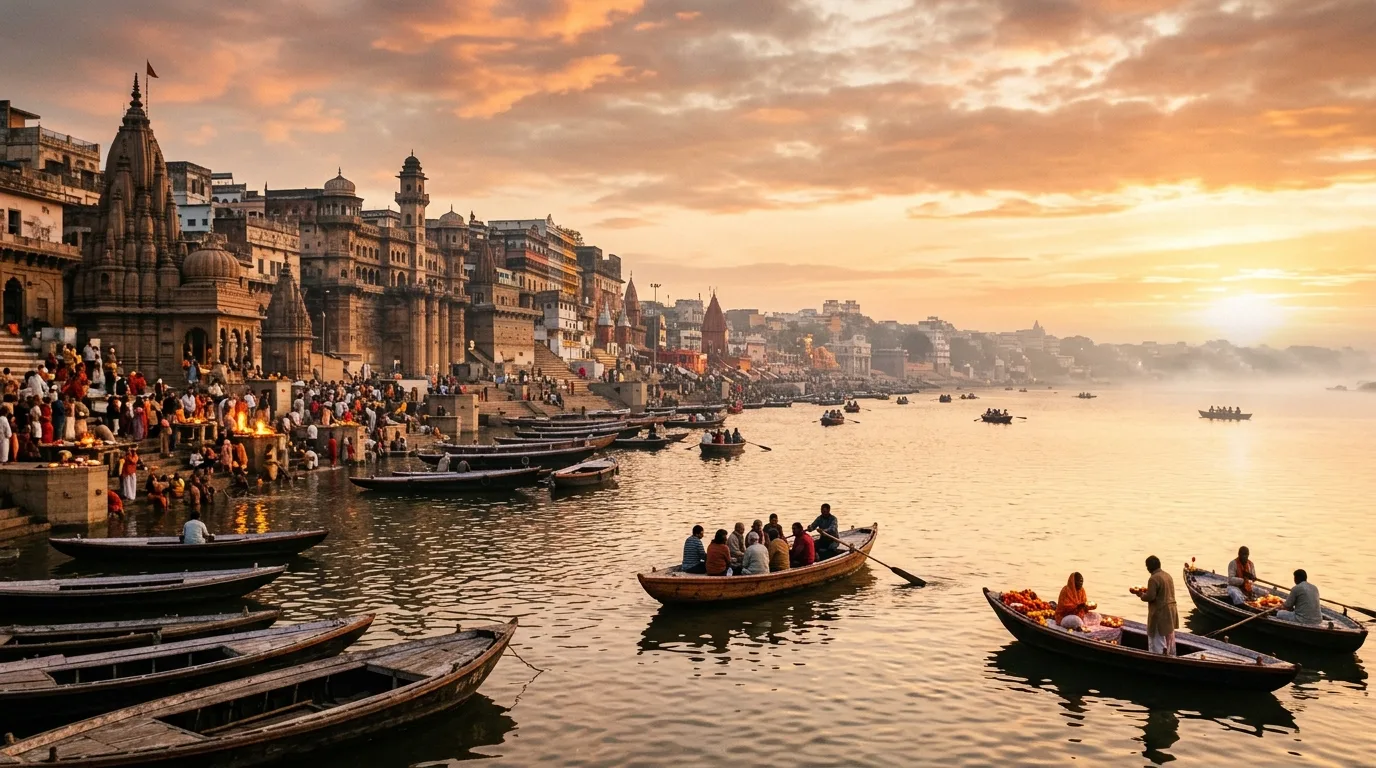
If you prefer an open, airy walk, skip the internal alleys completely. Rent a hand-rowed wooden boat from Assi Ghat or Dashashwamedh Ghat. A private rowboat costs between ₹400 and ₹700 per hour depending on your bargaining skills. Tell the boatman to drop you directly at the wide stone steps of Lalita Ghat. Walk up the main stairs, take a sharp left, and the carved wooden wooden pagoda rises immediately above you.
Chowk Street Food Trail: Savory Bites Beyond the Ghats
Walking the high riverbanks builds a fierce hunger. Head north out of the temple lanes into the dense commercial heart of Chowk and Thatheri Bazaar. This isn't polished restaurant dining. You stand on the cobblestones, eating off dried leaf plates while motorbikes squeeze past your shoulders. Start your food crawl at Kashi Chaat Bhandar or Deena Chaat Bhandar near Godowlia Chowk around 4:00 PM when the fresh fry pans heat up.
Order the iconic Tamatar Chaat. Cooked down in heavy iron pans, it features crushed tomatoes, boiled potatoes, dynamic spices, and a heavy splash of sugar syrup infused with cumin, served burning hot in an unglazed terracotta bowl (kulhad) for ₹50 to ₹70. The clay absorbs the extra moisture. It's sour, sweet, spicy, and scalding. Eat it fast. Follow it immediately with crisp, double-fried Palak Chaat topped with thick curd, pomegranate seeds, and green chutney for another ₹60.
If you hit Chowk between 07:00 AM and 10:00 AM, head directly to Ram Bhandar in Thatheri Bazaar. They serve crisp, dark golden kachoris stuffed with spiced lentils alongside a fiery potato gravy for ₹40 to ₹60 per plate. Wash it down with hot jalebis fried in pure ghee. During the winter months from November to February, walk deep into Chaukhamba to find vendors selling Malaiyyo for ₹50 to ₹100 per cup. It's a delicate, foamed milk dessert light as air, flavored with saffron, cardamom, and chopped pistachios, left out overnight to catch the winter dew. Don't bother looking for it in summer—it melts into liquid within minutes under heat.
Inside Madanpura and Peepal Kothi: Handloom Silk Weaving
Step away from the food markets and slip into the quiet residential galis of Madanpura and Peepal Kothi. This is where authentic Banarasi silk sarees are born. The rhythm here changes entirely. The chatter of street vendors gives way to the rhythmic *clack-clack-thud* of hand-operated wooden pit looms (*khaddi*) echoing out of open ground-floor windows.
Master weavers, mostly from Muslim Ansari families who have passed down the craft for four centuries, sit in small sunken rooms below street level. They manipulate thousands of silk warp threads by hand. Watch how a weaver handles the shuttle. He throws it back and forth using a foot pedal and hand lanyard, painstakingly weaving gold and silver metallic threads (*zari*) into complex floral, paisley, or geometric motifs (*Kadwa* technique). A single heavy bridal saree can take anywhere from three weeks to four months of continuous manual labor.
Be realistic about what you are seeing. A genuine, hand-woven Banarasi silk saree made with real silk and high-grade silver zari starts around ₹8,000 and easily runs upward of ₹40,000. If someone on the main street promises you a 'pure handloom silk saree' for ₹1,500, you are buying synthetic powerloom polyester. To experience genuine weaving, visit small family cooperatives in Madanpura. Ask the weaver politely if you can watch them work for five minutes; most will happily explain the shuttle mechanism while continuing their work.
Heritage & Transit Cost Summary
| Location / Experience | Best Time to Visit | Verified Fare / Cost (₹) | Key Practical Insight |
|---|---|---|---|
| Nepali Kathwala Temple | 06:00 AM – 10:00 AM | Free (₹20–₹50 donation optional) | Located at Lalita Ghat; quiet spot with clear river views. |
| Chowk Tamatar Chaat | 04:30 PM – 08:30 PM | ₹50 – ₹70 per kulhad | Kashi Chaat Bhandar; expect 15-minute standing queue. |
| Morning Kachori Sabzi | 07:00 AM – 10:30 AM | ₹40 – ₹60 per plate | Ram Bhandar in Thatheri Bazaar; sells out fast. |
| Hand-Rowed Wooden Boat | 05:30 AM – 07:00 AM | ₹400 – ₹700 per hour | Always fix total price before stepping onto the boat deck. |
| Varanasi Urban Ropeway | 06:00 AM – 10:00 PM | ₹50 – ₹80 (Expected Transit Rate) | Connects Cantt Railway Station to Godowlia Chowk in 15 mins. |
| Madanpura Silk Looms | 10:00 AM – 04:00 PM | Free to observe | Walk respectfully through galis; look for ground-floor pit looms. |
Frequently Asked Questions
Where is the Nepali Temple located in Varanasi and how do I get there?
The Nepali Temple is located directly on the cliff top at Lalita Ghat in Varanasi. You can reach it by taking an e-rickshaw to Godowlia Chowk (₹20-₹30), walking through the Kashi Vishwanath Corridor exit toward Lalita Ghat, or hiring a hand-rowed boat from Assi or Dashashwamedh Ghat for ₹400 to ₹700 per hour to drop you at the steps.
What makes the architecture of Varanasi's Nepali Temple unique?
The Nepali Temple is built entirely in the traditional Nepalese pagoda style using dark Himalayan sal wood and terracotta brick. Constructed by King Rana Bahadur Shah of Nepal in the early 19th century, it features intricate wooden roof struts, double-tiered pagoda eaves, and sharp carvings of Shiva that contrast completely with Kashi's stone spires.
What are the must-try street food items in the Chowk area of Varanasi?
The essential street food dishes in Chowk are Tamatar Chaat, crisp Palak Chaat, morning Kachori Sabzi, and seasonal Malaiyyo. Head to Kashi Chaat Bhandar or Deena Chaat Bhandar near Godowlia for Tamatar Chaat (₹50–₹70), visit Ram Bhandar in Thatheri Bazaar for breakfast kachori (₹40–₹60), and try sweet saffron Malaiyyo froth (₹50–₹100) in Chaukhamba during winter mornings.
Where can you observe real Banarasi silk weaving in Varanasi?
Authentic handloom Banarasi silk weaving can be observed in the residential galis of Madanpura and Peepal Kothi. Visitors can walk through the lanes during daytime hours (10:00 AM to 04:00 PM) to see artisan weavers operating traditional wooden pit looms (*khaddi*) using silver zari threads. Real hand-woven silk sarees start at ₹8,000 and go upward depending on complexity.
How much does the Varanasi Public Transit Ropeway cost and what is its route?
The Varanasi Urban Public Ropeway connects Varanasi Cantt Railway Station directly to Godowlia Chowk with an expected ticket price of ₹50 to ₹80 per passenger. The 3.8-4.2 km aerial line features 5 stations (Cantt, Vidya Peeth, Rath Yatra, Girja Ghar, and Godowlia Chowk), cutting the usual 45-60 minute gridlock commute down to roughly 15-17 minutes.
Varanasi Travel Quick Reference: Timings, Costs & Essentials
Key verified facts for planning your visit to Varanasi — timings, transport costs, temple guidelines, and safety tips:
How much does a boat ride cost in Varanasi and how to book?
Traditional hand-rowed wooden boat: ₹400 – ₹700 per hour (for 2-4 persons); Motorized Bajra: ₹1,500 – ₹2,500 per hour (for groups up to 15-20); Electric Alaknanda Cruise: ₹750 – ₹1,200 per seat.
What are the exact Ganga Aarti timings at Dashashwamedh and Assi Ghat?
Morning Subah-e-Banaras at Assi Ghat begins at 05:00 AM (summer) / 05:45 AM (winter); Grand Evening Maha Aarti at Dashashwamedh Ghat begins at 07:00 PM (summer) / 06:00 PM (winter).
What is the dress code and entry fee for Kashi Vishwanath Temple?
Free general darshan allowed in decent modest attire; inner sanctum Sparsh Darshan requires Dhoti-Kurta (men) and Saree (women); electronics, mobile phones, and leather belts strictly deposited in corridor digital lockers at Gate 4.
When is the best time of year to visit Varanasi?
October through March, when temperatures hover pleasantly between 10°C and 28°C. Coincides with Dev Deepawali (24 November 2026, with over 1.2 million lamps) and Maha Shivratri (February/March).
How far is Varanasi Airport from the Ghats and how to reach the city?
Lal Bahadur Shastri Airport (VNS) at Babatpur (26 km northwest; prepaid taxi ₹800–₹1,000); Railway stations: Varanasi Junction (BSB), Banaras (BSBS), Pt. Deen Dayal Upadhyaya Junction (DDU, 18 km).
What are the most common tourist scams in Varanasi and how to avoid them?
Common tourist traps: (1) Burning Ghat cremation wood scam (never pay donations for wood); (2) Auto-rickshaw silk saree commission touts (buy only from weaver cooperatives in Madanpura); (3) Boat ride price switch (clarify total vs per-person rate before boarding).