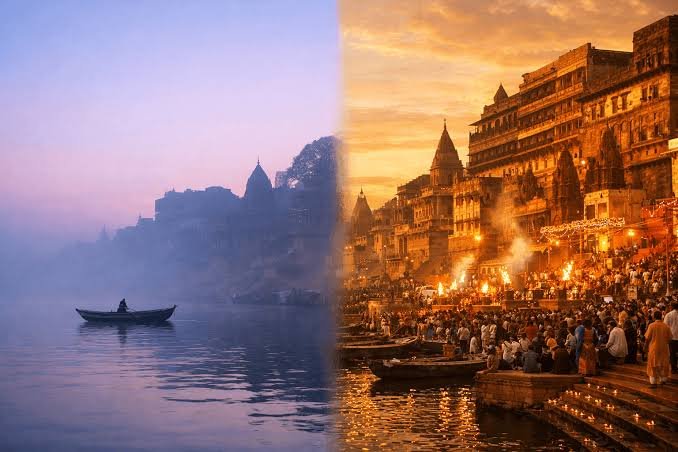
The Early Morning Cold at Kedar Ghat
Ditch the alarm at 5:00 AM. If you haven't hit the stone steps by five, you've already lost the battle against the humidity and the crowds. The river mist hangs low here; it’s thick and tastes like wet copper. Kedar Ghat is different from the rest. It doesn't have the manic energy of Dashashwamedh. It’s quiet. You’ll see the South Indian families arriving with their baskets of flowers—jasmine, marigold, tulsi. They come for the Kedareshwar temple. It sits right on the edge of the water; the red and white stripes of the walls are a clear marker. Don’t wait for a guide to tell you it's holy. You can feel it in the way the local priests move—methodical, unhurried, focused on the steady drip of ghee on the lingam. Watch your step on the lower levels. The limestone is slicker than ice after the river retreats. Wear rubber-soled sandals. Leather will betray you on the mossy patches. The boatmen here are aggressive, but they’re just men trying to eat. If they shout 800 rupees, keep walking. They’ll chase you down to 300 before you even reach the next landing. It’s a dance. Play your part.
The air here smells like woodsmoke and damp earth. It’s heavy. You won’t find the high-decibel chanting of the north here. The morning puja is private, personal, and stripped of the performative gloss you see elsewhere. I’ve sat on these steps for twenty years. Every day, the same elderly man with a white beard clears the debris from the lower stairs. He doesn't look at you. He doesn't want your money. He just wants the ghat to be clean for the first bath of the day. If you see him, just nod. Don't pull out your camera. It’s an intrusion you can’t buy your way out of. The light hits the temple spire around 6:15 AM—a sharp, golden strike that makes the stone look like it’s glowing from the inside. It lasts for seconds before the sun climbs too high. Catch it or miss it.
The Raw Grit of the Akhada
You want to see where the real Banaras breathes? Find an akhada. These are the wrestling pits, tucked into the belly of the city’s narrowest gullies. Don’t go looking for luxury. You’ll find dirt, sweat, and the smell of mustard oil. The wrestlers start their work early, rubbing the soil into their skin before the sun even touches the rooftops. It’s a physical religion. Each move is measured, calculated, and executed with a grace that defies their sheer bulk. I remember the first time I ducked into an akhada near Tulsi Ghat. The silence was absolute until the smack of skin against skin echoed off the stone walls. It’s rhythmic. Thud. Slide. Grunt. The older masters sit on the sidelines, watching with eyes that have seen forty seasons of training. They don’t talk much. They don’t need to.
These pits have been here for centuries. It’s not just about sport. It’s about discipline, about keeping the body as a temple while the world outside spins into chaos. The floor is sacred ground—literally. They mix the earth with red ochre, turmeric, and lime to keep it sterile. Every evening, they rake it by hand. They’re proud of that soil. If you visit, keep your distance. Don’t step on the pit floor unless you’re invited. It’s a grave insult to the wrestlers. Sit on the raised stone ledge and watch. Bring a bottle of water; the heat in those enclosed spaces will drain you in twenty minutes. If you’re lucky, someone might offer you a cup of milk or a piece of jaggery. Accept it with both hands. It’s a gesture of hospitality that isn’t meant for tourists; it’s meant for guests. There’s a distinct line between the two, and you’ll know exactly which side you’re on by how they treat you.
Kabir Chaura and the Sound of Silence
Heading inland toward Kabir Chaura feels like stepping back three hundred years. The lanes get tighter. The walls are older, thick with soot and layers of whitewash. This is where the mystic poet Kabir lived and taught. It isn't a place for casual sightseeing. It’s a place for listening. You’ll hear the faint, repetitive strike of a handloom. The rhythmic thrumming of a shuttle passing through silk threads is the heartbeat of this neighborhood. The air is thinner here, pushed through the narrow gaps between the houses. You’ll find the Kabir Math tucked behind a nondescript gate. It’s not flashy. There’s no gold leaf, no marble facade. It’s humble, just like the man himself. You go here to sit in the courtyard and shut your mouth for an hour. It’s a rare commodity in this city.
People come here looking for profound secrets. They won't find them written on signs. The mysticism of Kabir is in the rejection of the unnecessary. He lived here while the temple priests and mosque scholars bickered over scriptures, and he simply swept his floor and wove his cloth. There’s a quiet defiance in that. If you talk to the monks living there, they’ll tell you he never left. They’ll point to his wooden sandals and his weaving loom like he just stepped out for a stroll. Maybe he did. The atmosphere is thick with that specific kind of stillness. Don’t rush through the rooms. Look at the shadows on the floor. It’s a place that forces you to acknowledge your own insignificance, which is, in its own way, incredibly liberating. It’s the perfect antidote to the chaotic, sensory overload of the riverfront.
Navigating the Lanes: A Practical Reality
Walking the interior of the city is a contact sport. You aren’t just walking; you’re negotiating space with cows, motorbikes, pilgrims, and cart pullers. Godowlia is the center, but it’s a trap. Avoid the main square if you want to keep your sanity. Take the side alleys leading toward the river. From Godowlia to Dashashwamedh, take the lane that runs behind the old Bengali Tola houses. It’s quieter. It’s where the locals buy their groceries. You’ll see the spice shops—piles of turmeric, chili, and cumin that have been there for generations. The smell will cling to your clothes. Don’t buy the first thing you see. Prices are fixed for the locals, but the moment they see you, the mental calculator starts running. A cup of chai is 10 rupees. If they ask for 30, keep walking. You’ll find five other stalls within ten steps.
Navigation is tricky, and Google Maps will fail you inside the gullies. GPS signals bounce off the high brick walls, putting you three blocks away from where you actually are. Use the landmarks. The tall temple spires, the specific colors of the house doors, the smell of fresh rotis—these are your signs. If you get lost, just keep moving toward the slope of the ground. The city tilts toward the river. If you’re walking downhill, you’re eventually going to hit the ghats. That’s your safety net. Carry a small flashlight after dark. The street lighting is hit or miss, and you don’t want to trip over a sleeping dog or a pile of loose bricks in the dark. It sounds trivial, but I’ve seen enough sprained ankles to know better. Stick to the well-worn paths. If the lane ends in a dead-end with a heavy iron door, don’t try to force it. Turn around. It’s a private residence.
| Item | Typical Price (INR) | Local Advice |
|---|---|---|
| Shared Motorboat | 100 | Pay the driver directly, ignore touts. |
| Private Rowboat (1 Hour) | 400-600 | Haggle hard; start at 300. |
| Kulhad Chai | 10 | Drink at the vendor's stall, not on the go. |
| Evening Aarti Entry | Free | Skip the chairs; watch from the water. |
| Local Breakfast (Puri/Sabzi) | 40 | Look for the busiest, smallest shop. |
The Culinary Rituals of the Morning
Breakfast in Banaras isn't a meal; it’s a commitment. You start with the malaiyyo if it’s winter. It’s this airy, whipped milk foam that disappears the second it touches your tongue. They add saffron and pistachios, and it’s basically heaven in a cup. You can’t find it after the sun gets warm, so you’re looking at a 7:00 AM window. Find the guys selling it in small clay pots. If it looks dense, it’s not the real thing. It should look like a cloud. Pair it with a piping hot samosa—the kind that’s still leaking oil—and a ginger chai. The ginger should be fresh, crushed right in front of you. Not the syrupy, pre-mixed garbage. You want that sharp, spicy kick that wakes up your sinuses. Eat standing up. It’s how the locals do it. You lean against a wall, hold your kulhad with two hands, and watch the street life pass by.
By mid-morning, shift to the kachori-sabzi. The best shops are tucked in the lanes near Vishwanath Ganj. These aren’t restaurants; they’re holes in the wall with a giant iron vat of bubbling oil. The dough is stuffed with a lentil paste and fried until it’s perfectly crisp. The curry is made with potatoes and a mix of spices that’ll leave a burn on your lips for an hour. Don’t ask for a fork. Use your hands, tear the bread, and scoop the curry. If the locals are using their fingers, you should too. It’s cleaner, honestly. I see travelers trying to navigate this with napkins and plastic utensils, looking like they’re performing surgery. Stop. Just eat. It’s the only way to get the true flavor of the city. Also, don’t ignore the lassi. The thick, creamy stuff served in earthen pots with a layer of clotted cream on top—that’s the fuel of the ghats.
The Weight of the River
The Ganga isn't just a river to us. It’s a living thing. You see it change color depending on the season, the rainfall, and the amount of silt it carries. During the monsoon, it’s a raging, chocolate-brown beast that swallows the lower steps of every ghat. You don’t get near it then. You watch it from the high balconies and respect the power. In the winter, it’s a calm, turquoise ribbon that pulls you in. I take a dip every morning regardless of the temperature. The shock of the cold water on your skin is the only thing that truly snaps you out of the dreams you had the night before. It’s a sensory reset. If you’re not up for a full submersion, at least walk to the water’s edge and splash your face. There’s a specific energy there, a vibration that you can feel in your teeth.
Boatmen will try to sell you on the 'view from the middle.' They aren’t lying. The view of the city’s skyline from the water is the only way to understand the scale of the architecture. You see the towers, the arches, the balconies leaning over the water, and you realize the city is built like a tiered cake. It’s a massive, vertical construction project that’s been under progress for three millennia. Don’t go on the boats with the loudspeakers. If you hear someone blasting movie music from a motorboat, turn away. Rent a wooden rowboat. It’s quiet. The only sound is the oars cutting the water and the distant tolling of bells from the temples above. It’s the only way to experience the river as it was meant to be experienced. It’s a slow, quiet drift through time.
Frequently Asked Questions
Is it safe to walk these narrow alleys alone at night? It is generally safe, but keep your wits about you. The alleys aren't well-lit and it’s easy to get turned around. Stick to the main paths and don't wander into isolated sections after 10 PM. Trust your gut; if a street feels wrong, it probably is.
How do I handle the boatmen who won't take no for an answer? A firm, polite 'No, thank you' while you keep walking is the only move. Don't engage in negotiations if you don't intend to book. If they persist, look toward the next shopkeeper or bystander; the sudden attention usually makes them back off.
Are there specific clothes I should wear for the temples? Keep it modest. Shoulders and knees covered is the standard. It shows respect and saves you from the awkward conversations at the temple entrances. A light cotton scarf is always a good thing to have in your bag.
What is the best way to avoid the mid-day heat? Do your walking before 10 AM. Spend the hot afternoon in the cooler, shaded interiors of the old havelis or visit the museums. The city is designed to be lived in, not just seen, so find a shady corner and observe the life around you.
Why do people say 'Banaras is a state of mind'? Because you can visit and see nothing but the dirt, or you can look deeper and see the history, the art, and the devotion. It’s a mirror. Whatever you bring to the city, you’re going to get back tenfold. If you come with an open mind, you’ll leave with a different life perspective.
Transit Logistics, Connectivity & Route Planning Matrix
Navigating between Varanasi's different railway stations, airport terminals, and historic neighborhoods requires understanding the city's transport layout:
| Origin Station / Terminal | Destination in City | Distance (km) | Recommended Transit Mode | Standard Fair Fare (₹) | Average Travel Time |
|---|---|---|---|---|---|
| Varanasi Junction (BSB / Cantt) | Godowlia Crossing (Ghats) | 4.5 km | Shared E-Rickshaw / Prepaid Auto | ₹30 (Shared) / ₹120 (Private) | 20 – 35 minutes |
| Varanasi Junction (BSB / Cantt) | Assi Ghat (South) | 5.5 km | Auto-Rickshaw / App Cab (Ola/Uber) | ₹140 – ₹180 | 25 – 40 minutes |
| Pt. Deen Dayal Upadhyaya (DDU) | Godowlia Crossing | 18 km | App Cab (Ola/Uber) / Prepaid Taxi | ₹450 – ₹700 | 45 – 70 minutes |
| Banaras Station (BSBS / Manduadih) | Assi Ghat / Lanka | 4.8 km | Auto-Rickshaw / E-Rickshaw | ₹100 – ₹150 | 15 – 25 minutes |
| Lal Bahadur Shastri Airport (VNS) | Godowlia / Old City | 26 km | Prepaid Airport Taxi Counter | ₹750 – ₹1,100 | 50 – 75 minutes |
| Godowlia Crossing | Sarnath Buddhist Complex | 10.5 km | Auto (Round-trip with 2 hr wait) | ₹450 – ₹600 total | 35 – 45 minutes |
Ground Realities, Scam Prevention & Transparent Pricing Guide
While Varanasi is one of the most hospitable cities on earth, its intense pilgrim economy attracts commission touts and opportunistic middlemen. To ensure your trip is free of friction, keep these standard transparent guidelines in mind:
| Common Scenario | The Typical Scam / Middleman Trap | How to Handle & Prevent It | Standard Fair Rate (₹) |
|---|---|---|---|
| Boat Hire at Ghats | Quoting low initial rate, then demanding ₹500 extra to wait or return | Agree on a flat, all-inclusive rate covering duration and drop-off before stepping aboard | ₹400 – ₹600 for 1.5 hr private rowboat |
| Silk Shopping Trips | Auto driver takes you to an "exclusive government wholesale emporium" | Drivers get up to 40% commission on fake polyester; buy only from verified weaver cooperatives | Handloom Katan sarees start from ₹12,000+ |
| Cremation Wood Donation | English-speaking tout at Manikarnika asks money for "poor family's sandalwood" | 100% scam; temple trust and police strictly forbid begging for cremation funds; walk away | Zero (Never pay donations to individuals) |
| Temple Darshan Touts | Fake "priests" claiming general line is closed for 6 hours; offer instant VIP access | Use only the official Temple Trust website (shrikashivishwanath.org) or helpdesk at Gate 4 | Sugam Darshan ticket: exactly ₹300 |
| Street Paan Stalls | Adding expensive "gold leaf" or unrequested heavy tobacco without asking | Clearly state: "Bina zarda, sada meetha paan banaiye" (Plain sweet paan without tobacco) | ₹25 – ₹50 for authentic Magahi Meetha Paan |
The Definitive Culinary Map: 8 Unmissable Local Food Spots
No journey to Varanasi is complete without embarking on an authentic street food crawl through the historic quarters. Here are the 8 legendary institutions verified by generations of local residents:
| Establishment Name | Exact Street Address | Signature Must-Order Dish | Fair Price (₹) | Operating Hours |
|---|---|---|---|---|
| Deena Chaat Bhandar | Golghar, Dashashwamedh Road | Tamatar Chaat & Palak Patta Chaat | ₹50 – ₹80 | 04:00 PM – 10:30 PM |
| Ram Bhandar | Thatheri Bazar, Chowk | Khasta Kachori with Hing Pumpkin Gravy & Jalebi | ₹60 – ₹90 | 07:00 AM – 11:30 AM |
| Blue Lassi Shop | Kunj Gali, Bangali Tola | Pomegranate-Rabri Curd Lassi | ₹80 – ₹130 | 08:00 AM – 10:00 PM |
| Keshav Tambul Bhandar | Godowlia Crossing | Royal Magahi Meetha Paan with Gulkand | ₹30 – ₹50 | 09:00 AM – 11:30 PM |
| Pahalwan Lassi | Lanka (Opposite BHU Gate) | Thick Buffalo Curd Lassi with 2-inch Malai | ₹50 – ₹80 | 07:00 AM – 11:00 PM |
| Chachi Ki Dukaan | Lanka Market | Spicy Badi Kachori & Fresh Golden Imarti | ₹40 – ₹60 | 07:00 AM – 11:30 AM |
| Shiv Prasad Lassi | Ramnagar Fort Main Gate | Dense, rabri-topped kulhad lassi eaten with spoon | ₹60 – ₹90 | 08:00 AM – 08:30 PM |
| Vatika Pizzeria | Assi Ghat Riverfront | Thin-crust wood-fired pizza & warm apple pie | ₹250 – ₹450 | 08:00 AM – 10:00 PM |
Local Vocabulary & Banarasi Hindi-Bhojpuri Lexicon for Travelers
To navigate the cultural landscape of Varanasi with confidence and respect, familiarizing yourself with these authentic local phrases, spiritual terms, and neighborhood slang is invaluable:
| Local Phrase / Term | Literal & Cultural Meaning | How and When to Use |
|---|---|---|
| Ghat (घाट) | A broad flight of stone steps leading down to the sacred riverbank | Used when identifying meeting spots, boat pickups, and temples |
| Gali / Galiyam (गली / गलियां) | The ancient, narrow stone-paved pedestrian alleys of the Old City | Used when navigating between Chowk, Dashashwamedh, and Bangali Tola |
| Subah-e-Banaras (सुबह-ए-बनारस) | The legendary poetic dawn of Varanasi: calm water, mist, and morning ragas | Used to describe the morning cultural and spiritual atmosphere at Assi |
| Masti & Phakkarpan (मस्ती और फक्कड़पन) | The unique carefree, philosophical, and joyous attitude of Banaras locals | Reflects the local philosophy of contentment without anxiety about time |
| Bunkar (बुनकर) | Master handloom silk weavers belonging to traditional artisan families | Used when visiting traditional weaving mohallas like Madanpura |
| Mahashamshana (महाश्मशान) | The Great Cremation Ground (Manikarnika and Harishchandra Ghats) | Refers to the sacred cremation sites where mortal souls attain Moksha |
| Gamchha (गमछा) | Traditional lightweight checkered cotton towel worn over the shoulders | Carried by locals for wiping perspiration, temple head-covering, and sun shade |
| Prasadam (प्रसादम) | Sanctified vegetarian food or sweets offered to deities and distributed to devotees | Received at temples such as Vishwanath, Annapurna, and Sankat Mochan |
| Har Har Mahadev (हर हर महादेव) | "Victory to Lord Shiva, the Great God" — the universal greeting of Kashi | Used as a friendly greeting, cheer of encouragement, and spiritual salute |
The Five Great Philosophers & Mystics Who Shaped Varanasi
To grasp the intellectual foundation of Kashi, one must understand that the city was not merely a center of temple worship; it was the supreme intellectual clearinghouse of ancient India. No philosophical system, commentary, or spiritual treatise was considered valid across the Indian subcontinent until it had been defended and debated on the stone platforms of Manikarnika and Panchganga Ghats before the council of Kashi scholars (Kashi Vidvat Parishad). Here are the five towering philosophers whose footprints remain etched into the city:
| Philosopher / Saint | Historical Era | Primary Landmark in Kashi | Revolutionary Contribution to World Thought |
|---|---|---|---|
| Maharshi Patanjali | 2nd Century BCE | Nag Kuan (Snake Well), Jaitpura | Codified the Yoga Sutras (the 8 limbs of Raja Yoga) and wrote the Mahabhashya commentary on Sanskrit grammar |
| Adi Shankaracharya | 8th Century CE | Manikarnika Ghat & Kedar Ghat | Composed the Manisha Panchakam after an encounter with Shiva in the guise of an outcaste, cementing Advaita (non-dual) Vedanta |
| Sant Kabir | 15th Century (1398–1518 CE) | Kabir Chaura Math & Lahartara | Challenged rigid ritualism, caste distinctions, and religious hypocrisy through fearless vernacular poetry (Bijak) |
| Sant Ravidas | 15th – 16th Century | Seer Goverdhanpur (Near BHU) | Envisioned Begumpura (the City Without Sorrow)—a society free of caste discrimination, poverty, and taxes |
| Goswami Tulsidas | 16th Century (1532–1623 CE) | Tulsi Ghat & Sankat Mochan | Composed the Awadhi Ramcharitmanas, democratizing the epic across northern India, and established the Sankat Mochan temple |